
Gate Installation: Repair or Replace? How Los Angeles Homeowners Decide
Most gates in Los Angeles can be repaired two or three times before replacement becomes the smarter financial move. The tipping point usually comes when cumulative repair costs hit 60-70% of a new installation, or when the gate frame itself has rusted through at the welds. If you’d rather not sort this out alone, call us at (469) 530-2485 and we’ll give you a straight answer on which path makes sense for your setup.
The cheapest gate installation quote in Los Angeles is almost never cheap by the time the job is done. Low quotes routinely omit concrete footing work, electrical conduit runs, and permit fees that are mandatory, not optional. We’ve seen homeowners in Silver Lake and the Valley alike get burned by proposals that looked like bargains until the extras showed up.
When Repair Still Makes Sense
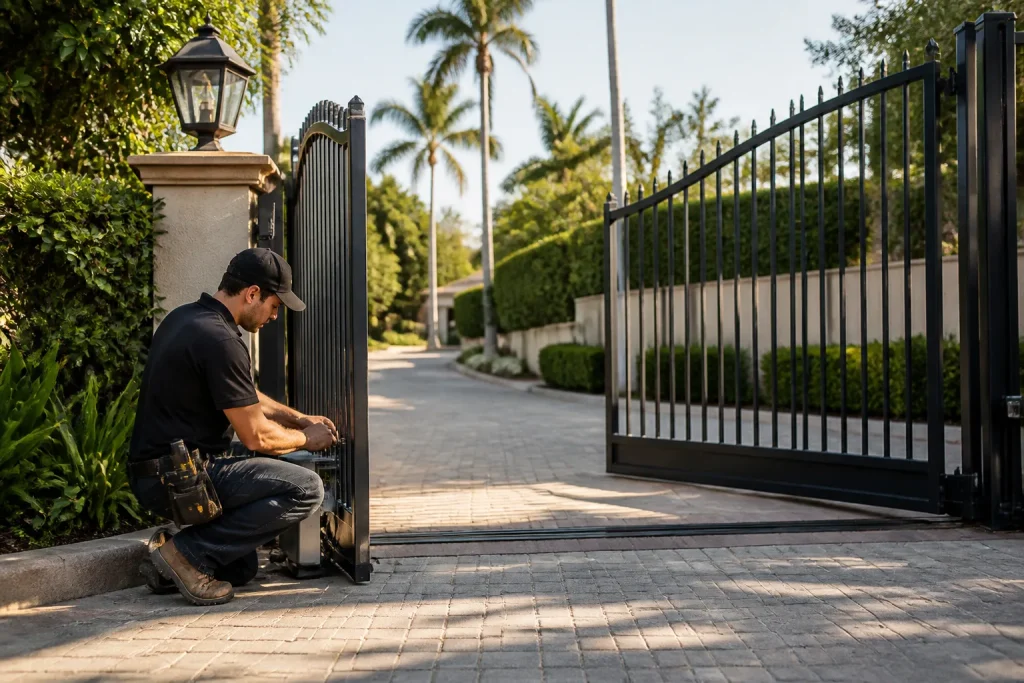
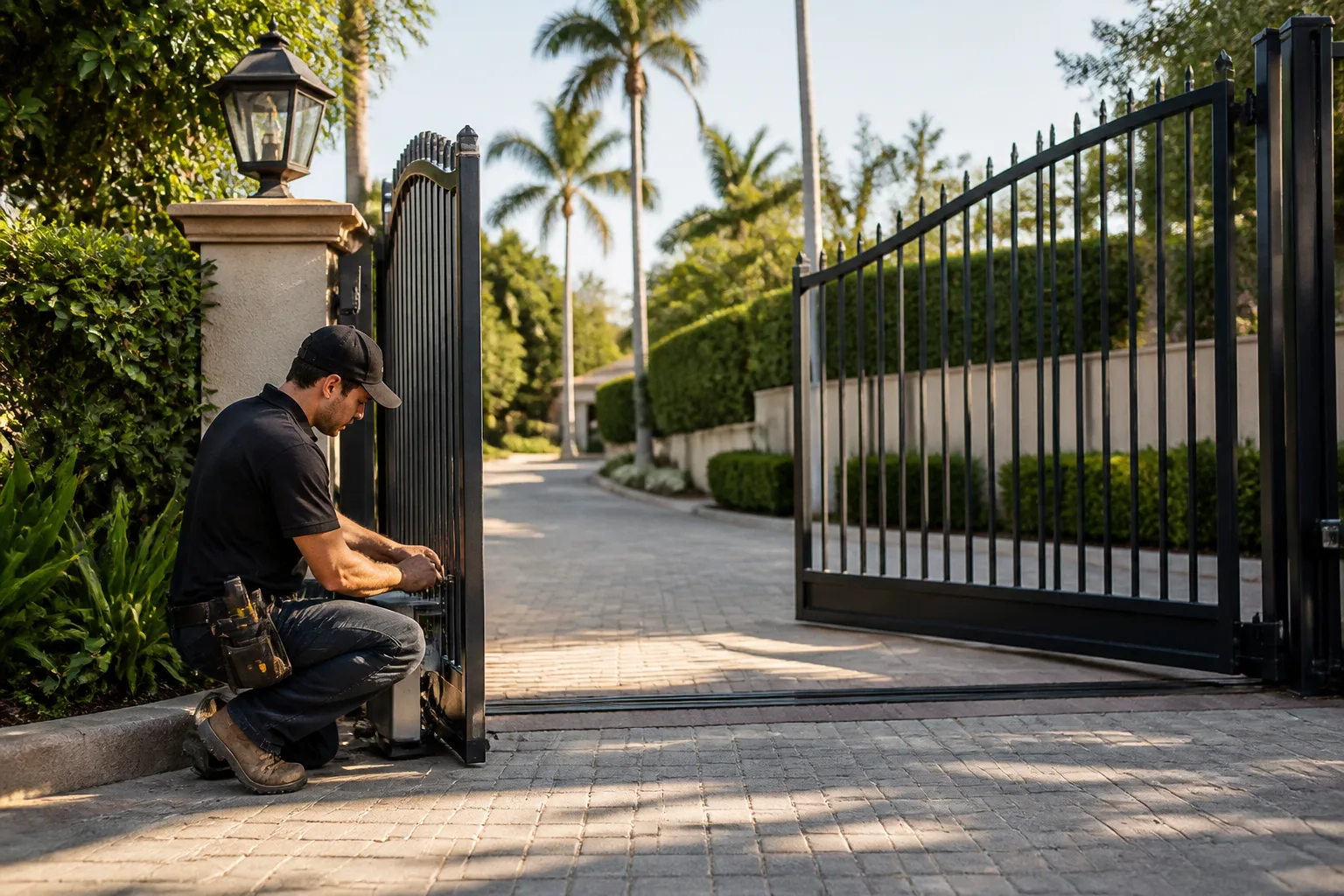
Repair is the right call when the gate structure is sound and the problem is isolated to one component. A failed limit switch on a swing operator, a cracked articulating arm, or a loop detector that’s lost sensitivity – these are single-point failures with clear fixes and predictable costs.
In our experience across Los Angeles, these conditions favor repair:
- The gate frame has no rust-through at weld points or hinge mounts
- The operator is under 10 years old and parts are still available for its brand
- The failure is mechanical (hinge, roller, arm) rather than structural
- Previous repairs were done correctly and haven’t cascaded into new problems
We repaired a gate last month in Los Feliz where the homeowner had been quoted full replacement by another company. The issue was a failed Viking operator and a misaligned safety edge. Two hours, written price agreed upfront, and the Done Right Promise applied. Total cost was under $900. Replacement would have run $4,200 minimum.
That said, we’ve also opened up gates that looked fine from the outside and found the internal frame rotted through from irrigation overspray. The surface paint held, but the structure was gone. Repairing cosmetics on a dying frame is throwing money away.
When Replacement Is the Only Honest Recommendation
Replacement becomes necessary when the gate’s skeleton is compromised or when the cost of bringing all systems current exceeds the value of the gate itself. In Los Angeles, this happens faster than many homeowners expect because of our specific climate stresses.
Coastal properties from Santa Monica to San Pedro see salt air corrosion that attacks steel from the inside out. Inland neighborhoods like Studio City or Pasadena get the thermal cycling – hot days, cool nights – that fatigues welds over years. The high-desert fringes of LA County, out toward Palmdale, hit gates with UV degradation and dust infiltration into operator housings.
These are the conditions that push us toward recommending replacement:
- Frame rust at load-bearing points, especially where posts meet the gate leaf
- Multiple previous repairs using mismatched parts or incompatible brands
- Operator failure in a unit that’s been discontinued and has no parts support
- Gate weight or width that no longer matches the operator’s rated capacity
- Homeowner wants access control features (keypad, intercom, app integration) that the existing structure can’t support
We pulled one out of a garage over in Echo Park last week where the previous installer had welded a Mighty Mule residential operator onto a 16-foot wrought-iron dual-swing gate weighing close to 800 pounds. The motor was rated for 550 pounds max. It had failed three times in four years. The frame was actually fine, but the operator mismatch had caused so much stress that the hinge mounts were cracking. Sometimes the gate survives but the installation history kills it.
What Los Angeles Permitting Actually Requires
New gate installations in Los Angeles trigger permitting requirements that many contractors skip or bury. This matters because unpermitted work can block a home sale, trigger code-enforcement action, or void your homeowner’s insurance if someone gets hurt.
Here’s the reality by jurisdiction:
- LA County (unincorporated areas): A building permit is required for any new gate over 6 feet high or any automated gate regardless of height. Electrical permit required for the 110V run to the operator.
- City of Los Angeles: Department of Building and Safety requires permits for automated gates and any masonry or concrete footing work. The permit application must include engineered drawings for gates over 10 feet wide.
- Beverly Hills, Santa Monica, Pasadena: Historic district overlays and design review boards add a second layer. We’ve seen installations held up six months because the gate style didn’t match neighborhood guidelines.
A legitimate installation quote in Los Angeles should either include permit costs or explicitly state that permits are the homeowner’s responsibility. If a contractor says “we don’t pull permits to save you money,” that’s a red flag. The savings are temporary; the liability is permanent.
At Carver Gate Repair, we itemize permit fees in every Gate Installation in Los Angeles proposal. The price you sign is the price you pay, and that includes the city or county fees we know are coming.
Material Choice: What Lasts in LA’s Climate Zones
The material you select for a new gate in Los Angeles should be driven by your specific microclimate, not by what looked good in a magazine. Here’s how the common options actually perform here:
Wrought iron is the traditional choice for security and aesthetics in neighborhoods like Hancock Park or Hancock Park-adjacent areas. The trade-off is maintenance. Iron needs sanding and repainting every 3-5 years in coastal zones, every 5-7 inland. Skip a cycle and you get the hidden rust problem we described earlier. Budget $400-800 every maintenance cycle for a standard residential gate.
Aluminum has become our most-specified material for Los Angeles installations in the last five years. It doesn’t rust, weighs roughly 60% less than iron (which reduces operator strain and opens up more motor options), and powder-coats well. The downside: it’s softer, so a vehicle impact does more damage, and wide aluminum gates can flex in high winds. For most LA properties, the maintenance savings outweigh these concerns.
Vinyl works for privacy gates in mild inland areas. It won’t handle thermal cycling well in the high desert, and the color fades noticeably within 7-8 years in full sun. We rarely specify it for automated gates because the material flex can interfere with operator alignment.
Wood – usually redwood or cedar – is beautiful and repairable, but it’s thirsty for maintenance in our dry climate. Without annual sealing, checking and warping are guaranteed. We’ve seen properly maintained wood gates last 25 years in Los Angeles; neglected ones fail in 8.
Operator Compatibility: The Spec Most Quotes Ignore
Here’s where generalist contractors treating gate work as an afterthought get homeowners into trouble. The operator must be matched to the gate’s weight, width, and cycle count before the gate is ever fabricated. Get this wrong and you get premature failure, safety hazards, or both.
Weight is straightforward: the operator’s rated capacity must exceed the gate’s actual weight by at least 20% to account for wind load and friction. Width matters because longer gates create more leverage stress on the operator’s output shaft. Cycle count – how many open/close operations per day – determines whether you need a residential-duty or commercial-duty unit.
A typical Los Angeles residential driveway gate cycles 4-8 times daily. A multi-unit building or home with frequent visitors might hit 20-30. Residential-duty operators from most brands are rated for about 20 cycles per day. Exceed that regularly and you’re buying a commercial unit or replacing the residential one every 3-4 years.
We work on nine gate-motor brands – including FAAC, BFT, Linear, and Viking – so we can match the right system to your gate rather than forcing whatever’s in the warehouse. A Gate Motor Repair in Los Angeles call often traces back to an operator that was never appropriate for the gate it was bolted to.
What a Complete Installation Quote Must Itemize
A replacement gate installation in Los Angeles should be quoted as a system, not a product. Any proposal that hands you a single number with no breakdown is hiding something. Here’s what we itemize on every Carver Gate Repair home installation:
- Posts and footings: Depth below frost line (18″ minimum in LA, we typically go 24-30″ for stability), concrete spec (minimum 3,000 PSI, we spec 4,000 for automated gates), and rebar cage detail
- Gate fabrication or panel supply: Material gauge, finish spec, and hardware grade
- Operator: Brand, model, duty rating, and integration capability with your preferred access method
- Access control: Keypad, intercom, remote, or app-based entry – installed and programmed
- Safety systems: Loop detectors, safety edges, photo eyes – whatever the gate configuration requires per UL 325
- Electrical: Conduit run from panel to operator, dedicated circuit, GFCI protection
- Permits and inspections: All fees, drawings, and scheduling
The written price we deliver before any work starts includes every line item. The number doesn’t move at the door. That’s The Garrison Standard, and it’s been non-negotiable.
Custom Fabrication vs. Prefabricated Panels
This distinction affects your gate’s appearance, its cost, and critically – its long-term repairability.
Custom fabrication means a local metal shop measures your opening, designs the gate to fit, and welds it from raw stock. You get exact dimensions, unique design, and typically heavier material. The downside: if the fabricator goes out of business or you don’t know who built it, replacement parts may need to be custom-made later. We’ve fabricated gates in Los Angeles for 15 years and we keep drawings on file, but not every shop does.
Prefabricated panels are manufactured in standard sizes and adapted to your opening with posts and hardware. Brands like Ameristar or Specrail have established distribution, so replacement pickets, hinges, or frames are orderable years later. The trade-off is less design flexibility and sometimes lighter gauge material.
For most Los Angeles homeowners, we recommend custom fabrication for front-entry gates that are highly visible and contribute to curb appeal, and prefabricated systems for side-yard or rear security gates where function dominates. Either way, we document the manufacturer and model in your file so future Gate Repair in Los Angeles calls don’t start with “we have no idea what this is.”
When to Call a Pro
If your gate is making unusual noises, moving slowly, or has failed to open or close more than once in the past month, it’s telling you something. Catching a failing operator or a cracked weld early often means repair instead of replacement. Waiting until the gate collapses or the motor burns out completely removes that option.
Related services in Los Angeles: Gate Repair in Los Angeles | Gate Installation in Los Angeles | Gate Motor Repair in Los Angeles
The Bottom Line
The repair-or-replace decision comes down to three questions: Is the structure sound? Are the operating systems compatible and supportable? And will the cumulative cost of keeping this gate working exceed the cost of a new system that meets current codes and your actual needs?
In Los Angeles, factor in the permitting reality, the climate stress on your specific material choice, and whether your quote includes everything the job actually requires. A gate is a system – posts, footing, frame, operator, safety devices, and power – and pricing any one piece without the others is a setup for surprises.
If you’re in Los Angeles and need help evaluating your gate, Carver Gate Repair offers free estimates. We’ll tell you honestly whether repair or replacement is the right call, and we’ll put the full scope and price in writing before any work starts. Call (469) 530-2485.
Frequently Asked Questions
A complete residential gate installation in Los Angeles typically ranges from $3,800 for a basic single aluminum swing gate with a standard operator, up to $12,000 or more for dual wrought-iron gates with intercom access, loop detectors, and masonry pillars. The wide range reflects material choice, automation level, and whether permitting and electrical runs are included. Call (469) 530-2485 for an exact quote on your specific setup – estimates are free.
Yes, if the gate is automated or over 6 feet high in LA County unincorporated areas, or if any concrete footing or electrical work is involved in the City of Los Angeles. Specific municipalities have additional requirements. Doing the work without required permits can block a home sale and create liability exposure. We pull permits as part of our standard installation process and include those fees in our written price.
Typically 2-4 weeks for a custom fabrication job in Los Angeles, assuming standard permitting timelines. Prefabricated panel installations can move faster, sometimes 1-2 weeks. Historic districts or design review overlays add time. We provide a written schedule with our proposal, including permit submission and inspection dates, so you know the timeline before committing.
Sometimes we can source rebuilt or aftermarket parts, but when an operator has been discontinued for more than 5-7 years, replacement is usually the more reliable path. We work on nine brands – FAAC, BFT, Linear, Viking, and others – so we can often find a compatible replacement that fits your existing gate without full replacement. We’ll tell you straight if repair is viable or if you’re throwing money at a dead system. Call (469) 530-2485 and we’ll assess what you’ve got.
Written by the team at Carver Gate Repair.
Need Gate Repair Help?
Call Carver Gate Repair - licensed & insured, here with fast after-hours help in Los Angeles.
(469) 530-2485