
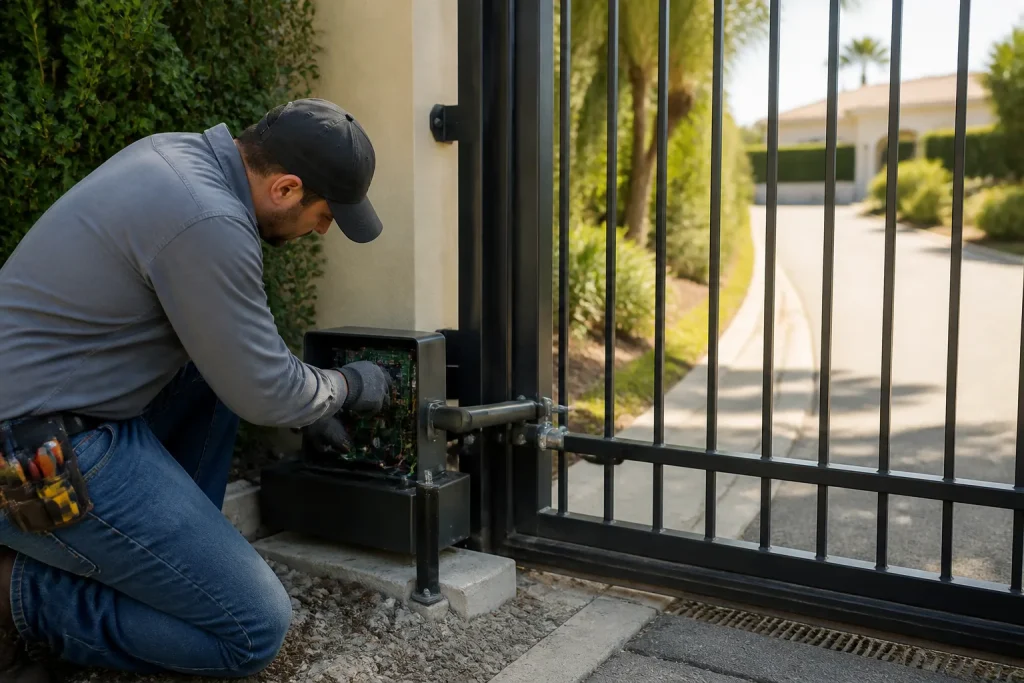
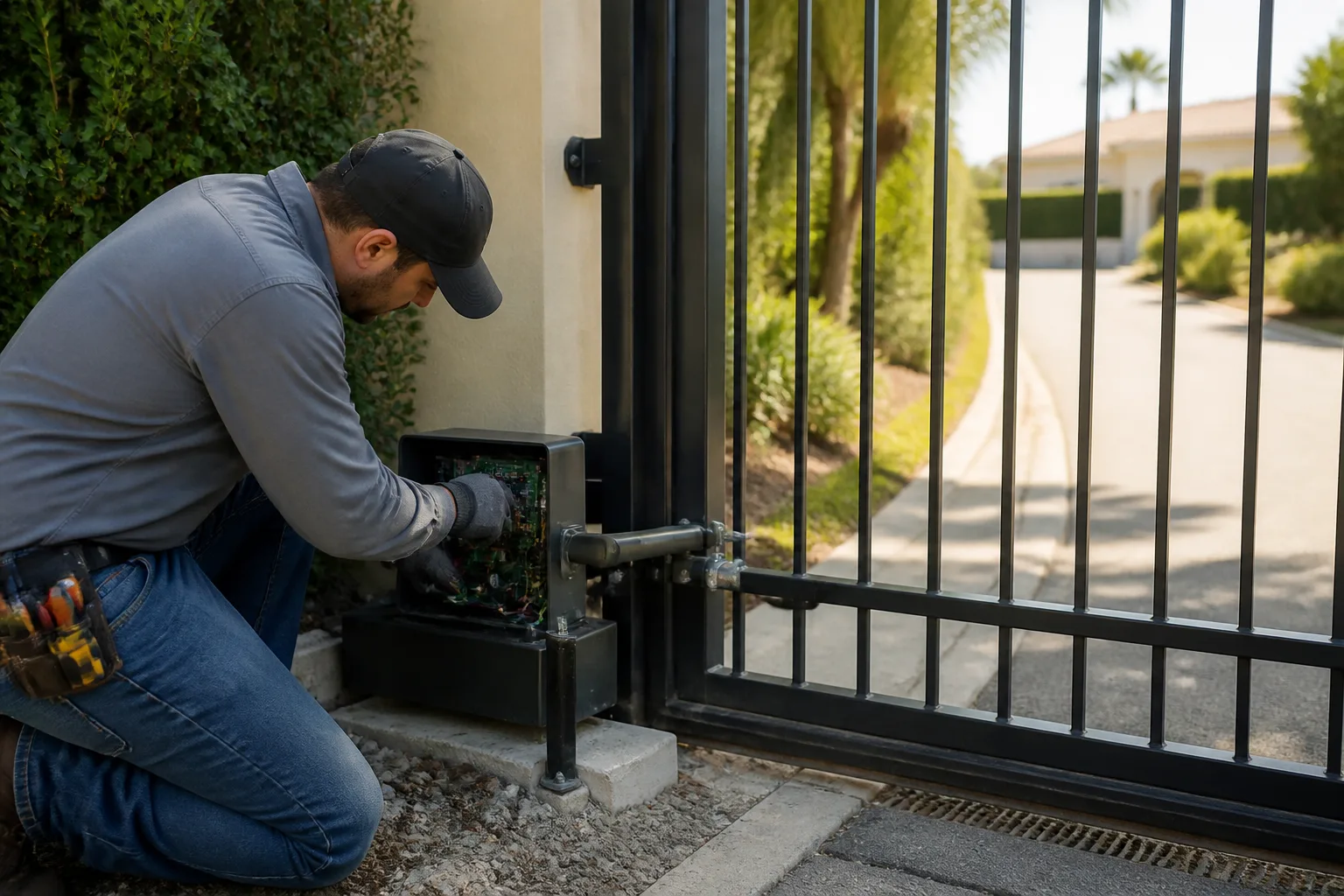
Ghost Controls Gate Repair in Los Angeles: A Homeowner’s Guide
Ghost Controls gate repair in Los Angeles typically costs between $180 and $450 for most issues, with battery replacements and limit switch adjustments on the lower end and full control board or actuator arm work on the higher end. Most calls we receive aren’t actually unit defects – they’re installation errors that have compounded over months or years. If you’d rather not troubleshoot this yourself, call us at (469) 530-2485 for a free estimate.
Here’s the pattern we see across Los Angeles: Ghost Controls is popular with DIY installers because the kits are well-packaged, the instructions are readable, and the price point sits below commercial-grade brands like FAAC or BFT. The problem starts when a homeowner in Encino or Silver Lake mounts a solar panel where afternoon shade from a neighbor’s oak tree drops the charge rate below what the battery needs. Six months later, the gate opens fine but won’t close – and the owner assumes the motor failed.
We pulled one out of a garage over in Studio City last month where the solar panel was bolted to a north-facing fence post. Beautiful installation, level and clean. Zero direct sun past 10 a.m. The battery had been cycling to depletion for fourteen months. The arm was fine. The control board was fine. The battery was swollen and the bracket was starting to rust from the acid. A $38 battery and a $15 mounting arm later, the gate was reliable again – but only after we relocated the panel to the roof edge where it could actually charge.
Why Ghost Controls Units Fail in Los Angeles
The number-one Ghost Controls failure call in Los Angeles is a gate that opens but won’t close. In roughly seven out of ten of those cases, the solar panel is mounted at the wrong angle for the property’s actual sun exposure, starving a battery on a system that was never wired to grid power.
Los Angeles solar math is specific. A Ghost Controls 10-watt panel in full sun delivers about 0.6 amps in ideal conditions. The TSS1 or TDS2 operator draws roughly 2 – 4 amps during operation, with each cycle lasting 15 – 20 seconds. A gate used four times daily consumes maybe 5 – 8 amp-hours per week. The standard 12V 7Ah battery needs to replace that, plus cover standby drain for the control board and any accessories.
But “full sun” in Los Angeles means different things:
- Coastal neighborhoods like Santa Monica or Venice get marine layer cover until late morning for much of the year
- Hillside properties in Los Feliz or the Hollywood Hills lose afternoon sun behind ridgelines by 3 p.m.
- Mature canopy in Pasadena or Hancock Park can block panels even on south-facing mounts
- Winter sun angle drops effective panel output by 30 – 40% from June peaks
We audit solar-only Ghost Controls installations with a simple rule: if the panel doesn’t have clear sky from 9 a.m. to 4 p.m. year-round, the system needs either grid power or a second panel in series. Most DIY installers don’t run this check. They mount where it’s convenient, not where it’s effective.
Auditing Your DIP Switch Settings
Ghost Controls control boards use DIP switches to set operational parameters. Most Los Angeles service calls we make on units under five years old involve switches set incorrectly from day one. Two settings cause the majority of problems:
Auto-close timer. Switch 1 controls whether the gate auto-closes and how long it waits. In our experience across Los Angeles, DIY installers often set this to “off” because they want manual control, then later forget – leaving the gate open indefinitely. Or they set a 30-second close on a driveway where someone needs to carry groceries, and the gate starts closing on them repeatedly. The correct setting depends on actual use patterns, not the default.
Open-too-long alert. Switch 3 enables an audible alarm if the gate stays open past the timer. Homeowners in dense neighborhoods like Koreatown or Westlake often disable this to avoid bothering neighbors, then lose the diagnostic signal that would tell them the auto-close has failed.
Here’s how to audit your current configuration:
- Power down the operator at the battery disconnect
- Open the control box and locate the 8-position DIP switch block
- Photograph the current positions before changing anything
- Cross-reference against the installation manual for your specific model – the TDS2, AXWK, and older TSS1 use different default configurations
- Change one switch at a time, test operation, and confirm behavior before moving to the next
If your manual is lost, Ghost Controls publishes current documentation on their support site. We keep printed reference cards on hand for the four most common board revisions we encounter in Los Angeles.
Battery Replacement: What Actually Works
Ghost Controls specifies a 12V 7Ah sealed lead-acid battery. Not all 12V 7Ah batteries perform equally in Los Angeles heat. We’ve replaced batteries in North Hollywood that lasted eighteen months and identical-looking batteries in Woodland Hills that failed in seven. The difference is usually the operating temperature and the depth of discharge cycle.
Los Angeles summer temperatures in direct sun locations regularly push control box internal temperatures past 120°F. Standard SLA batteries lose capacity rapidly above 100°F. The electrolyte evaporates faster, the plates sulfate earlier, and the effective cycle life drops by half or more.
For solar-only installations, we specify AGM (absorbed glass mat) batteries with a 10Ah capacity where the enclosure allows. The extra headroom reduces depth of discharge per cycle, and AGM construction handles heat better than flooded designs. For grid-powered installations, a quality 7Ah AGM is sufficient – the battery stays topped, cycles less, and runs cooler.
Replacement interval in Los Angeles conditions:
- Solar-only, full sun exposure: 18 – 30 months typical
- Solar-only, partial shade or high heat: 12 – 18 months typical
- Grid-powered, ventilated enclosure: 3 – 5 years typical
- Grid-powered, enclosed or unshaded: 24 – 36 months typical
We date-stamp every battery we install. When we return for any service call, we check that stamp. A battery approaching end of life gets flagged before it fails – part of how we operate to The Garrison Standard.
Magnetic Limit Switch Drift on Single-Arm Swing Gates
Ghost Controls single-arm swing operators use magnetic limit switches to determine open and closed positions. The magnet mounts on the gate frame, the reed switch on the operator arm or post bracket. Over time, especially on heavier gates or gates with slight hinge sag, the magnet and switch drift out of alignment.
The symptom is inconsistent stopping – the gate might open fully one cycle and stop six inches short the next. Or it closes to the post, reverses, and throws an obstruction error. Homeowners in Los Angeles often describe this as “the gate is possessed.”
Resetting the limit switches correctly requires more than loosening and sliding. The magnet must sit within 3/8 inch of the switch face, aligned parallel, with no ferrous metal between them. The bracket can’t flex under gate weight. On single-arm installations, the arm bracket itself is a common failure point – it bends slightly with each cycle, and after thousands of operations, the magnet position shifts by fractions of an inch that compound into operational failure.
We check bracket integrity before adjusting limits. A bent bracket gets replaced, not shimmed. The arm bracket on a Ghost Controls single-arm unit is aluminum, and once it takes a set, it work-hardens and cracks. We’ve seen technicians in Los Angeles try to bend them back and end up snapping the mount ear. The correct repair is a new bracket, properly torqued, with the magnet re-positioned and the control board re-learned.
Warranty Claims: What Documentation You Need
Ghost Controls offers a limited warranty that covers manufacturing defects. It does not cover installation errors, weather damage, or normal wear. For a Los Angeles homeowner facing a potential warranty claim, documentation determines whether the claim succeeds.
Required documentation:
- Original purchase record with date and seller – Amazon receipts are acceptable if they show the seller was authorized
- Installation photos showing mounting locations, wiring runs, and solar panel positioning
- Serial number from the operator housing – photographed clearly
- Description of the failure symptom and any troubleshooting already performed
We submit warranty claims on behalf of our Los Angeles customers when the failure is clearly a manufacturing defect. We do not submit claims for installation-related failures – that’s not what the warranty covers, and Ghost Controls’ claims department correctly denies them. Our written price before any work starts includes a line item distinguishing warranty-repairable issues from installation-correctable ones, so the homeowner knows exactly what they’re paying for and why.
If you purchased the unit yourself and installed it, keep your documentation organized. We’ve seen valid warranty claims denied because the homeowner couldn’t produce a receipt from two years prior. Digital copies in cloud storage solve this.
When to Call a Professional
If your Ghost Controls gate in Los Angeles opens but won’t close, starts and stops erratically, or makes grinding noises from the actuator, the first check is power – battery voltage at rest and under load. Below 11.8 volts at rest means the battery is depleted or failing. If voltage drops below 10.5 volts during operation, the control board can’t maintain logic and the gate will behave unpredictably.
Beyond basic voltage checks, we recommend professional service for limit switch realignment, control board replacement, or any work involving the high-torsion spring assist on heavy dual-arm systems. These components store significant energy and can cause injury if handled incorrectly.
Related services in Los Angeles: Gate Repair in Los Angeles, Gate Installation in Los Angeles, and Gate Motor Repair in Los Angeles.
The Bottom Line
Most Ghost Controls problems in Los Angeles trace back to installation decisions, not unit quality. Solar panel placement, DIP switch configuration, and limit switch alignment are the three factors that determine whether a Ghost Controls system runs for years or fails repeatedly. The units themselves are capable when installed with attention to these details.
Key takeaways:
- Audit your solar panel’s actual sun exposure across all seasons before assuming the panel is adequate
- Photograph your DIP switch positions and verify them against the manual for your specific model
- Use AGM batteries, expect shorter life in solar-only or high-heat installations, and date-stamp replacements
- Limit switch drift on single-arm units usually indicates bracket flex – replace, don’t shim
- Keep purchase records and installation photos organized for any potential warranty claim
If you’re in Los Angeles and need help diagnosing or repairing a Ghost Controls system, Carver Gate Repair offers free estimates. We work to The Garrison Standard – written price before work starts, background-checked and uniformed technicians, and our Done Right Promise on every repair. Call (469) 530-2485.
Frequently Asked Questions
Most Ghost Controls repairs in Los Angeles fall between $180 and $450. Battery replacement and limit switch adjustment typically run $180 – $280. Control board replacement or actuator arm work ranges from $320 – $450, including parts and labor. We provide a written price before any work starts, and estimates are free. Call (469) 530-2485 for an exact quote on your specific issue.
Yes, and in many Los Angeles locations it’s the right move. Ghost Controls operators accept a 16V AC transformer that plugs into standard household current. The wiring run from house to gate needs outdoor-rated cable and proper burial depth – 18 inches for direct burial, 12 inches in conduit. We handle the power run, transformer mounting, and control board reconfiguration as part of a standard conversion. The cost typically runs $280 – $420 depending on trench length and existing conduit.
This is almost always a power or safety sensor issue. Check battery voltage first – if it’s below 11.8 volts at rest, the operator may have enough juice to run the lighter “open” cycle but not the “close” cycle, which often works against gate weight or slope. Second, check whether the auto-close timer is enabled and whether the photo eye or loop detector is obstructed or misaligned. If both check out, the control board’s close relay may be failing. Call (469) 530-2485 and we’ll diagnose it properly.
We service nine gate motor brands: LiftMaster, FAAC, BFT, Linear, Viking, Ghost Controls, DoorKing, Elite, and Mighty Mule. Our technicians carry common parts for all nine and are trained on the specific failure patterns of each. In Los Angeles, we see Ghost Controls and LiftMaster most frequently on residential properties, with FAAC and BFT more common on commercial installations. Whatever system you have, we can repair it or tell you honestly when replacement makes more sense.
Written by the team at Carver Gate Repair.
Need Gate Repair Help?
Call Carver Gate Repair - licensed & insured, here with fast after-hours help in Los Angeles.
(469) 530-2485