
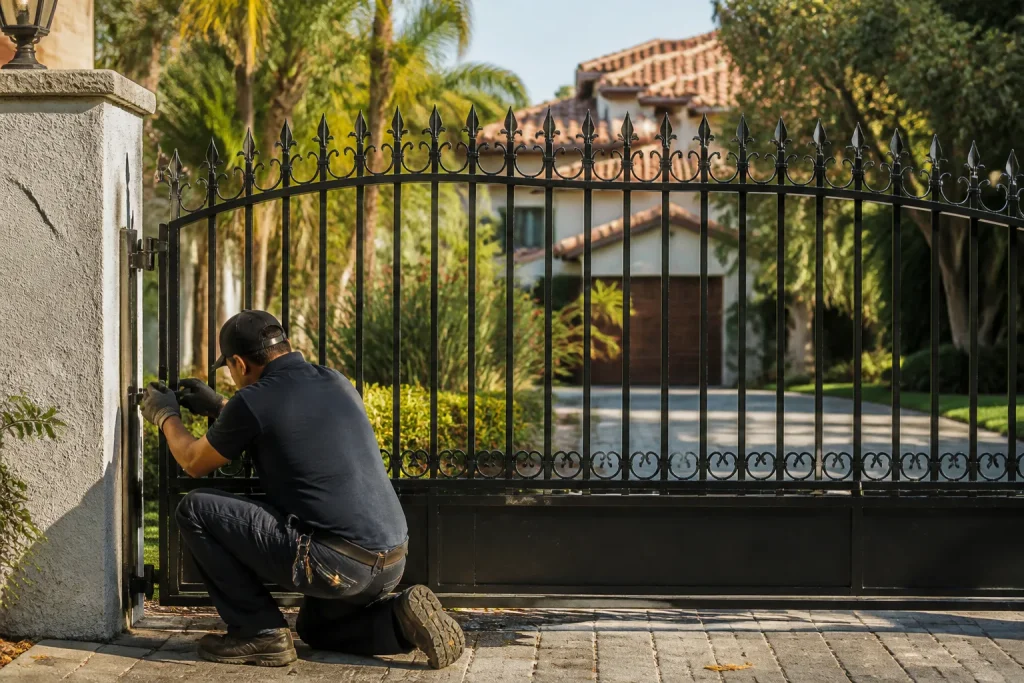
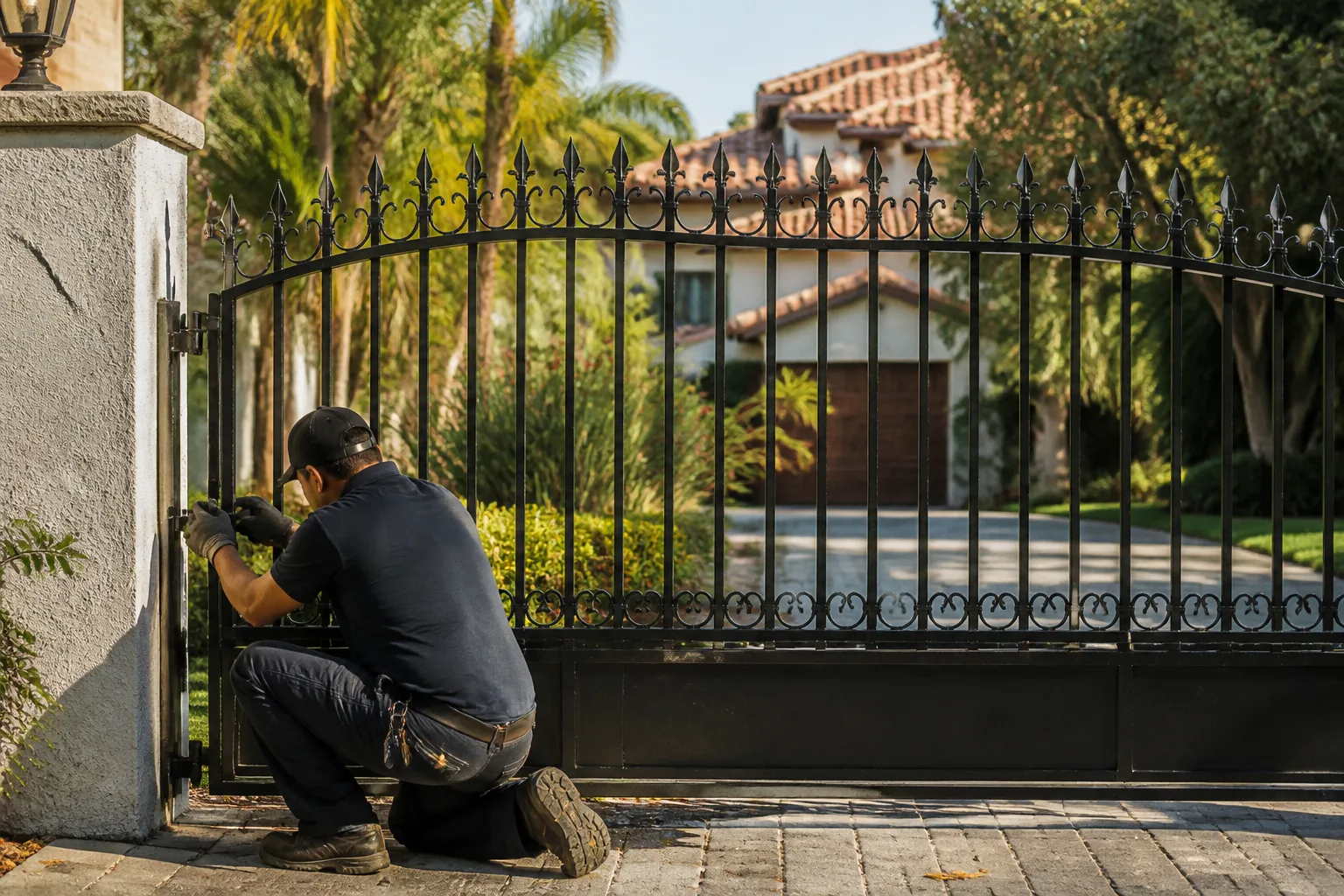
Preparing Your Home’s Gate Repair for Winter in Los Angeles
Most gate failures in Los Angeles don’t happen during the rainy months – they happen in the first two weeks of rain after five months of dust buildup. A 30-minute inspection in late October prevents the dust-to-mud infiltration that accounts for more November service calls than any other cause. If you’d rather not handle the inspection yourself, call us at (469) 530-2485 and we’ll walk you through what’s needed or send a technician.
We see it every year across Los Angeles, from the hills of Pacific Palisades to the flat lots of the San Fernando Valley. Summer’s fine dust settles into every seam and housing. Then the first significant rain arrives, flash-washes that dust into slurry, and drives it past seals that were never designed to stop mud. The result: seized rollers, fouled photo eyes, and motor housings full of grit that acts like valve-grinding compound on gears. The season seems mild, but the transition is brutal on equipment.
Why LA’s Dry-to-Wet Cycle Destroys Gate Motors
Los Angeles averages just 14 inches of rain annually, but nearly all of it arrives in concentrated November-through-March cycles. The preceding six months deposit a layer of atmospheric dust, road grime, and pollen that coats every exposed surface. When rain finally hits, that layer becomes a transport medium.
Underground operators – the motor housings buried beside swing gates in upscale Los Angeles neighborhoods like Bel Air and Hancock Park – are especially vulnerable. Brands like FAAC and BFT manufacture excellent submersible housings, but the seals compress and harden during summer heat. First-rain infiltration doesn’t just wet the motor; it carries abrasive particulate directly into the worm gear and limit switch assemblies. We’ve opened FAAC 770 units in December where the oil bath looked like chocolate milk.
Above-ground operators fare better but still suffer. Chain-drive openers on sliding gates collect dust in the chain housing all summer. Rain turns it to paste that increases load by 30 to 40 percent, enough to trip thermal overloads on older LiftMaster or Linear units that were already running near capacity.
What to check before the first rain:
- Remove the motor housing cover and vacuum loose dust with a soft brush attachment – never compressed air, which drives particles deeper
- Inspect the rubber gasket for hardening or cracks; replace if it doesn’t rebound when pinched
- Verify the housing drain holes are clear – poke with a wooden skewer, never metal wire that can damage the opening
- Check the oil level in submerged units against the manufacturer’s cold mark
If the housing has been opened, the gasket should be replaced. Reusing a compressed seal guarantees infiltration. This is straightforward preventive work, but underground operators involve 240V electrical connections and hydraulic systems under pressure. We don’t recommend homeowners open these themselves.
Photo Eye Maintenance: Clean Without Scratching
Photo eyes are the infrared safety sensors that prevent a gate from closing on a vehicle or person. In Los Angeles, they sit six inches above pavement that bakes at 140 degrees in August and collects road dust from the 405, the 10, and every construction site upwind. By October, the lenses look frosted.
Here’s what most people get wrong: they wipe the lenses with a dry cloth or paper towel. Road dust contains silica. Dry-wiping grinds that silica into the acrylic lens surface, creating microscopic scratches that scatter the infrared beam. The gate begins “ghosting” – reversing for no visible reason – and the only fix is replacing the sensor pair.
The correct method:
- Shut off gate power at the breaker
- Apply distilled water or lens cleaner to a microfiber cloth – never directly to the sensor, where liquid can seep into the housing
- Wipe gently in one direction, then turn the cloth and wipe again
- Check alignment: both sensors should show steady LEDs, not flickering
- Restore power and test the gate’s auto-reverse with a solid object
We replaced three sets of photo eyes last November in Los Angeles neighborhoods near active construction – one in Playa Vista, two in the Arts District – where homeowners had scrubbed the lenses clean and destroyed them in the process. A $12 bottle of proper cleaner prevents a $280 sensor replacement.
Concrete Footings and Micro-Settlement During Wet Years
Gate posts in Los Angeles are typically set in concrete footings 36 to 48 inches deep, which puts them below the frost line but not below the seasonal moisture fluctuation zone. In normal years, this is fine. During El Niño cycles – like the 2023-24 season and potentially 2025-26 – soil saturation reaches depths that soften the bearing layer beneath footings.
The movement is small: fractions of an inch. But a gate leaf that was balanced to within 3/16 inch now drags at the latch or binds at the hinge. The operator strains, draws excess current, and eventually faults out. Homeowners blame the motor when the real problem is geometry.
Signs a post has shifted enough to need re-leveling:
- The gate touches the ground or stop plate at one corner but not the other
- Hinge bolts show fresh rust streaks from recent movement
- The latch striker no longer meets the catch dead-center; you must lift or push the gate to engage it
- The operator’s force setting has been increased more than once in the past year
Re-leveling a post is not a DIY project. It involves supporting the gate, breaking the old footing, and pouring new concrete with proper rebar and drainage. In hillside areas of Los Angeles – Silver Lake, Echo Park, the Hollywood Hills – we also install French drains behind retaining walls that saturate gate post footings from the uphill side. If your gate has become harder to operate after heavy rain, the post is the first thing we check.
Battery Backup Testing: The Load Test That Matters
Every automatic gate in Los Angeles installed since 2019 is required to have battery backup, and most pre-2019 systems have been retrofitted. The battery is there for power outages during Santa Ana wind events or winter storms. What most homeowners don’t know: a battery can show 12.6 volts at rest and still fail under load.
The standard voltmeter check is meaningless. A battery with sulfated plates holds surface voltage but has no capacity. The gate draws 8 to 15 amps during startup; a weak battery collapses to 9 volts, the operator faults, and the gate stops mid-cycle – potentially blocking your driveway during an evacuation.
The proper load test procedure:
- Disconnect AC power to the operator
- Attempt a full open-close cycle using only battery power
- Time the cycle; it should complete within 10 percent of normal speed
- Repeat the cycle three times consecutively
- Reconnect AC power and verify the charger resumes (usually indicated by a status LED)
If the gate slows noticeably on the first cycle or fails to complete the third, the battery is degraded. In Los Angeles heat, gate batteries typically last 3 to 4 years, but we’ve seen two-year failures in unshaded metal enclosures that reach 120 degrees. Replacement is simple on most LiftMaster and Linear systems – two wing nuts and a polarity check – but some FAAC and BFT units require recalibrating the charging circuit after battery swap. We include this in our standard motor service.
Lubrication Schedule for LA’s Summer-to-Winter Transition
Los Angeles gates dry out faster than equipment in humid climates. Summer heat drives off light oils. By October, hinges chirp, chains rattle, and worm gears run metal-to-metal. Then rain arrives and the remaining lubricant emulsifies, losing film strength exactly when load increases from dust contamination.
The correct products matter. WD-40 is not a lubricant for this application; it’s a water displacer that evaporates. Here’s what we apply and where:
| Component | Product Type | Application Notes |
|---|---|---|
| Chain (sliding gate) | White lithium grease or chain-specific lube | Apply to inner rollers and outer plates; wipe excess that attracts dust |
| Worm gear (operator) | Manufacturer-specified gear grease | LiftMaster and Linear use NLGI #1 or #2; FAAC and BFT specify their own compounds |
| Hinge pins (swing gate) | Moly-disulfide grease or synthetic bearing grease | Remove pin if possible, clean old grease, repack; grease zerk fittings annually |
| Track rollers (sliding gate) | Light machine oil on bearings only | Never oil the wheel tread; oil attracts grit that accelerates track wear |
Timing: we schedule this work for mid-October in Los Angeles, after the last heat wave and before the first rain. One application carries most gates through winter. Gates on beach-adjacent properties – Malibu, Playa del Rey, San Pedro – need mid-season touch-up due to salt air accelerating corrosion.
When to Call a Pro
The inspection steps above are safe for most homeowners. Stop and call us if you find exposed wiring, hydraulic fluid leaks, or a post that moves when you push the gate leaf. Underground operators should not be opened by anyone without electrical and hydraulic training. The 240V supply and pressurized fluid present genuine hazards.
We also recommend professional service if your gate operator is more than 10 years old and has never had a limit switch adjustment. The switches that tell the gate where to stop drift over time, and incorrect adjustment causes repeated impact loading that cracks drive brackets.
Related services in Los Angeles: Gate Repair in Los Angeles, Gate Motor Repair in Los Angeles, and Gate Installation in Los Angeles if your system is beyond economical repair.
Key Takeaways
- LA’s first rain converts summer dust into abrasive mud – inspect and clean motor housings before November
- Photo eye lenses scratch permanently if dry-wiped; use damp microfiber only
- El Niño saturation can shift concrete footings fractions of an inch, enough to bind gates and burn out operators
- Test battery backup under load, not just with a voltmeter; three full cycles is the standard
- Use the correct lubricant for each component and apply in mid-October, before the rainy season
The Bottom Line
Los Angeles winters are mild compared to most of the country, but the dry-to-wet transition is hard on gate equipment. A focused inspection in late October prevents the majority of seasonal failures we see every November. The work is straightforward – clean, test, lubricate, verify – but it has to be done before the rain, not after.
If you’re in Los Angeles and want a technician to handle the inspection, or if you’ve found something that doesn’t look right, Carver Gate Repair offers free estimates. Call (469) 530-2485. We’ll give you a written price before any work starts, and every repair carries our Done Right Promise.
Frequently Asked Questions
A basic seasonal inspection typically runs $95 to $150, depending on gate type and accessibility. If we find issues, we’ll itemize repair costs in writing before starting any work. Call (469) 530-2485 for an exact quote – estimates are free.
Homeowners can safely lubricate hinges, chains, and visible track rollers. Underground operators, internal gearboxes, and any component behind an electrical cover should be serviced by a trained technician. We’ve seen gates damaged by incorrect lubricant type – especially heavy grease on track rollers that attracted grit and destroyed the track in six months.
Perform the three-cycle load test: disconnect AC power and run three complete open-close cycles on battery alone. If the gate slows significantly or fails to complete the third cycle, replace the battery. Most Los Angeles gates need replacement every 3 to 4 years. Call (469) 530-2485 if you’d like us to test and replace it – we stock batteries for all nine brands we service.
First, check the photo eyes – rain and wind-blown debris commonly block the beam. If the LEDs are steady and the gate still won’t move, check the breaker. If those are fine, the issue is likely water infiltration in the motor housing or a shifted post. Don’t continue cycling the operator; running a stalled motor causes thermal damage. We answer calls 24 hours a day, including holidays, and can dispatch a technician to diagnose the problem.
Written by the team at Carver Gate Repair.
Need Gate Repair Help?
Call Carver Gate Repair - licensed & insured, here with fast after-hours help in Los Angeles.
(469) 530-2485