
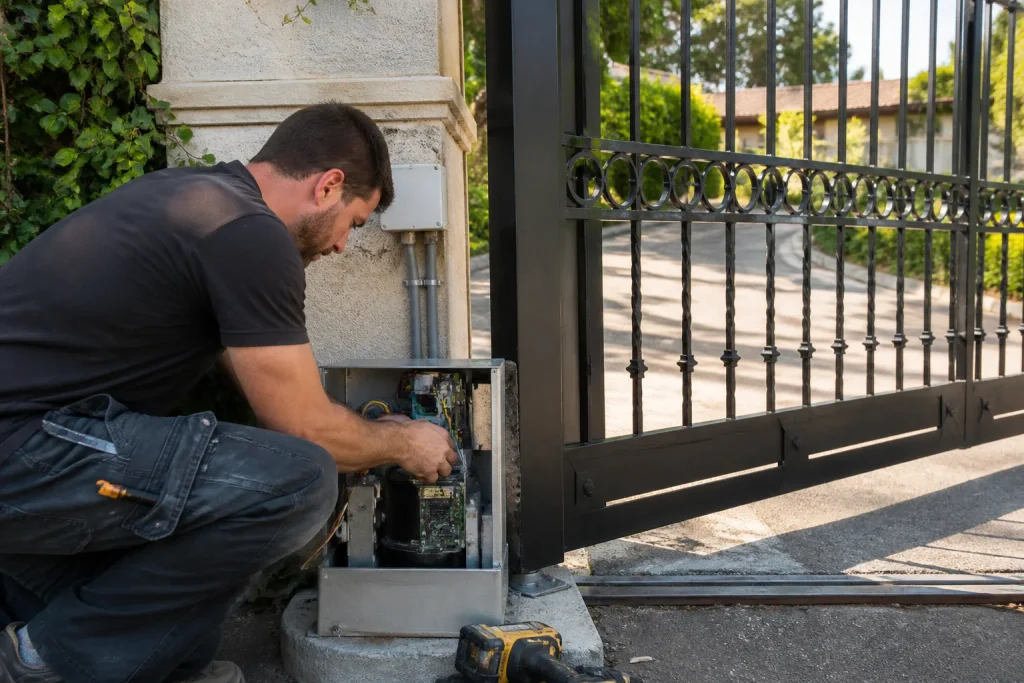
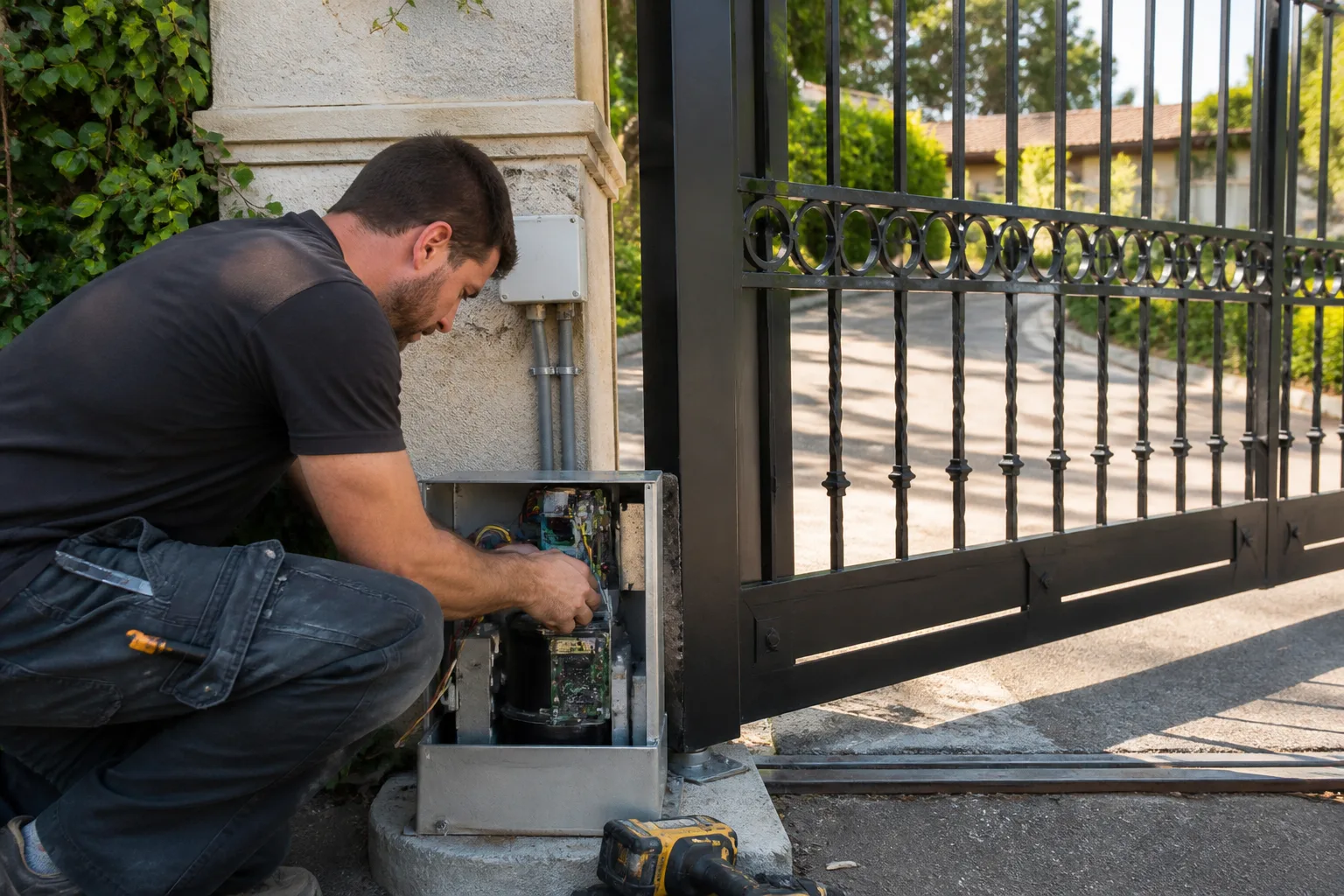
FAAC Gate Repair in Los Angeles: A Homeowner’s Guide
FAAC gate repair in Los Angeles typically runs $280 – $620 for hydraulic actuator work and $180 – $420 for electromechanical board or limit-switch issues, with most residential calls resolved in a single visit if the technician knows which FAAC series is installed and whether it’s hydraulic or electromechanical. The brand’s European engineering means parts sometimes ship from overseas, so correct diagnosis on the first trip saves days of downtime. If you’d rather not sort this out yourself, call us at (469) 530-2485 – we carry common FAAC components and can usually quote a firm price over the phone once we know your model.
FAAC is one of the few gate operator brands that uses hydraulic fluid in its actuator systems. A technician who doesn’t know to check fluid condition and level is diagnosing a hydraulic failure with an electrical mindset, and that mismatch wastes your money. We’ve seen it repeatedly in Los Angeles: a homeowner pays for a new control board when the real problem is a 50-cent O-ring letting hydraulic fluid past the piston seal. The gate still won’t move, the invoice grows, and nobody checked the reservoir.
How FAAC Hydraulic and Electromechanical Models Differ
FAAC builds two fundamentally different drive systems, and the repair approach for each is nearly opposite.
Hydraulic actuators – found in the 400 and 700 series – use pressurized fluid to push a piston that moves the gate. These systems are quiet, powerful, and tolerate heavy gates well. They’re also sensitive to fluid degradation and seal wear. In Los Angeles, where summer temperatures spike above 95°F and winter nights drop below 45°F, the thermal cycling accelerates fluid breakdown. FAAC specifies a hydraulic fluid replacement every 36 months under normal conditions, but we recommend checking fluid clarity and level every 18 months in Southern California’s climate extremes.
Electromechanical operators – the 500 and 600 series – use a motor, gearbox, and screw or rack drive. No fluid, fewer seals, but more mechanical wear points: brushes, limit switches, and the gearbox itself. These fail differently. A hydraulic unit might creep slowly when the fluid’s contaminated; an electromechanical unit will hit its limit switches and stop hard, or chatter against a stripped rack.
The diagnostic path splits immediately. A technician who treats a hydraulic 412 like an electromechanical 560 will replace parts that test fine and miss the actual failure. We’ve inherited those calls in Bel Air and Silver Lake – second visits to fix what should have been caught the first time.
Identifying Your FAAC Series Before the Technician Arrives
Knowing your series saves time, money, and a return trip. FAAC stamps the model number on a metal plate attached to the operator housing, usually on the motor body or the underside of the control enclosure. Here’s what to look for:
- 400 series – 402, 412, 422, etc. Compact hydraulic swing-gate operators. The housing is a rounded aluminum canister, roughly the size of a large coffee can. Common on residential driveway gates in Los Angeles.
- 500 series – 560, 580, etc. Electromechanical swing operators. Boxier housing, visible vent slots for motor cooling. The gearbox is audible when running.
- 600 series – 620, 640, etc. Electromechanical sliding-gate operators. Long horizontal housing, motor at one end, rack drive visible along the gate frame.
- 700 series – 721, 741, etc. Heavy-duty hydraulic operators for large or high-cycle gates. Larger reservoir, often with an external fluid sight glass. Common on commercial and estate properties in Hancock Park and the Hollywood Hills.
Take a photo of that plate. Text it to any technician before they dispatch. If they can’t tell you whether your part is in stock based on that photo, they may not have worked on FAAC before. We ask for it on every Los Angeles FAAC call – it’s that useful.
Why the E124 Board Gets Replaced When It Shouldn’t
The FAAC E124 control board is the brain of most residential operators, and it’s the most commonly misdiagnosed component we see in Los Angeles. Here’s what actually happens.
The E124 manages motor direction, limit-switch input, safety-device loops, and the optional radio receiver. When a gate stops moving entirely, many technicians default to “bad board” because it’s the central component and it’s easy to blame. But the E124 rarely fails outright. More commonly:
- A safety edge or loop detector opens the circuit, and the board correctly refuses to operate. The board is fine; the safety device is damaged or misaligned.
- Low hydraulic fluid triggers the pressure switch, and the board correctly shuts down to prevent dry-running the pump. The board is fine; the fluid is low.
- A corroded terminal on the terminal block creates voltage drop, and the board behaves erratically. The board is fine; the connection needs cleaning.
We’ve replaced E124 boards on other companies’ callbacks in Los Angeles where the original board was functional and the real problem was a $12 loop detector or a loose ground. A proper technician tests inputs before condemning the processor. At Carver, we check fluid, voltage at the terminals, and every safety loop before we quote a board replacement. The Garrison Standard means we diagnose, not guess.
FAAC Parts Availability and Realistic Repair Timelines
Here’s where FAAC ownership in Los Angeles gets practical. FAAC is headquartered in Italy, and while common 400-series parts are warehoused in the US, less common items – 700-series hydraulic rams, specific E124 firmware revisions, older 500-series gearboxes – often ship from Bologna or through a single US distributor with limited stock.
What this means for your repair timeline:
- Common items – hydraulic fluid, O-ring kits, standard E124 boards, 400-series actuators: typically 1 – 3 business days if not in local stock.
- Less common items – 700-series piston assemblies, obsolete 500-series gearboxes, specialized limit-switch housings: 7 – 14 days, occasionally longer if customs delays.
- Emergency workarounds – some hydraulic failures can be field-repaired with generic seals if the cylinder bore isn’t scored. We keep a seal assortment for exactly this reason. It’s not a permanent fix, but it gets a Los Angeles homeowner operational while the factory part transits.
This is why correct series identification matters so much. A technician who knows you have a 741 versus a 422 can check stock before leaving the shop, quote an accurate timeline, and avoid the “we’ll have to order that” surprise at your gate. We carry common FAAC wear items on our Los Angeles service vehicles for this reason – not every company does.
When to Call a Professional for FAAC Repair
Some checks are safe for a homeowner: verifying power at the outlet, confirming the remote has fresh batteries, clearing debris from the gate track. Beyond that, FAAC systems involve high-tension springs on some models, 110V or 220V electrical connections, and in hydraulic units, fluid under pressure that can penetrate skin. We don’t recommend disassembly.
Call a technician if the gate moves partially and stops, makes grinding or chattering noises, or responds inconsistently to the remote. These symptoms point to mechanical or control issues that need proper testing equipment. In Los Angeles, where gate security is often perimeter security, downtime also means vulnerability.
Related services in Los Angeles: Gate Repair in Los Angeles | Gate Motor Repair in Los Angeles | Gate Installation in Los Angeles
What Carver Does Differently on FAAC Calls
We’re not the only company that works on FAAC in Los Angeles, but we are one of the few that focuses exclusively on gates and motor systems. That matters because a generalist contractor sees maybe two FAAC units a year; our technicians see them weekly across nine brands including LiftMaster, Elite, and Mighty Mule.
Every Carver FAAC repair in Los Angeles follows The Garrison Standard: a background-checked, uniformed technician arrives, diagnoses with the correct mindset for your hydraulic or electromechanical system, and delivers a written price before any work starts. The Done Right Promise covers every repair – if it fails inside that year, we return free, no argument. Phones are answered by a live person 24 hours a day, including weekends and holidays. We’ve operated this way, and we don’t plan to change.
We pulled one out of a garage over in Los Feliz last month where a homeowner had been quoted $1,400 for a “complete system rebuild.” The actual problem was a cracked hydraulic reservoir cap that was letting air into the system – $38 part, 20 minutes. The previous technician hadn’t checked fluid level because they assumed it was an electrical fault. That’s the kind of mismatch that happens when FAAC knowledge is thin.
The Bottom Line
FAAC operators are built for durability, but they’re built with specific engineering assumptions – hydraulic fluid maintenance, European voltage standards, metric fasteners – that don’t always translate cleanly to Los Angeles residential installations. The most expensive FAAC repair is the one that’s misdiagnosed, especially when parts ship from overseas and a second visit costs another week of downtime.
Key takeaways:
- Identify your FAAC series (400/500/600/700) from the housing plate before calling for service
- Hydraulic and electromechanical models fail differently and require different diagnostic approaches
- The E124 board is rarely the actual failure – test inputs first
- LA’s temperature swings accelerate hydraulic fluid degradation; check every 18 months
- Parts availability varies; confirm stock before authorizing a tear-down
- Get a written price before work starts, and ask what the guarantee covers and for how long
If you’re in Los Angeles and need FAAC gate repair, call (469) 530-2485. We’ll ask for your model number, check parts availability, and give you a firm price range before we dispatch. Estimates are free, and every repair carries our written Done Right Promise.
Frequently Asked Questions
FAAC gate repair in Los Angeles typically costs $180 – $420 for electromechanical issues like limit-switch or board replacement, and $280 – $620 for hydraulic actuator work including seal kits, fluid service, or ram refurbishment. A full hydraulic actuator replacement on a 700-series unit can run higher depending on parts availability. We deliver a written price before any work starts – call (469) 530-2485 for an exact quote based on your model.
Common 400-series parts usually arrive in 1 – 3 business days from US stock. Less common 700-series or obsolete 500-series components often take 7 – 14 days from European distribution. We verify parts availability before quoting the job so you know the timeline upfront, and we can sometimes field-repair hydraulic seals temporarily while factory parts transit.
Any licensed technician can attempt FAAC repair, but the brand’s hydraulic systems and European control logic reward specific experience. We’ve been called to fix misdiagnosed FAAC systems in Los Angeles where generalist contractors replaced functional boards or misidentified hydraulic failures as electrical problems. Carver technicians train specifically on FAAC architecture alongside eight other major brands.
Yes. Every Carver FAAC repair carries our Done Right Promise in writing. If the repair fails within that year from the date of service, we return and make it right at no charge. No argument, no re-diagnostic fee. This is standard on every job, not an upsell.
Written by the team at Carver Gate Repair.
Need Gate Repair Help?
Call Carver Gate Repair - licensed & insured, here with fast after-hours help in Los Angeles.
(469) 530-2485