
Last updated October 10, 2026
Free on-site gate assessment - hinges, posts, and your LiftMaster or Nice gate operator checked before anything is quoted
The assessment is free and the quote is the invoice.

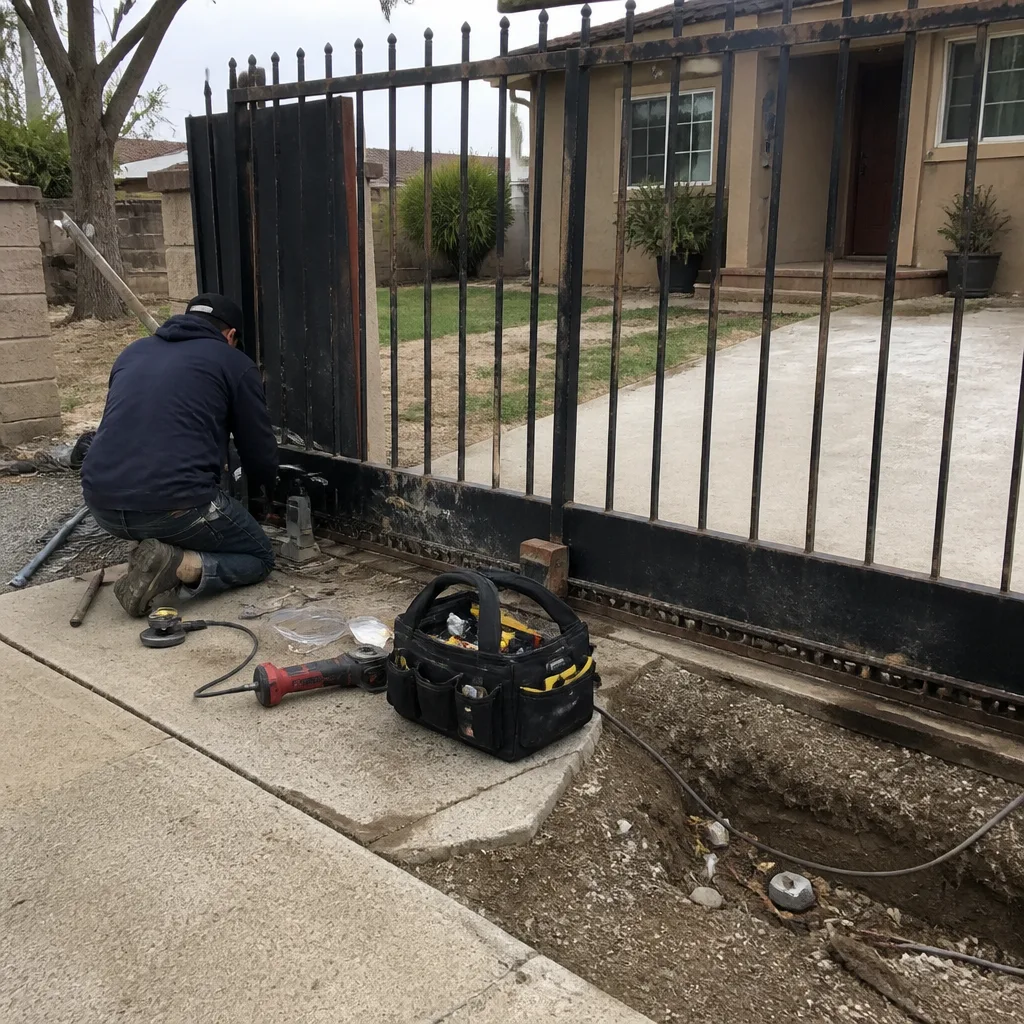 Before
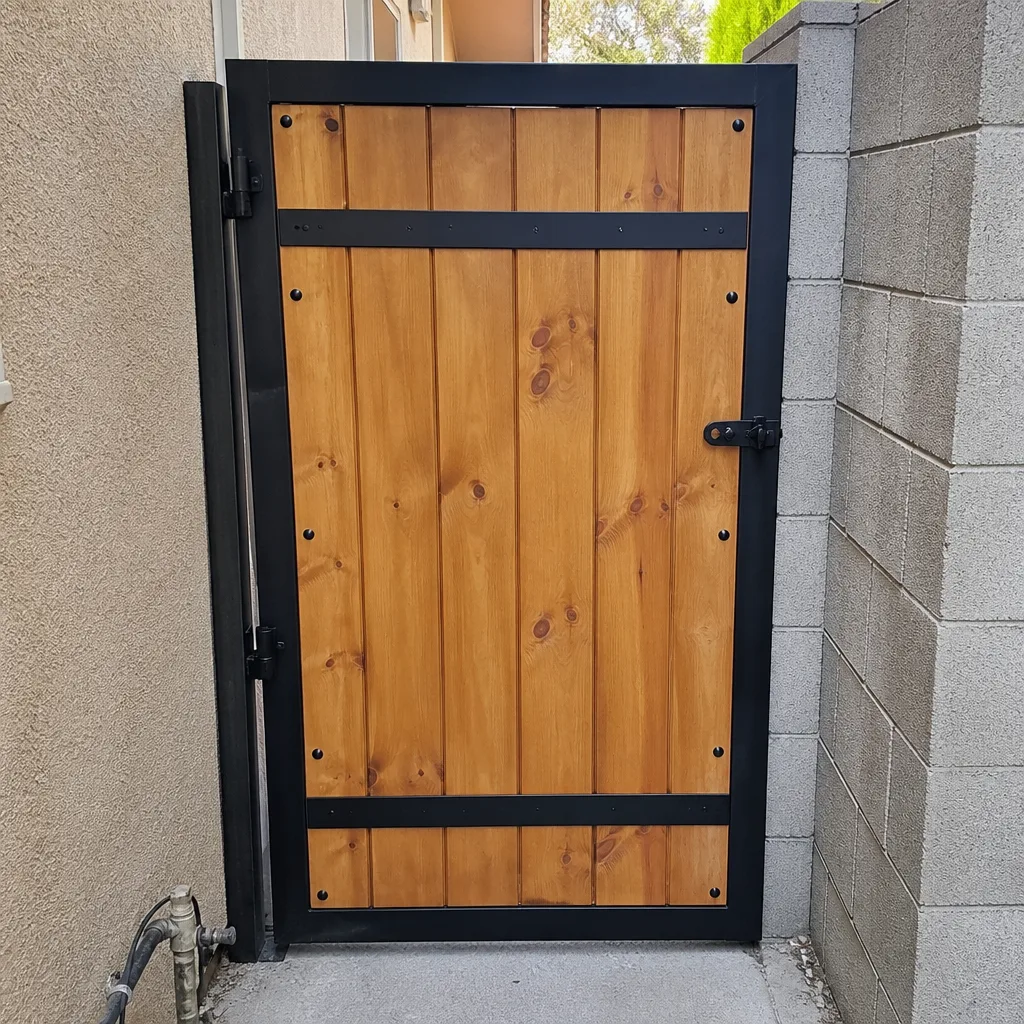 After
After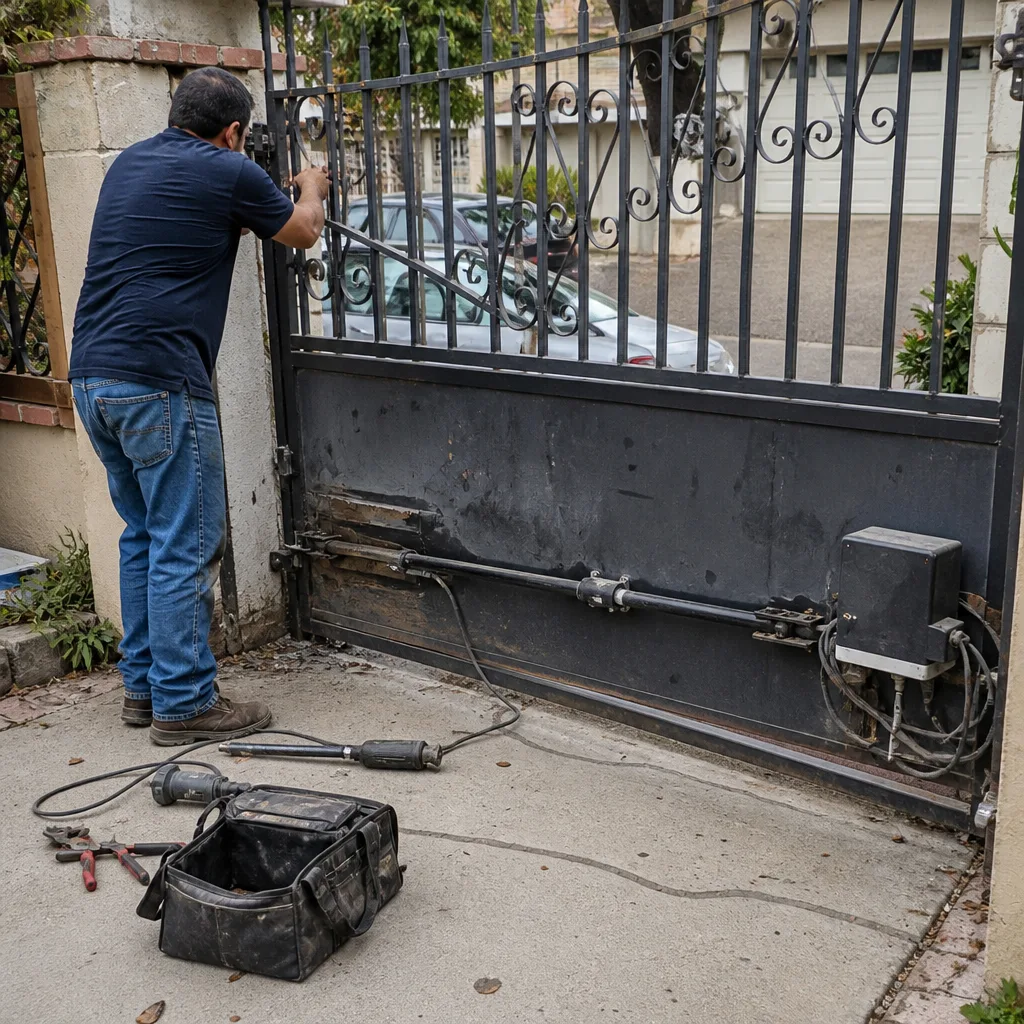 Before
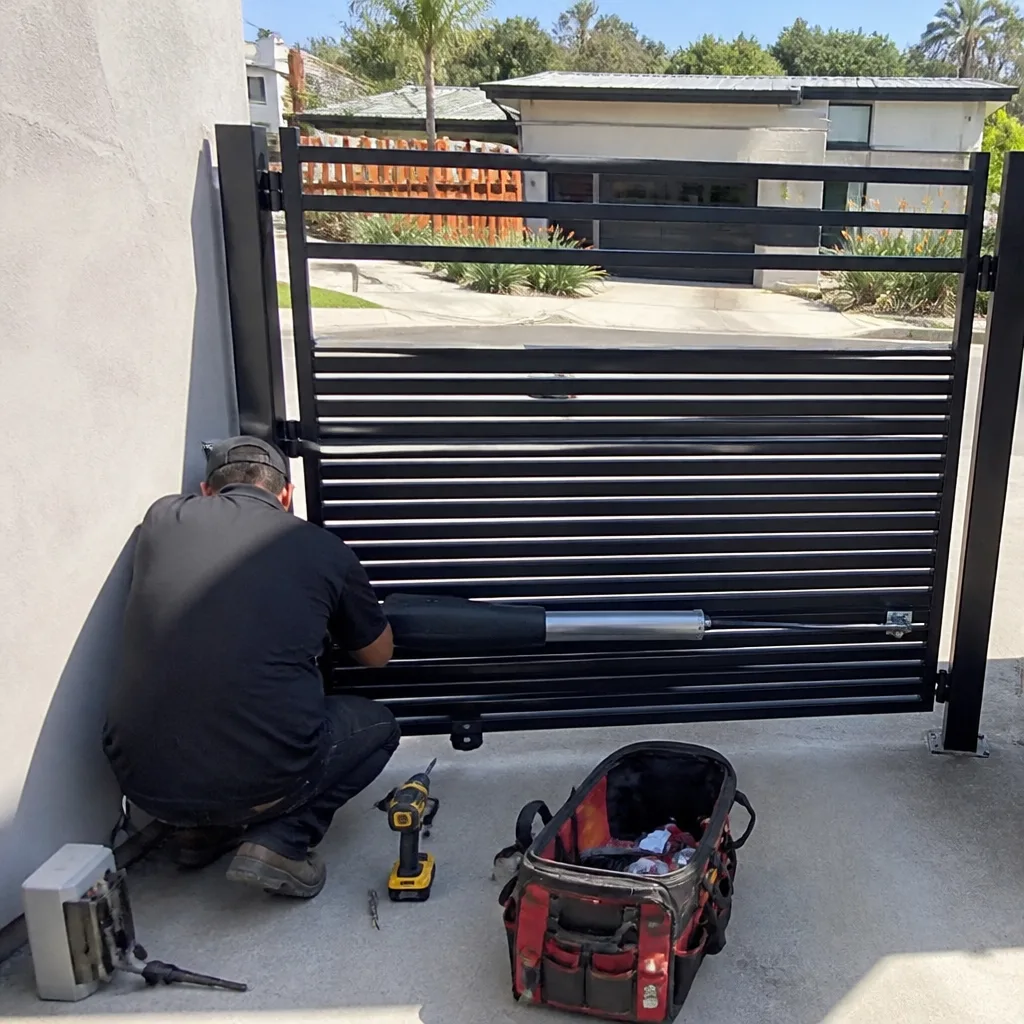 After
After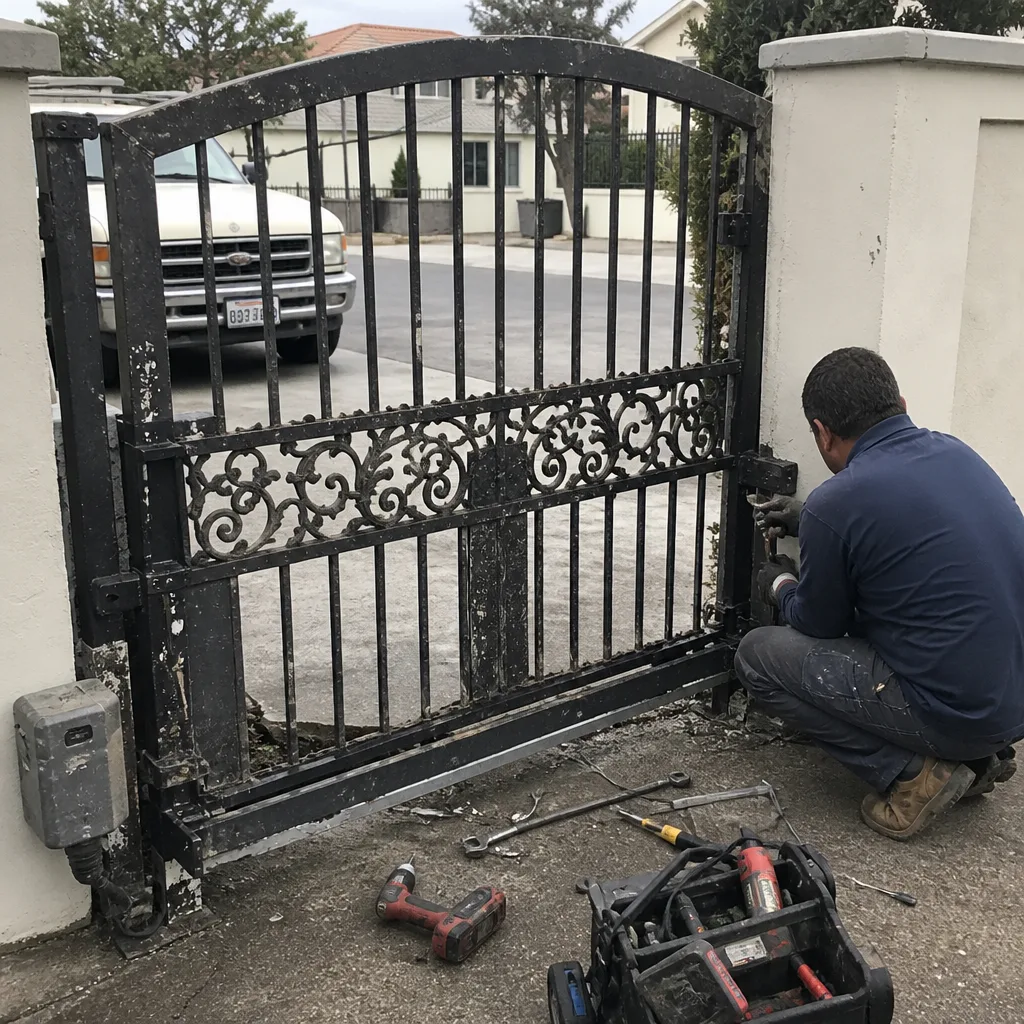 Before
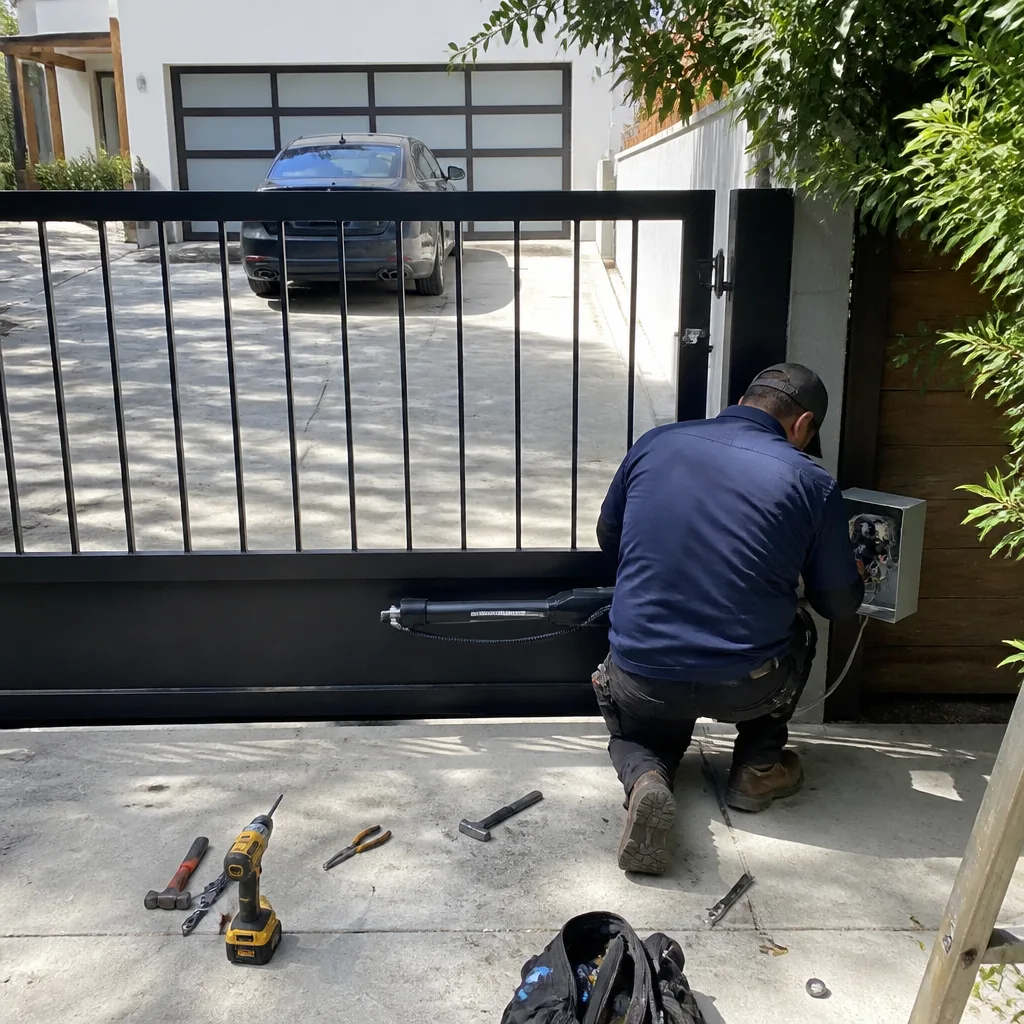 After
AfterGate Repair Maintenance Checklist for Los Angeles Homeowners
Most gate failures in Los Angeles trace back to a single error: applying a generic maintenance checklist to a specific system. We’ve seen homeowners in Brentwood lubricate a FAAC chain-drive operator with standard lithium grease, only to watch Santa Ana winds deposit fine grit that turns the lubricant into grinding paste. Six months later, they’re replacing a $400 chain assembly for a problem that proper maintenance would have prevented. This guide gives you a checklist calibrated to your actual gate type, your motor brand, and the specific stresses that Los Angeles weather and geography place on automated gates, with Gate Repair Maintenance Schedule: What to Do and When guidance for timing. You’ll learn which tasks you can handle, which ones require a technician to protect your warranty, and the three checks that catch most failures before they become emergency calls.
Quick Answer
Gate maintenance in Los Angeles should be performed monthly for visual inspections, quarterly for mechanical checks, and annually for professional servicing. The exact tasks differ for sliding versus swing gates, single versus dual panels, and vary by motor brand. Homeowners can safely clear debris, test safety features, and document wear, but should not adjust limit switches, tension springs, or electrical components without risking warranty voidance and personal injury.
Table of Contents
- Why Generic Checklists Fail in Los Angeles
- Monthly Visual Inspection Checklist
- Quarterly Mechanical Tasks by Gate Type
- What Annual Professional Service Should Include
- Brand-Specific Maintenance Notes
- Documenting Maintenance for Warranties and Claims
- The Three Checks Almost No Homeowner Performs
- Common Mistakes to Avoid
- When to Call a Professional
- Frequently Asked Questions
- The Bottom Line
Why Generic Checklists Fail in Los Angeles
Los Angeles presents a combination of environmental stressors that generic maintenance guides ignore. The Mediterranean climate delivers intense UV exposure, prolonged dry periods punctuated by concentrated winter rainfall, and seasonal Santa Ana winds that carry abrasive particulates from the desert basins east of the metro area. These factors don’t just accelerate wear; they create failure modes that don’t exist in other markets.
Consider the winter rain window, typically December through March. Most of the region’s annual precipitation arrives in brief, intense episodes. For gates in hillside neighborhoods like Laurel Canyon or the Hollywood Hills, this means water sheeting across driveways, carrying sediment into track systems and creating corrosion opportunities on hardware that sat dry for eight months. A generic “quarterly lubrication” schedule might have you greasing components in October, right before the dry season ends, leaving fresh lubricant exposed to washout when the rains arrive.
Fire season, roughly June through November, introduces another variable. Ash and charred particulate from wildfires in the Angeles National Forest or Santa Monica Mountains settle on gate systems across the metro area. These particulates are chemically active and more abrasive than typical dust. In areas like Pacific Palisades or Topanga, where we’ve performed service calls after major fire events, we’ve found accelerated wear on rack-and-pinion sliding gate drives and premature failure of sealed bearings in swing gate operators.
The coastal influence matters too. Properties within two miles of the Pacific, from Malibu through the South Bay to San Pedro, experience salt air corrosion that inland neighborhoods like Pasadena or Encino don’t face. Stainless steel hardware that performs indefinitely in Glendale may show surface rust in Manhattan Beach within eighteen months.
This is why we structure maintenance around Los Angeles conditions, not calendar quarters. The checklist below separates tasks by frequency and by gate type, with notes on when seasonal timing matters.
Monthly Visual Inspection Checklist
These tasks take ten to fifteen minutes and require no tools beyond a flashlight and your phone’s camera. Perform them on a consistent date each month; the first Saturday works well for most homeowners.
- Walk the gate path. For sliding gates, clear the full travel path of rocks, landscape debris, and any objects that could obstruct movement. In Los Angeles, this means eucalyptus bark, palm fronds, and the small branches that fall during Santa Ana wind events. For swing gates, verify that the arc of travel remains clear and that landscaping hasn’t encroached during the growing season.
- Inspect track or hinge hardware. On sliding gates, examine the track for dents, corrosion spots, or accumulated debris in the channel. Look for cracks in concrete mounting pads, which are common in areas with expansive clay soils like parts of the San Fernando Valley. On swing gates, check hinge pins for rust streaks and verify that mounting bolts remain tight.
- Test safety features. Every automated gate must have functioning entrapment protection. For gates with photoelectric sensors, wave an object through the beam during closing and confirm the gate reverses. For gates with edge sensors or loop detectors, test according to the manufacturer’s procedure. Document the test with your phone’s video function.
- Listen to the operator. Run the gate through a full cycle and note any changes in sound. Grinding, clicking, or labored motor noise indicates developing problems. In our experience across Los Angeles, a change in operating sound precedes visible failure by four to eight weeks.
- Photograph and date. Take clear photos of the operator, track or hinges, and any wear points. Store these in a dedicated folder with the date in the filename. This documentation becomes valuable for warranty claims and for comparing wear progression over time.
These monthly checks are homeowner-appropriate and do not risk voiding warranties. What they accomplish is early detection. A track dent caught in month two, before it deforms the gate carriage, prevents a $200 adjustment from becoming an $800 track replacement.
Quarterly Mechanical Tasks by Gate Type
Quarterly tasks require basic tools and some mechanical comfort. Perform them in March, after the winter rain window, and in October, before fire season intensifies. These timings align maintenance with Los Angeles seasonal transitions.
Sliding Gates
- Clean and inspect the rack. The rack is the toothed metal strip that engages the operator’s drive gear. Remove accumulated grease and debris with a solvent-dampened rag, then inspect teeth for wear or damage. In Los Angeles, rack wear accelerates when grit embeds in old lubricant.
- Lubricate the chain or belt. For chain-drive operators, use manufacturer-specified lubricant only. For FAAC and BFT chain drives, this typically means a dry-film or specialized chain lubricant, not general-purpose grease. For belt-drive systems, inspect the belt for cracking and verify tension; do not apply lubricant to belts.
- Check carriage wheels and bearings. The carriage assembly that connects the gate to the operator should roll smoothly. Worn bearings produce a rumbling sound and allow gate sag that stresses the operator. In coastal Los Angeles, inspect for corrosion on bearing races.
- Verify gate balance. Disconnect the operator and move the gate manually. It should travel the full length with moderate, consistent effort. Binding or uneven resistance indicates track problems, carriage wear, or gate frame distortion.
Swing Gates
- Inspect and lubricate hinges. Remove old grease and apply fresh lubricant to hinge pins. For heavy gates in windy areas like the Hollywood Hills, check for hinge elongation that allows the gate to drop and bind.
- Check gate leaf alignment. Dual-panel swing gates must meet evenly at the center. Seasonal ground movement, common in areas with fill soils or expansive clays, can shift posts and create misalignment. Look for uneven gaps or scraping at the meeting point.
- Test manual release. Every swing operator has a manual release for power failures. Verify that it functions smoothly and that you can operate the gate by hand. In Los Angeles, where earthquake preparedness matters, this check has practical significance beyond maintenance.
- Inspect articulating arms. For Linear or Viking articulating arm operators, check pivot points for wear and verify that arms move through their full range without binding. These components see high stress on heavy gates and hillside installations.
Dual-Panel Specifics
Dual-panel gates, whether sliding or swing, require additional attention to synchronization. The two panels must start, travel, and stop in coordination. Listen for impact at the meeting point, which indicates timing issues in the operator’s control board. For gate motor repair in Los Angeles, synchronization problems are among the most common dual-panel complaints we address.
What Annual Professional Service Should Include
Annual service by a qualified technician covers adjustments and inspections that require specialized knowledge and tools. This service protects your warranty, which most manufacturers require documented professional maintenance to maintain. In Los Angeles, schedule annual service in April, after winter rains and before summer heat peaks.
A proper annual service should include:
- Electrical system inspection, including control board, transformer, and all connections
- Limit switch adjustment and verification for accurate open and stop positions
- Loop detector testing and sensitivity calibration
- Operator force settings verified against current gate weight and wind load
- Gearbox oil change or inspection, depending on operator type and manufacturer specification
- Full safety system test with documentation
- Written condition report with photographs
At Carver Gate Repair, our Gate Repair services follow The Garrison Standard: a written price before we start, background-checked and uniformed technicians, and a full condition report you keep for your records. The 365-Day Done Right Promise covers any repair we perform, and if a repair fails within that year, we return at no charge. This isn’t an upsell; it’s the baseline for how we operate.
Homeowners should not attempt limit switch adjustment, control board programming, or force setting changes. These adjustments affect safety system function, and incorrect settings can cause entrapment hazards or operator damage. Most manufacturer warranties explicitly exclude damage from unqualified adjustment.
Brand-Specific Maintenance Notes
Different motor brands have specific maintenance requirements that generic checklists ignore. We’ve worked on nine major brands across Los Angeles, and these are the brand-specific points that prevent common failures.
FAAC operators, common in higher-end residential installations from Bel Air to Hancock Park, use a hydraulic system that requires specific fluid and filter attention. The hydraulic oil should be inspected annually for contamination; in Los Angeles heat, oil degradation accelerates. Never substitute automotive hydraulic fluid. FAAC’s warranty requires documented service with specified fluids.
BFT operators often feature electromechanical screw drives rather than chains or belts. The screw mechanism requires specific grease, applied sparingly. Over-greasing attracts debris and creates a grinding compound. In dusty areas like the inland valleys, we’ve seen BFT screws fail prematurely from exactly this error.
Linear articulating arm operators are widely installed on swing gates across the San Fernando Valley and Westside. The arm pivot bushings wear with gate weight and wind load. Annual inspection should include bushing measurement; when wear exceeds specification, the arm develops play that stresses the operator gearbox.
Viking operators are known for robust construction but have specific control board programming requirements. After any power interruption or surge, which are more common in Los Angeles during Santa Ana wind events, verify that all programmed features remain active. Viking’s surge protection should be tested annually, especially in hillside areas with longer utility runs.
For any brand, using non-specified parts or fluids voids warranty coverage. Keep documentation of all maintenance, including brand-specific parts used.
Documenting Maintenance for Warranties and Claims
Documentation is the maintenance task that no one performs and everyone needs. Manufacturer warranties, homeowner’s insurance claims, and contractor dispute resolution all depend on maintenance records. In Los Angeles, where gate systems often represent significant property value and security investment, proper documentation protects that investment.
We recommend a simple system:
- Create a gate file. Physical or digital, your choice. Include the operator manual, warranty documents, and original installation invoice.
- Log every maintenance event. Date, tasks performed, materials used, and photographs. For professional service, keep the written report.
- Photograph before and after conditions. For any wear point or developing problem, a dated photograph establishes timeline if warranty coverage becomes disputed.
- Note environmental events. Record Santa Ana wind episodes, fire season ash accumulation, or unusual rain. These contextual notes explain accelerated wear that might otherwise appear as maintenance neglect.
- Store records for the equipment lifespan plus two years. Most gate operators have a ten to fifteen year service life; keep records for seventeen years.
This documentation practice directly affects warranty claims. We’ve seen manufacturers deny claims for “lack of maintenance” when the homeowner had performed maintenance but couldn’t prove it. Written records with photographs eliminate this dispute.
For insurance purposes, documentation of proper maintenance can affect coverage determinations if a gate failure causes property damage or injury. In litigious markets like Los Angeles, this protection matters.
The Three Checks Almost No Homeowner Performs
These three checks catch the majority of preventable failures we encounter in Los Angeles service calls. They take minimal time and require no special tools.
Check One: The manual release function under load. Most homeowners test the manual release with the gate at rest. The meaningful test is with the gate in mid-travel, simulating a power failure during operation. Can you stop the gate, engage the release, and move it safely? For heavy gates on slopes, this test reveals whether you can actually clear the gate during an emergency. In hillside Los Angeles neighborhoods, this is a practical safety verification, not theoretical.
Check Two: The control board’s error history. Most modern operators store fault codes or error counts in the control board memory. Accessing this history requires consulting your manual, but the information is valuable. Repeated overcurrent faults indicate developing mechanical problems. Frequent obstruction faults may mean sensor misalignment or actual entrapment risks. For Linear and Viking operators, the error history is particularly detailed. Record any codes and their frequency; this data guides professional diagnosis before failure occurs.
Check Three: The foundation and mounting integrity. Walk the gate posts or mounting pads and look for new cracks, soil settlement, or concrete spalling. In Los Angeles, seismic activity, expansive soils, and irrigation-related erosion all affect foundations. A post that tilts half an inch changes gate geometry enough to cause operator strain. Caught early, foundation correction is minor. Ignored, it destroys the operator and requires gate rebuilding. We see this most in older neighborhoods with original installations, like parts of Los Feliz or the older Pasadena areas.
These three checks, performed quarterly, require perhaps twenty minutes total. They prevent the emergency calls that come at inconvenient hours and carry premium rates.
Common Mistakes to Avoid
- Using WD-40 as a lubricant. WD-40 is a solvent and water displacer, not a lubricant. It evaporates and leaves surfaces unprotected. On chain drives, it strips existing lubricant and accelerates wear. Use manufacturer-specified products only.
- Greasing a rack that should run dry. Some rack materials and operator combinations are designed for dry operation. Adding grease attracts grit and creates accelerated wear. Check your manual; if it doesn’t specify lubrication, don’t assume it’s needed.
- Ignoring the drain holes. Operator housings have drain holes to prevent water accumulation. In Los Angeles, these clog with dust and debris, then winter rain fills the housing and damages electronics. Annual clearing of drain holes takes two minutes and prevents common failures.
- Adjusting force settings without a meter. Force settings determine how hard the gate pushes before reversing. Homeowners often increase force when a gate starts to bind, masking mechanical problems and creating entrapment hazards. Force adjustment requires a force meter and knowledge of current code requirements.
- Pressure-washing the operator. The cleaning convenience isn’t worth the water intrusion damage. We’ve replaced control boards in Marina del Rey and Redondo Beach after exactly this “maintenance” shortcut.
- Skipping maintenance after a seismic event. Los Angeles experiences frequent minor earthquakes that shift gate geometry. Even if the gate still operates, post-event inspection catches alignment changes before they stress the operator.
When to Call a Professional
Call a technician when you encounter electrical issues, significant mechanical wear, or any safety system malfunction. Specifically: control board faults you can’t clear with the manual reset procedure; gate binding or uneven travel that quarterly maintenance doesn’t resolve; damaged springs or cables on swing gates, which carry dangerous tension; and any safety feature that fails testing.
For gate repair in Los Angeles, Carver Gate Repair offers free estimates with written pricing before any work begins. Our technicians are background-checked, uniformed, and trained across nine major brands including FAAC, BFT, Linear, and Viking. Calls are answered by a live person 24 hours a day, including weekends and holidays. Call (469) 530-2485 to schedule.
For new installations or system upgrades, see our gate installation in Los Angeles page. For motor-specific issues, our gate motor repair in Los Angeles service covers diagnostics and repair across all major brands.
Frequently Asked Questions
Annual professional service typically ranges from $150 to $350 depending on gate type, operator brand, and access conditions. Dual-panel systems and hillside installations with difficult access fall at the higher end. Carver Gate Repair provides a written price before any work starts, and that number doesn’t change once the job is open. Call (469) 530-2485 for an exact quote on your system.
Homeowners can safely perform visual inspections, debris clearing, and safety feature testing without affecting warranty coverage. However, limit switch adjustment, control board programming, force setting changes, and any internal electrical work typically require documented professional service to maintain warranty validity. Check your specific operator manual, as requirements vary by manufacturer and model year.
Los Angeles gates need more frequent attention to debris clearing and corrosion inspection than gates in temperate, humid climates, but less winterization than cold-climate installations. The specific timing in this guide, monthly visual checks and professional service in April, reflects LA’s dry-season/wet-season pattern and Santa Ana wind cycle. Coastal properties add salt-air corrosion checks that inland locations don’t need.
After significant Santa Ana winds, inspect the full travel path for new debris, test safety sensors for alignment shifts, and listen for changed operating sounds. Wind-driven grit affects chain and rack lubrication; if winds were severe, consider an early quarterly mechanical check. Photograph any new wear patterns for comparison with your maintenance records.
Replacement becomes practical when repair costs exceed 50% of replacement cost, when the operator is past manufacturer-supported parts availability, or when safety features can’t be brought to current code compliance. In Los Angeles, pre-2010 operators often lack current entrapment protection standards. A qualified technician can assess whether repair or replacement is the sound investment.
We service and maintain LiftMaster, FAAC, BFT, Linear, Viking, Ghost Controls, DoorKing, Elite, and Mighty Mule operators. Our technicians carry common parts for these brands and can source manufacturer-specific components when needed. If you’re uncertain of your operator brand, the model plate is typically located on the operator housing; photograph it and we’ll identify the system when you call.
The Bottom Line
Effective gate maintenance in Los Angeles requires matching your checklist to your actual system and environment, not following generic guidance. Perform monthly visual inspections, quarterly mechanical checks timed to seasonal transitions, and annual professional service with documented results. Use brand-specific materials and procedures. Keep photographic records. And perform the three overlooked checks, manual release under load, control board error history, and foundation integrity, that catch most failures early. The time invested, perhaps two hours annually beyond professional service, prevents the emergency repairs that disrupt schedules and strain budgets. For homeowners who prefer to delegate maintenance entirely, professional service programs are available; see our more guides & resources for related topics. The key is consistency and specificity, not perfection.
Written by Lonnie Burke, Owner at Carver Gate Repair, serving Los Angeles since 2008.