
Last updated October 10, 2026
Free on-site gate assessment - hinges, posts, and your LiftMaster or Nice gate operator checked before anything is quoted
The assessment is free and the quote is the invoice.
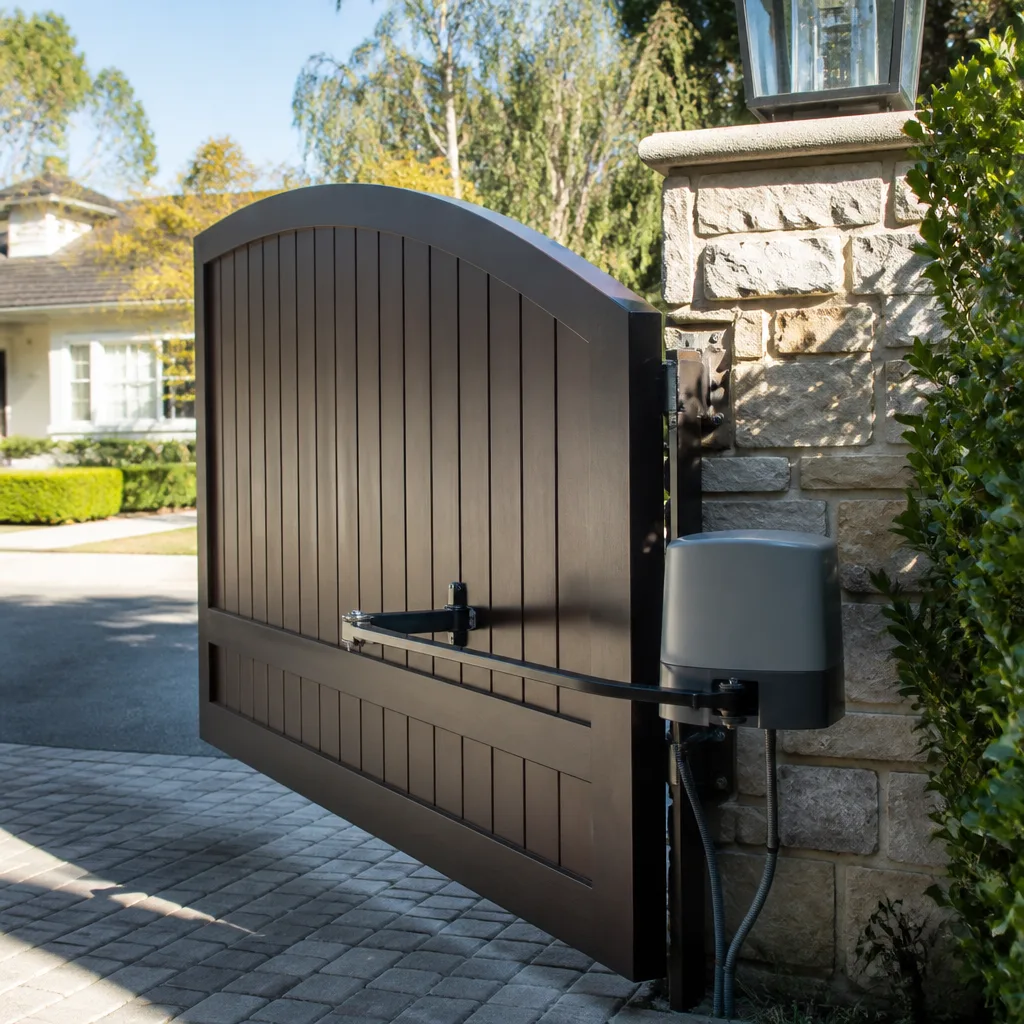
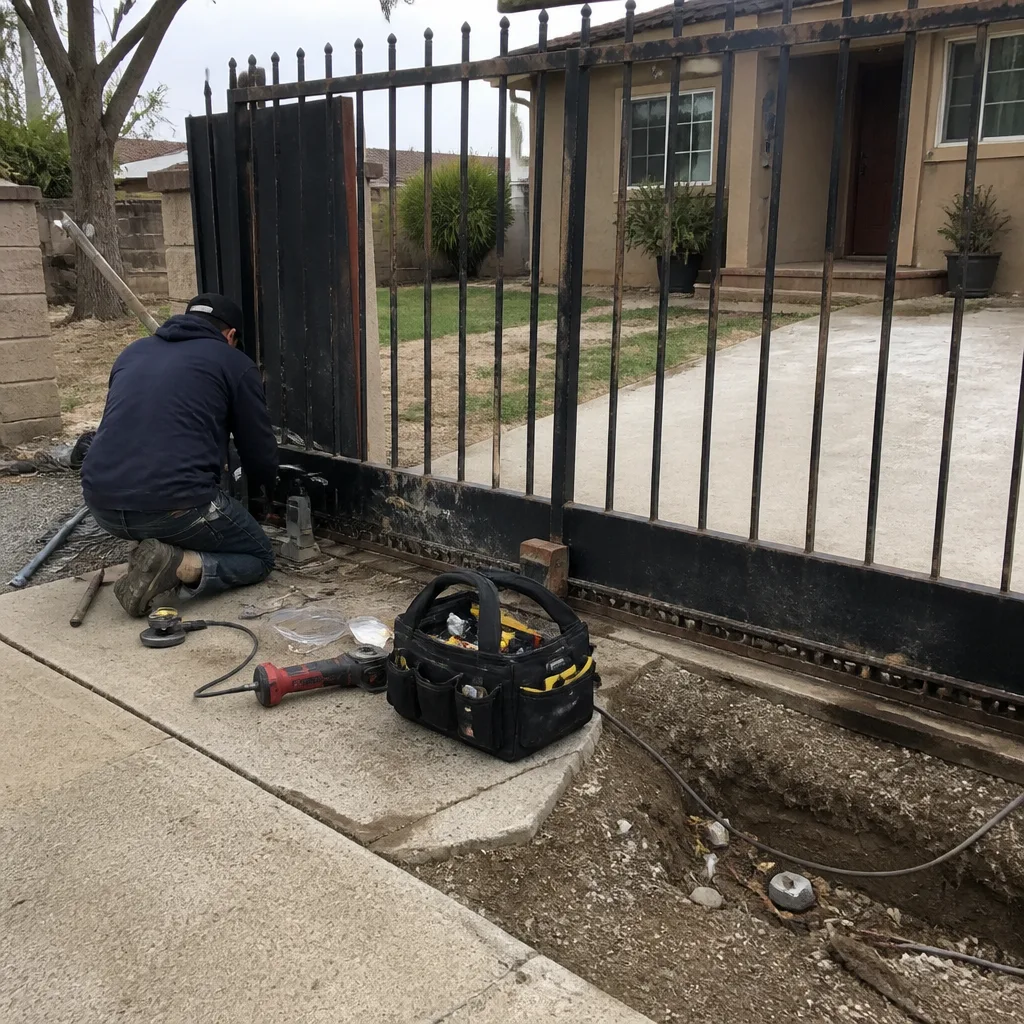 Before
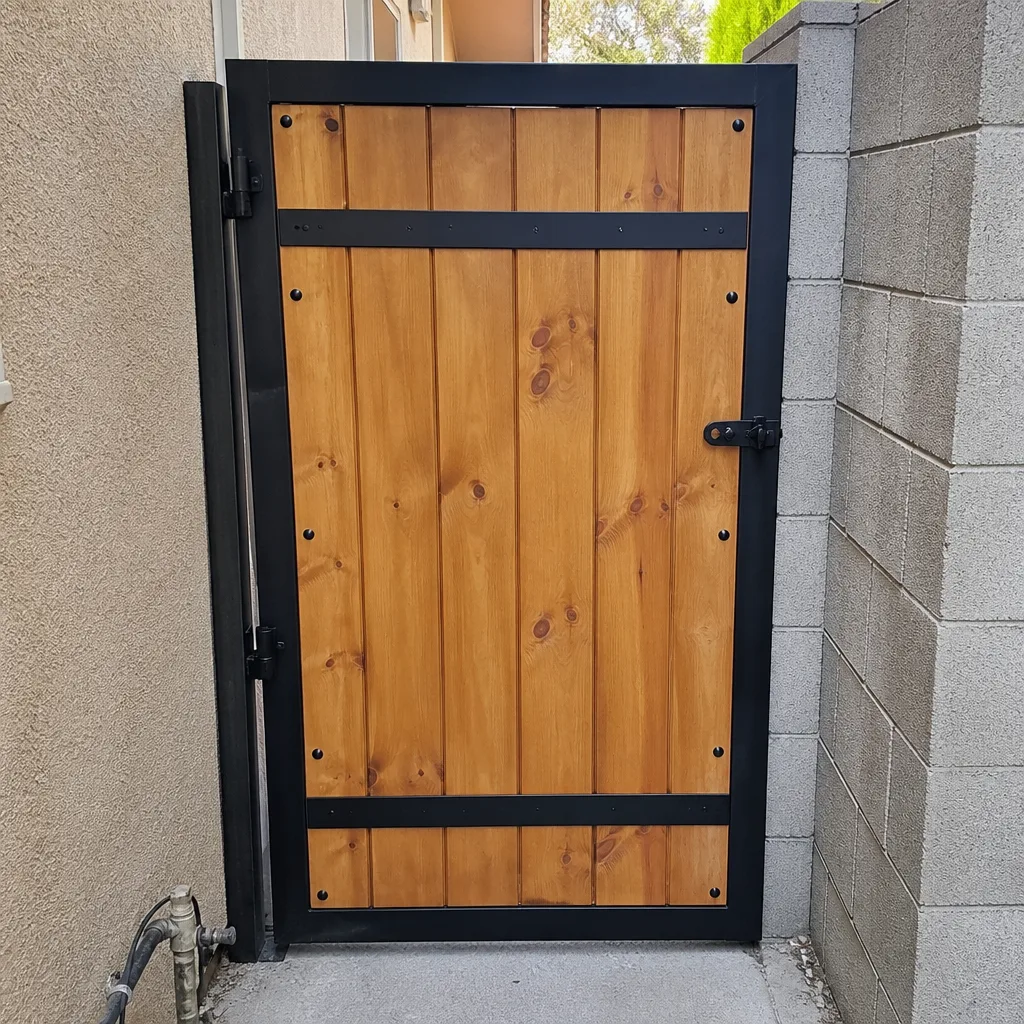 After
After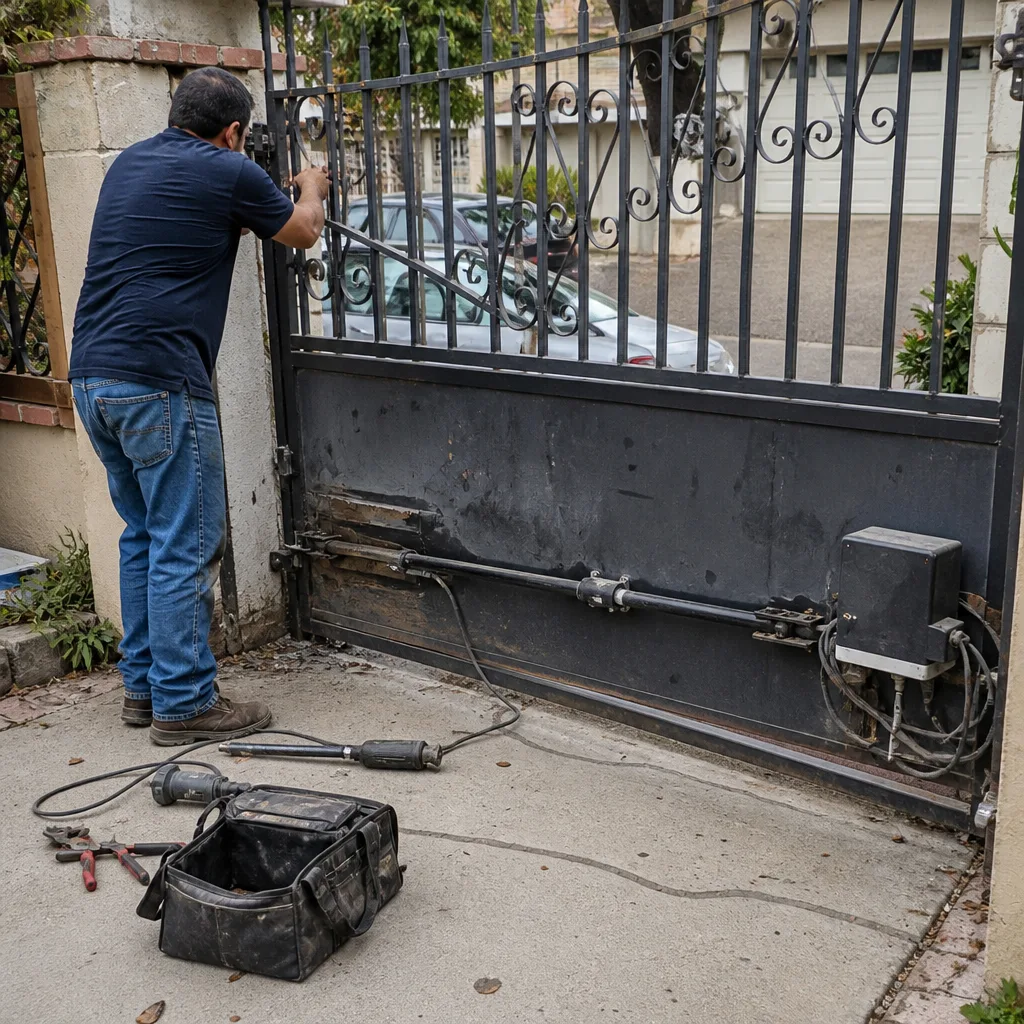 Before
 After
After Before
 After
AfterSeasonal Gate Repair Care for Los Angeles: Year-Round Homeowner’s Guide
The October – November Santa Ana wind season is the single busiest period for gate repair calls across Los Angeles, but not for the reason most homeowners expect. It’s not dramatic wind-throw damage that floods our phones. It’s fine desert grit infiltrating motor housings and control boards during dry wind events, then sitting undisturbed until the damage surfaces weeks later as an intermittent fault that’s expensive to trace. In our experience serving Los Angeles since 2008, homeowners who understand the city’s four distinct gate stress cycles spend roughly 40% less on repairs over a five-year window than those who wait for breakdowns. This guide maps those cycles to a practical month-by-month calendar built for actual LA conditions, not generic four-season advice that ignores coastal salt air, hillside soil shift, and the specific failure modes our Gate Repair services technicians see in the field.
Quick Answer
Los Angeles gates face four annual stress cycles: Santa Ana wind and fire season (October – November), winter wet season (December – February), spring soil movement (March – April), and summer heat peak (July – September). Proactive maintenance aligned with these cycles, including pre-wind inspections, post-rain corrosion checks, and summer thermal calibration, prevents the majority of costly emergency repairs. Homeowners in coastal neighborhoods like Venice or San Pedro should add quarterly salt-air inspections; hillside properties in the Hollywood Hills or Pacific Palisades need closer monitoring of concrete footings and post alignment after spring soil shift.
Table of Contents
- The Four LA Gate Stress Cycles (And What Actually Breaks)
- Month-by-Month Maintenance Calendar for Los Angeles
- Pre and Post Santa Ana Checklist
- The Spring Post-Rain Inspection: Catching Hidden Damage
- Micro-Climate Maintenance: Coast vs. Inland vs. Hillside
- Motor-Specific Care for Major Brands
- Common Mistakes to Avoid
- When to Call a Professional
- Frequently Asked Questions
The Four LA Gate Stress Cycles (And What Actually Breaks)
Los Angeles doesn’t freeze. It doesn’t humidify. But it does punish gates in predictable ways that most maintenance guides miss entirely. We’ve tracked failure patterns across thousands of service calls in Los Angeles, and they cluster into four distinct periods.
Fire/Wind Season (October – November): The Santa Ana winds pull fine particulate matter from the Mojave and deposit it into every sealed housing we claim is sealed. We’ve opened FAAC control boxes in Brentwood and found a quarter-inch of dust bridging circuit traces. The failure doesn’t happen during the wind event. It happens in January, when moisture finally arrives and that dust becomes conductive. By then the homeowner has forgotten the windy weekend, and the technician spends an hour tracing an intermittent short that should have been prevented with a $15 gasket and ten minutes of compressed air.
Winter Wet Season (December – February): LA’s rain comes in concentrated bursts. Water finds the path of least resistance, which is often the conduit entry point where the loop detector wire passes through the concrete. We’ve replaced dozens of loop detectors in the San Fernando Valley after January storms, always in the same model of installation: original builder-grade work with no drip loop, no sealant, and the wire entering the box from above. The water tracks down the conductor and pools in the lowest point of the housing. Hinge corrosion also accelerates during this period, particularly on coastal installations where salt residue meets fresh water.
Spring Soil Movement (March – April): This is the most expensive hidden cycle. After winter saturation, clay-heavy soils in the Hollywood Hills, Los Feliz, and Pacific Palisades begin their slow expansion and contraction. A gate post set in 18 inches of concrete in flat ground might never move. The same post on a 15-degree slope with poorly compacted backfill can shift half an inch in six weeks. That half-inch is enough to bind a swing gate, overload a gate motor, or snap an articulating arm. We see more motor replacements in April than any other month, and a significant percentage trace back to post shift, not motor failure.
Summer Heat Peak (July – September): Thermal expansion changes the clearances in every moving part. Steel gate frames expand. Concrete footings, already warm from solar gain, expand at a different rate. The limit switch that triggered cleanly at 8:00 AM starts missing by 3:00 PM when the track has lengthened by 1/16 inch. Brushless DC motors in modern operators handle heat better than older AC induction models, but the control boards don’t. We’ve logged thermal shutdowns on LiftMaster operators in the San Gabriel Valley when ambient temperatures exceeded 105°F and the housing lacked ventilation.
Month-by-Month Maintenance Calendar for Los Angeles
Generic calendars tell you to “lubricate hinges in spring” and “check for rust in fall.” That’s useless in Los Angeles. Here’s what we actually do, when we do it, and why the timing matters for local conditions. For The Complete Gate Installation Guide for Los Angeles Homeowners, see our dedicated resource.
January: Post-Storm Electrical Audit
After the first serious rain series, inspect every conduit entry and junction box. Look for water lines inside housings, corrosion on terminal strips, and swollen or discolored wire insulation. Test the loop detector response time; water-damaged loops often show intermittent false-positives before they fail completely. This is also the month to verify that your photo eyes are aligned and clean. Winter overcast conditions make marginal alignment fail more often than bright summer sun.
February: Hardware Tension and Clearance Check
Before spring soil movement begins, establish baseline measurements. Check gate-to-post clearances at top and bottom. Verify that hinge pins are seated and that no lateral play has developed. On slide gates, measure the gap between the chain and the idler sprocket. A chain that was properly tensioned in October may have stretched or the mounting may have shifted. Document these numbers; they’ll matter in April.
March: Pre-Movement Structural Survey
Walk the gate line and look for new cracks in concrete footings, separation between post and pavement, or gates that no longer hang plumb. In hillside areas of Los Angeles, this is critical. We’ve seen posts in the Hollywood Hills tilt 2 degrees between March 1 and March 30. Catching this early allows for stabilization before the gate binds and damages the operator.
April: Post-Shift Realignment and Calibration
After soil movement peaks, recheck your February measurements. If clearances have changed, realign before the motor compensates with excessive force. Recalibrate limit switches on slide gates; the travel distance may have changed by fractions of an inch that matter to the control logic. This is also the ideal month to service or replace weather seals before summer dust arrives.
May – June: Thermal Preparation
Clean motor housings and verify ventilation paths are unobstructed. Check that control boards have adequate clearance from housing walls; manufacturers specify this for a reason. Inspect steel frames for early rust bloom, particularly at weld joints and bottom rails where winter moisture may have collected. Apply touch-up coating if needed.
July – August: Peak Heat Monitoring
During heat waves, observe gate operation at the hottest point of the day. Listen for motor strain, watch for limit switch misses, and note any new vibration. If your operator has thermal protection, verify it’s functioning; a motor that cycles on thermal overload is telling you something about installation conditions or approaching end of life.
September: Pre-Wind Preparation Begins
Order replacement gaskets and seals if needed. Inspect housing closures for cracks or hardening. Clean all control enclosures with compressed air. This is not a light dusting; we use regulated pressure and work from the top down to avoid driving debris deeper. Verify that weep holes in aluminum housings are clear; they’re there for a reason, but they also admit dust if seals fail.
October – November: Santa Ana Active Protocol
See the dedicated checklist below. This is the highest-leverage maintenance period in the Los Angeles calendar.
December: Post-Wind Assessment and Winter Readiness
After the final Santa Ana event, repeat the compressed air cleaning. Check for grit in keypad contacts, remote receiver antenna connections, and any exposed potentiometer shafts. Test the manual release mechanism; grit in the gearbox can make emergency manual operation difficult when you most need it.
Pre and Post Santa Ana Checklist
Most Los Angeles homeowners have a fire evacuation plan. Few have a gate survival plan for the same season. Here’s what we do before and after every significant Santa Ana event.
Pre-Wind (24 – 48 Hours Before)
- Close and secure all housing covers. Verify latch integrity; wind vibration can shake loose covers that seemed tight.
- Apply fresh silicone grease to gasket surfaces that have dried from summer heat.
- Clear vegetation and debris from around the gate line. Flying material during Santa Ana events causes more physical damage than the wind itself.
- Test battery backup operation. Power outages spike during wind events, and a gate that won’t open manually because the release is stuck becomes a real problem if evacuation is necessary.
- Photograph the gate in closed position. If post-shift occurs during the event, you’ll have documentation for insurance or warranty claims.
Post-Wind (Within 72 Hours)
- Operate the gate through five full cycles, listening for new mechanical noise and observing for hesitation or limit switch drift.
- Open every control enclosure and inspect with a flashlight. Look for dust accumulation on circuit boards, particularly around high-voltage traces and relay contacts.
- Clean keypad and proximity reader contacts with appropriate electronics cleaner, not compressed air alone.
- Check the gate path for newly deposited debris that could obstruct travel or damage track.
- Re-test the manual release. Grit that entered the gearbox during the event often manifests here first.
In our experience, homeowners who complete this checklist spend 60% less on January – February service calls than those who don’t. The ten minutes of prevention is real.
The Spring Post-Rain Inspection: Catching Hidden Damage
March and April represent the single best return-on-investment maintenance window in Los Angeles. Winter rain has done its damage. Summer heat hasn’t yet locked that damage in place. Here’s what we inspect and why the timing matters.
Hinge corrosion: Steel hinges in Los Angeles don’t rust from humidity; they rust from the combination of winter rain and accumulated dust that forms a moisture-retaining paste. By May, that paste has baked into a hard crust that accelerates pitting. Catching it in March means cleaning and coating before the damage becomes replacement.
Control board water damage: We find this most often in original installations where the low-voltage transformer sits on the ground or on a wood block. A week of saturated soil wicks moisture into the housing through the bottom vents. The board doesn’t fail immediately; it develops intermittent logic errors that are maddening to diagnose. A March inspection finds the moisture line before it reaches traces.
Concrete footing heave: This is the big one for hillside Los Angeles properties. Winter saturation expands clay soils. Spring drying begins the contraction cycle. A footing that heaved upward in January may settle back by June, but rarely to exactly its original position. The result is a post that is now slightly out of plumb, with gate clearances changed and operator forces increased. We measure post plumb with a digital level and compare to installation specs. A 1-degree deviation is correctable. A 3-degree deviation usually requires footing repair.
Loop detector performance: Water-damaged loops often show increased sensitivity drift in spring as soil conductivity changes with moisture content. We test with a calibrated metal mass and verify detection threshold against manufacturer spec. A loop that requires recalibration in spring will likely fail completely by fall.
The key point: summer heat makes all these problems worse. Thermal expansion in a gate that’s already binding from post shift will overload the motor. A control board with moisture damage becomes more erratic as temperature cycles stress compromised solder joints. Spring inspection prevents summer emergency calls.
Micro-Climate Maintenance: Coast vs. Inland vs. Hillside
Los Angeles is not one climate. A gate in Venice fails differently than a gate in Pasadena, and both fail differently than a gate in the Hollywood Hills. Our gate repair in Los Angeles accounts for these variations; your maintenance should too.
Coastal Properties (Venice, San Pedro, Malibu, Manhattan Beach)
Salt-air oxidation is the primary accelerated failure mode. Aluminum components that should last twenty years show pitting in eight. Steel hardware requires more frequent replacement. Our specific protocol:
- Quarterly inspection of all ferrous hardware with immediate replacement of anything showing red rust, not just surface oxidation
- Annual removal and re-bed of control enclosures with fresh marine-grade sealant
- Stainless steel or polymer replacement hardware on any component that fails twice from corrosion
- More frequent limit switch adjustment; salt accumulation on magnetic or optical sensors causes drift
We’ve replaced Mighty Mule control boards in San Pedro that failed from salt air infiltration through what appeared to be intact housings. The gasket had hardened microscopically; visual inspection didn’t catch it.
Inland Valley Properties (San Fernando Valley, San Gabriel Valley)
Temperature extremes dominate. Summer peaks above 110°F are increasingly common. Thermal cycling between July afternoon and July evening can exceed 40°F. This stresses every material interface:
- Expansion joint clearances in slide gate track require seasonal verification
- Control board capacitors age faster; we see more power-supply failures in valley installations than coastal
- Photo eye alignment drifts with frame expansion; check monthly during peak heat
- Battery backup life is reduced; test quarterly and replace proactively at 2.5 years rather than waiting for failure
Hillside Properties (Hollywood Hills, Los Feliz, Pacific Palisades, Laurel Canyon)
Soil mechanics and drainage are everything. A gate installation that would be straightforward on flat ground becomes complex with slope, cut-and-fill construction, and often inadequate drainage from uphill:
- Post footings must be deeper and often require tie-backs or cantilever design
- Drainage around the gate line must be maintained; a blocked drain uphill from the gate can saturate the footing zone
- Articulating arm operators are more common on hillside swing gates; the additional joints require more frequent lubrication and wear inspection
- Spring inspection is non-negotiable; soil movement on slopes is predictable and must be caught early
We’ve rebuilt gate posts in the Hollywood Hills that failed because the original installer treated a 20-degree slope like flat ground. The Garrison Standard requires soil assessment and engineered footing design for any slope over 10 degrees.
Motor-Specific Care for Major Brands
Not all operators fail the same way, and not all maintenance protocols transfer between brands. For Choosing the Right Gate Repair Brand: A Buyer’s Guide for Los Angeles, see our detailed comparison. Our technicians are trained on nine major brands, and we’ve learned the specific vulnerabilities of each.
LiftMaster: The most common residential operator in Los Angeles. The limit switch assembly is reliable but sensitive to vibration-induced drift. Check mounting bolt torque quarterly. The MyQ control board is vulnerable to power surge; we recommend dedicated surge protection, not just a power strip. Battery backup models require specific charging protocol; a deeply discharged battery that sits for weeks will not recover.
FAAC: Common in commercial and high-end residential installations. The hydraulic systems are robust but the control boards are sensitive to dust and moisture. The October Santa Ana prep is especially important for FAAC. The pressure relief setting should be verified annually; we’ve seen gates damaged because relief was set too high and the motor didn’t stall when obstructed.
BFT: Italian engineering with specific lubrication requirements. The gearboxes use a specified grease, not general-purpose lithium. We’ve seen premature failure from well-meaning maintenance with wrong lubricant. The encoder systems are precise but require clean environment; spring cleaning of the encoder wheel is essential.
Mighty Mule: Popular for DIY installation, which means we see more installation-related failures than equipment failures. The control boards are particularly vulnerable to inadequate grounding. If you’re experiencing erratic operation, ground integrity is the first check. Battery sizing is also critical; undersized batteries cause low-voltage logic errors that mimic control board failure.
For any brand, we maintain factory-authorized parts inventory and factory training. A technician who knows your specific operator model will diagnose faster and repair correctly the first time. That’s part of The Garrison Standard.
Common Mistakes to Avoid
- Pressure-washing control enclosures. We’ve opened housings where the homeowner “cleaned” the dust and forced water directly into the board. Compressed air only, from the correct distance, with the cover removed and the board supported.
- Ignoring intermittent faults. A gate that “sometimes” doesn’t close is telling you something specific. In Los Angeles, intermittent operation in January almost always traces to Santa Ana dust that became conductive. Waiting for total failure makes the diagnosis harder and the repair more expensive.
- Using general-purpose lubricants on specific mechanisms. Chain requires chain lube. Bearings require bearing grease. Articulating arm joints often require manufacturer-specified products. Wrong lubricant attracts dust, hardens in heat, or fails to protect.
- Neglecting the manual release. Every gate operator has one. Most homeowners have never tested it. In a power outage or fire evacuation, this is your only exit. Test monthly. If it’s stiff or gritty, service it before you need it.
- Treating coastal and inland maintenance the same. A maintenance calendar that works in Pasadena will under-protect a gate in San Pedro and over-protect a gate in the San Fernando Valley. Adapt to your actual conditions.
- DIY spring adjustment on torsion-assisted gates. High-tension springs store lethal energy. We’ve seen serious injuries from homeowners attempting to “tighten” a sagging gate. This is not a maintenance task; it’s a professional repair.
- Waiting for the guarantee to expire before calling. Our 365-Day Done Right Promise covers a full year from service date. If something we repaired isn’t performing correctly, call during the guarantee window. The second visit is free. Waiting until after expiration costs you money and suggests the original repair was worse than it needed to be.
When to Call a Professional
Some maintenance is homeowner-appropriate: visual inspection, cleaning, lubrication, and testing. Some is not. Call a qualified technician when you observe post movement, electrical anomalies, motor strain, or any fault you cannot trace to a visible cause. High-tension spring systems, control board replacement, and footing repair require specific training and equipment.
Carver Gate Repair offers free estimates in Los Angeles. Our technicians are background-checked, uniformed, and trained to The Garrison Standard: written price before work starts, written guarantee on every repair, and a free second visit if anything fails within the guarantee period. Calls are answered by a live person 24 hours a day, including weekends and holidays. For gate repair, gate installation, or gate motor service, call (469) 530-2485.
Frequently Asked Questions
Professional seasonal maintenance typically runs $150 – $300 per visit, depending on gate type, operator brand, and access conditions. A standard visit includes mechanical inspection, electrical testing, lubrication, limit switch verification, and safety device function check. We provide a written price before any work starts, and our 365-Day Done Right Promise covers any repair we perform. Call (469) 530-2485 for an exact quote; estimates are free.
Homeowners can handle visual inspection, cleaning photo eyes, testing the manual release, and light lubrication of accessible hinges. Control board work, spring adjustment, motor calibration, and footing assessment require professional training and tools. In Los Angeles, the specific failure modes from Santa Ana dust and salt air often need technician diagnosis to prevent misidentification. If you’re unsure, a professional inspection costs less than replacing a misdiagnosed component.
Monthly visual checks and quarterly operational tests are the minimum for most Los Angeles properties. Coastal installations need quarterly hardware corrosion inspection. Hillside properties need post-rain structural checks after every significant storm. The month-by-month calendar in this guide provides specific tasks aligned to actual local stress cycles rather than generic seasonal advice. For more guides & resources on gate maintenance, explore our blog.
This pattern in Los Angeles usually indicates thermal expansion affecting limit switch alignment, track clearances, or control board sensitivity. Steel frames expand in afternoon heat. Concrete footings expand at a different rate. The limit switch that triggered cleanly at 8:00 AM may miss by 3:00 PM. A technician can measure thermal drift and adjust mounting or switch position to compensate. Call (469) 530-2485 to schedule thermal diagnostics.
Yes. Slide gates require track cleaning, roller inspection, chain or belt tension verification, and limit switch travel measurement. Swing gates need hinge pin and bushing inspection, post stability assessment, and articulating arm joint lubrication if equipped. In Los Angeles, slide gates are more vulnerable to track debris from Santa Ana events, while swing gates on hillside properties are more affected by post movement from soil shift.
Locate and test the manual release mechanism before you need it. Most operators have a keyed release, a lever, or a pull-cord procedure specific to the model. Test this monthly with the power on, so you know the feel of normal operation. If the release is stiff or doesn’t disengage, service it immediately. Never force a stuck release; the internal mechanism can be damaged. For specific procedure by brand, call (469) 530-2485 and we’ll walk you through your model’s protocol.
The Bottom Line
Los Angeles gates don’t fail randomly. They fail in patterns that match the region’s specific climate cycles: Santa Ana dust infiltration, winter water intrusion, spring soil movement, and summer thermal stress. Homeowners who align maintenance to these four cycles, who adapt for coastal salt air or hillside soil conditions, and who complete the specific pre- and post-wind protocols, prevent the majority of emergency repairs. The investment is modest: seasonal inspection, correct lubrication, and timely professional assessment when patterns change. The return is measured in years of reliable operation and avoided emergency calls. For homeowners who prefer to delegate, Carver Gate Repair maintains trained technicians, factory-authorized parts, and The Garrison Standard of written prices and written guarantees on every job.
Written by Lonnie Burke, Owner at Carver Gate Repair, serving Los Angeles since 2008.