
Top Signs You Need Gate Repair Service – Don’t Ignore These
A gate that hesitates for two seconds before moving isn’t “just slow” – that hesitation is the motor drawing more amperage to overcome a problem that will only get worse. Most gates give weeks of small, ignorable signals before they fail completely, and learning to read those signals is the difference between a $200 repair and a $1,400 emergency call. If you’d rather not diagnose it yourself, call us at (469) 530-2485 and we’ll send a technician to your Los Angeles property.
Why a Hesitating Gate Is Never “Just Slow”
Gate motors are rated for a specific amperage draw under normal load. When a gate hesitates before opening or closing, the motor is pulling extra current to overcome mechanical resistance. That resistance has a source, and it never resolves itself.
In our experience across Los Angeles, from the hillside properties in the Hollywood Hills to the flat lots in the San Fernando Valley, hesitation typically points to one of three problems: track or wheel degradation on sliding gates, hinge seizing or misalignment on swing gates, or internal gearbox wear in the operator itself. A BFT or Linear operator drawing 8 amps instead of its rated 4.5 amps will eventually burn out its control board. The motor doesn’t complain – it just works harder until it fails.
What makes this signal easy to miss is that gates often hesitate only under specific conditions: first movement of the morning, or when moving uphill, or during cooler weather. Homeowners adapt to the rhythm. By the time the gate stops entirely, the original problem has usually damaged a second component.
We measure amperage draw on every service call. It’s a 30-second diagnostic that tells us whether we’re looking at a lubrication issue, a mechanical binding, or motor replacement. If your gate has developed a personality – a little pause, a different sound, a slower speed than you remember – that’s data, not quirkiness.
What Your Gate Is Telling You by Sound
Gates are mechanical systems with moving parts, and moving parts have characteristic failure sounds. Learning to map sound to problem saves time and prevents collateral damage.
Grinding on a sliding gate usually means the V-groove wheels have worn flat spots or the track has accumulated debris that the wheels are crushing through. In Los Angeles, where Santa Ana winds blow fine dust and palm debris against gate systems for days at a stretch, track contamination is common. Grinding accelerates wheel wear and can deform the track itself.
Clicking without movement is the sound of a motor trying to engage against a locked mechanical load. On a Ghost Controls or Viking swing operator, this often means the articulating arm has seized at its pivot, or the limit switch has failed and the motor is hitting a physical stop. Repeated clicking will strip the operator’s internal clutch or damage the drive gear.
Humming without movement indicates the motor is energized but cannot transfer power. On electric gate systems, this points to capacitor failure, especially in operators more than five years old. Capacitors provide the initial torque burst that starts the motor; a weak capacitor hums while the motor stalls. In Los Angeles afternoon heat, when ambient temperatures climb past 90°F, capacitor failure becomes more common because heat degrades the electrolytic components faster.
High-pitched whining that changes pitch with gate position typically signals belt or chain tension problems. Too tight, and bearings wear prematurely. Too loose, and the belt skips teeth under load, causing erratic limit switch behavior.
We carry replacement capacitors, belts, and limit switches for all nine brands we service, including Linear and Viking systems. Most sound-based diagnostics lead to same-day repairs.
Gate Sag Is Structural, Not Cosmetic
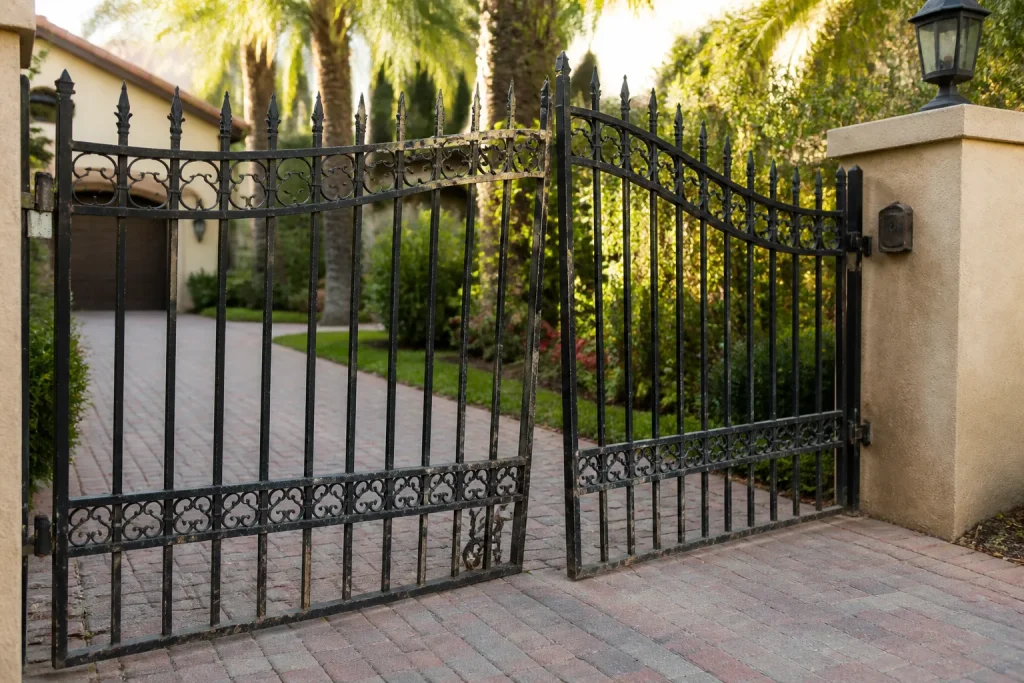
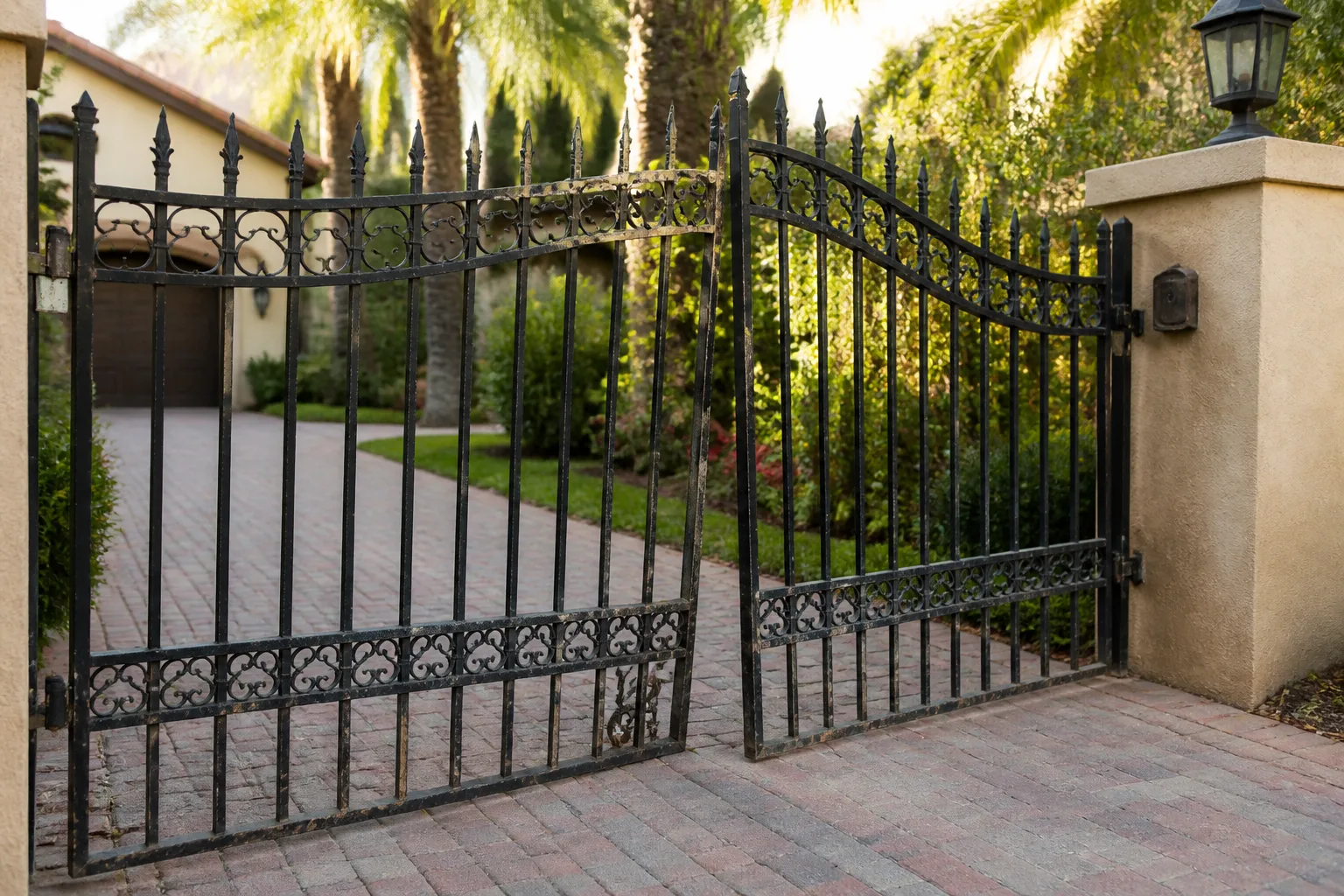
A gate that has dropped an inch on its hinge side looks like a minor alignment issue. It isn’t. Sag indicates that either the hinge post has shifted in its footing, the hinge itself has elongated, or the gate frame has twisted under load. Any of these conditions creates a cascade of secondary problems.
Misalignment increases friction at every point of contact. The motor works harder, drawing more amperage. The gate rollers or wheels ride unevenly, creating flat spots. The latch no longer meets the strike plate cleanly, so homeowners compensate by slamming or forcing – which bends the latch mechanism and eventually the frame.
In Los Angeles, where many properties sit on hillside lots with seasonal soil movement, post shifting is particularly common. We’ve repaired gates in the Pacific Palisades where the hinge post had tilted three degrees over two rainy seasons. The homeowner had adjusted the latch three times before calling us. By then, the operator’s clutch was worn, the bottom frame rail was twisted, and what should have been a post-reset and hinge replacement had become a full gate rebuild.
The correct response to sag is to find the source, not to adjust around it. We check post plumb, hinge pin wear, and frame square as standard procedure. Addressing sag early typically costs $180 – $400. Waiting until the operator fails adds $650 – $1,200 for motor replacement.
The Electrical Sign Almost Everyone Misses
The most diagnostically useful pattern we hear from Los Angeles homeowners sounds like this: “The gate works fine in the morning, but by afternoon it struggles or won’t move at all.” This temperature-dependent failure has a specific cause, and it’s almost always electrical.
Gate operators rely on capacitors and, in solar or battery-backup systems, on lead-acid or lithium batteries. Both components are temperature-sensitive. A capacitor that tests within specification at 65°F may deliver 40% less starting torque at 85°F. A battery that shows 12.6 volts at 8 AM may drop to 11.2 volts under load at 3 PM, which is below the threshold many control boards need to engage the motor.
This pattern is so reliable that when a homeowner describes it, we bring replacement capacitors and a battery load tester to the first visit. No second trip needed. The repair typically runs $220 – $380, depending on operator model and whether the control board has sustained damage from repeated low-voltage starting attempts.
If your gate has a mood that matches the thermometer, that’s not imagination. It’s a failing energy storage component, and it will get worse as summer progresses.
A Five-Minute Monthly Inspection That Catches Most Problems
Gate systems don’t fail randomly. They fail predictably, and the predictability means most failures are visible early to someone who knows where to look. We teach this inspection to every Los Angeles homeowner who asks. It takes five minutes, once a month.
- Track and wheels (sliding gates): Clear debris from the track with a stiff brush. Spin each wheel by hand – they should rotate freely, without grinding or catching. Look for flat spots, cracks, or wobble on the wheel face. Check that wheels sit fully in the track groove, not riding on the edge.
- Hinges and posts (swing gates): Open the gate manually to the 90-degree position. It should swing freely, without binding or weight shift. Check the hinge pin for vertical play – any up-and-down movement indicates a worn pin or elongated hinge. Sight along the gate edge; it should be plumb, not leaning.
- Operator mounting and hardware: Verify that the operator arm or chain drive mounting bolts are tight. Look for cracked welds, bent brackets, or loosening concrete anchors. Vibration from daily operation slowly works hardware loose.
- Electrical connections and enclosure: Open the operator cover and look for moisture, insect nests, or corroded terminals. In Los Angeles, ants are a particular problem – they nest in warm enclosures and can bridge low-voltage terminals with their bodies, causing erratic behavior. Check that conduit fittings are tight and that the enclosure gasket seals.
- Safety devices: Test photoelectric eyes by breaking the beam during closing – the gate should reverse immediately. Test edge sensors by pressing the rubber edge while the gate moves. Clean eye lenses with a dry cloth; film buildup from irrigation overspray or road dust causes false obstructions.
Problems found during this inspection are almost always cheaper to fix than problems found after total failure. A wheel replacement is $85 – $140. A motor replacement because the damaged wheel derailed the gate and jammed the operator is $800 – $1,400.
When to Call a Pro
Some gate problems are genuinely dangerous to address without training. High-tension spring-assisted gates, hydraulic operators pressurized to 2,000 PSI, and 240-volt hardwired systems all carry injury risk. If your inspection reveals anything involving these components, or if the gate has become unpredictable in its movement, stop using it and call for service.
At Carver Gate Repair home, we dispatch background-checked, uniformed technicians on every call. You’ll get a written price before any work starts, and every repair carries our Done Right Promise. If you’re seeing signs your gate needs attention, Gate Repair in Los Angeles is our core service, and we also handle Gate Installation in Los Angeles and Gate Motor Repair in Los Angeles when replacement makes more sense than repair.
The Bottom Line
Gates communicate through hesitation, sound, position, and temperature response. The homeowners who avoid emergency repairs are the ones who learn to read these signals and act while the problem is still isolated. A monthly five-minute inspection, attention to changes in behavior, and prompt service when something shifts – these are the habits that keep gate systems reliable for years.
If you’re in Los Angeles and your gate is showing any of the signs we’ve described, call (469) 530-2485 for a free estimate. We’ll diagnose the problem, give you a written price before any work starts, and back the repair with a full-year guarantee.
Frequently Asked Questions
Most residential gate repairs in Los Angeles run $180 – $550, depending on the problem. Wheel and track work typically falls at the lower end. Motor or control board replacement runs $650 – $1,200. We provide a written price before any work starts, so the number never moves. Call (469) 530-2485 for a free estimate.
No. A slow or hesitating gate is drawing extra amperage to overcome mechanical or electrical resistance, and that resistance always worsens. What starts as a lubrication issue becomes bearing wear, then motor failure. Addressing it early prevents the cascade.
This temperature-dependent failure almost always indicates a weakening capacitor or failing battery. Both components lose capacity in heat. In Los Angeles summer conditions, a capacitor that starts the motor at 65°F may not deliver enough torque at 85°F. Replacement is straightforward and typically costs $220 – $380.
Motor replacement becomes necessary when the operator shows internal mechanical damage – stripped gears, burned windings, or cracked housings – or when replacement parts are no longer available for the model. We service nine brands including Linear, Viking, and Ghost Controls, so we can often repair rather than replace. Our technician will show you the specific failure and explain both options with prices before you decide.
Written by the team at Carver Gate Repair.
Need Gate Repair Help?
Call Carver Gate Repair - licensed & insured, here with fast after-hours help in Los Angeles.
(469) 530-2485