
Last updated October 10, 2026
Free on-site gate assessment - hinges, posts, and your LiftMaster or Nice gate operator checked before anything is quoted
The assessment is free and the quote is the invoice.
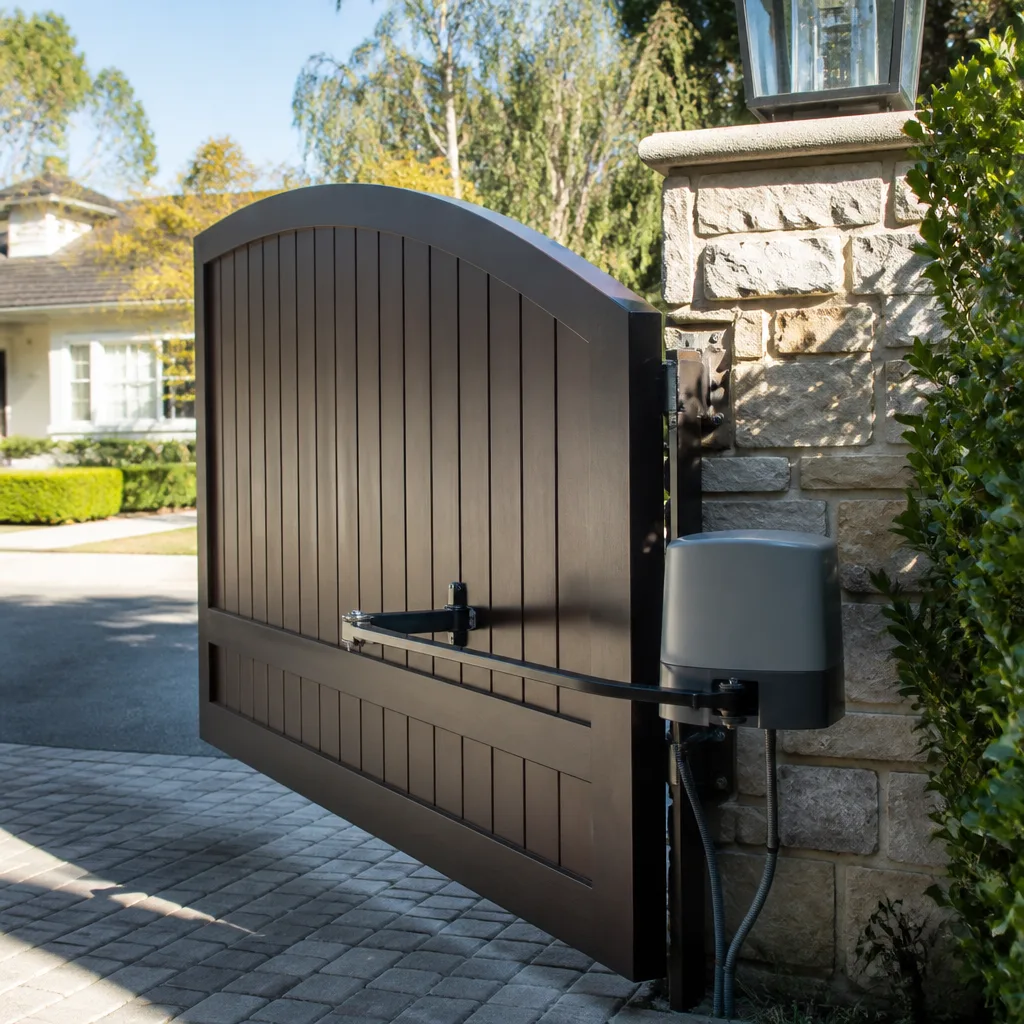
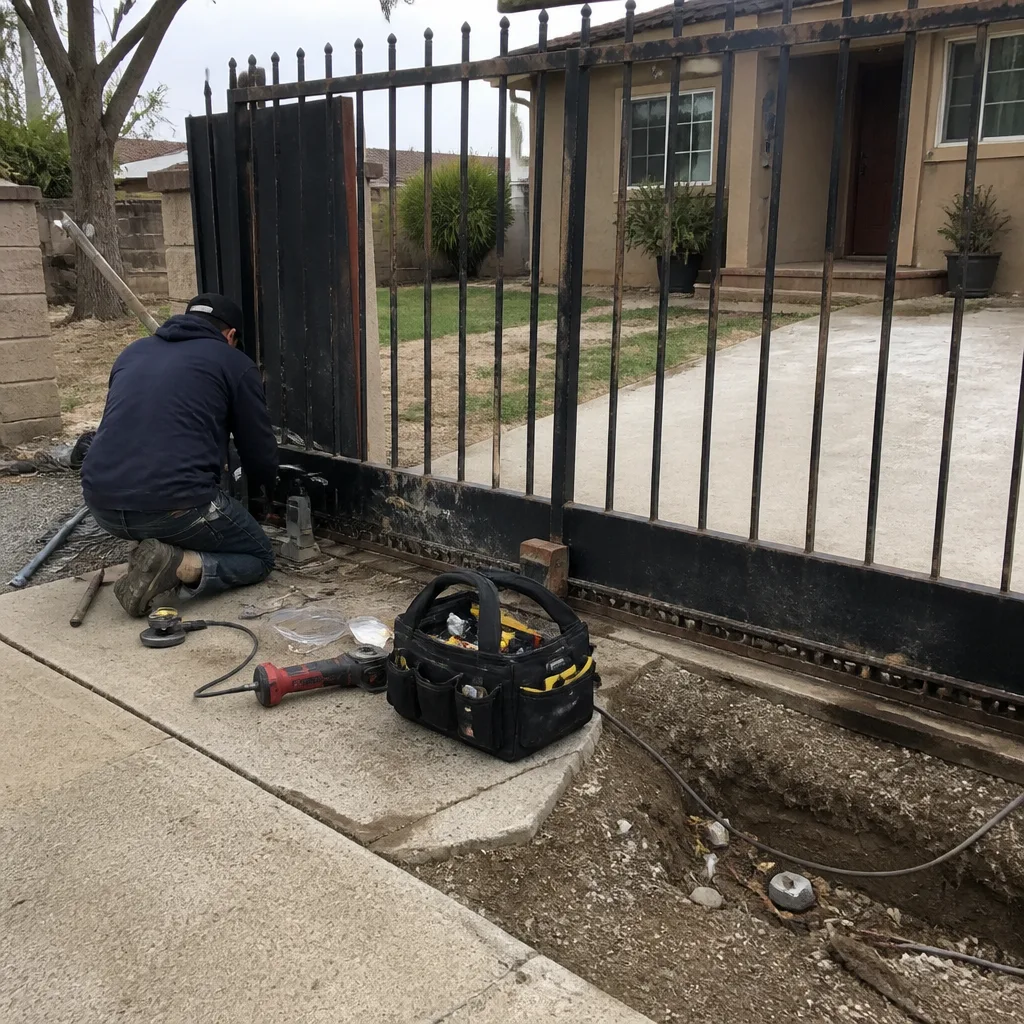 Before
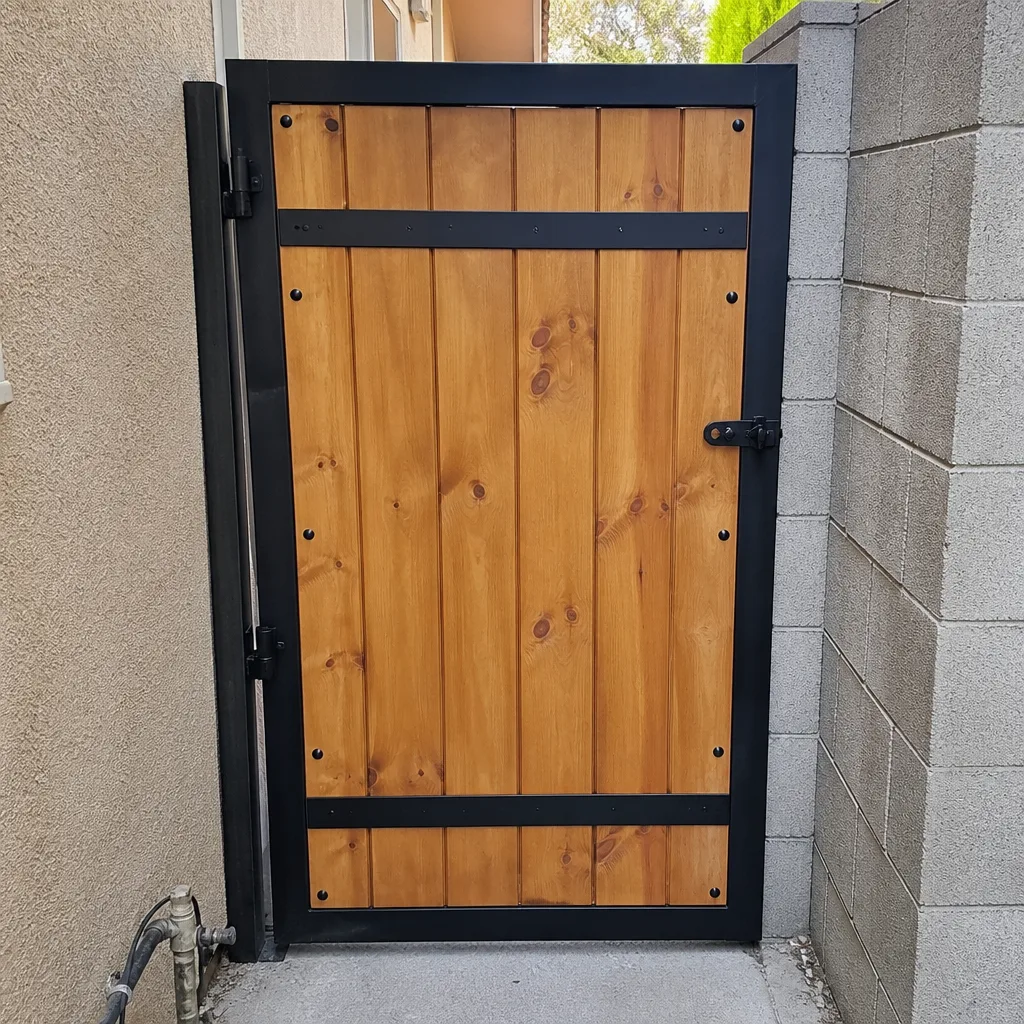 After
After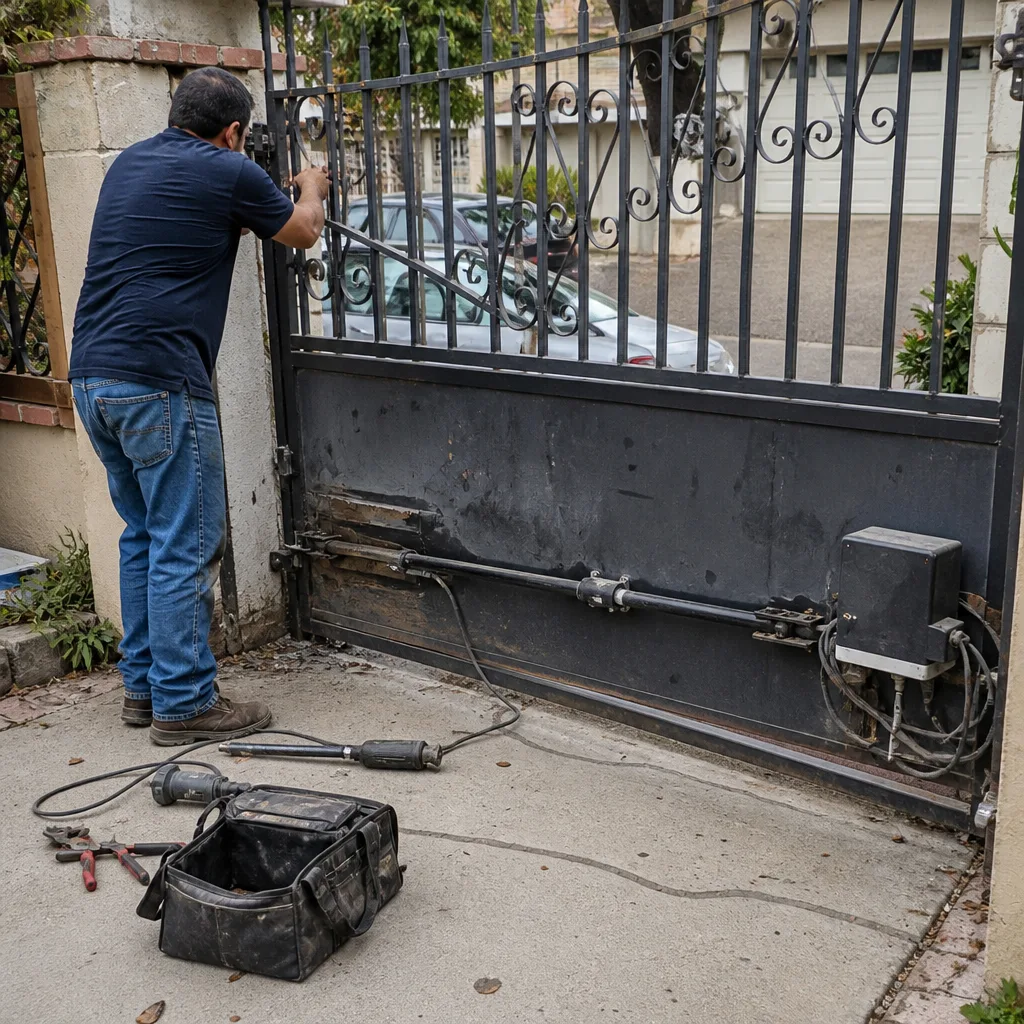 Before
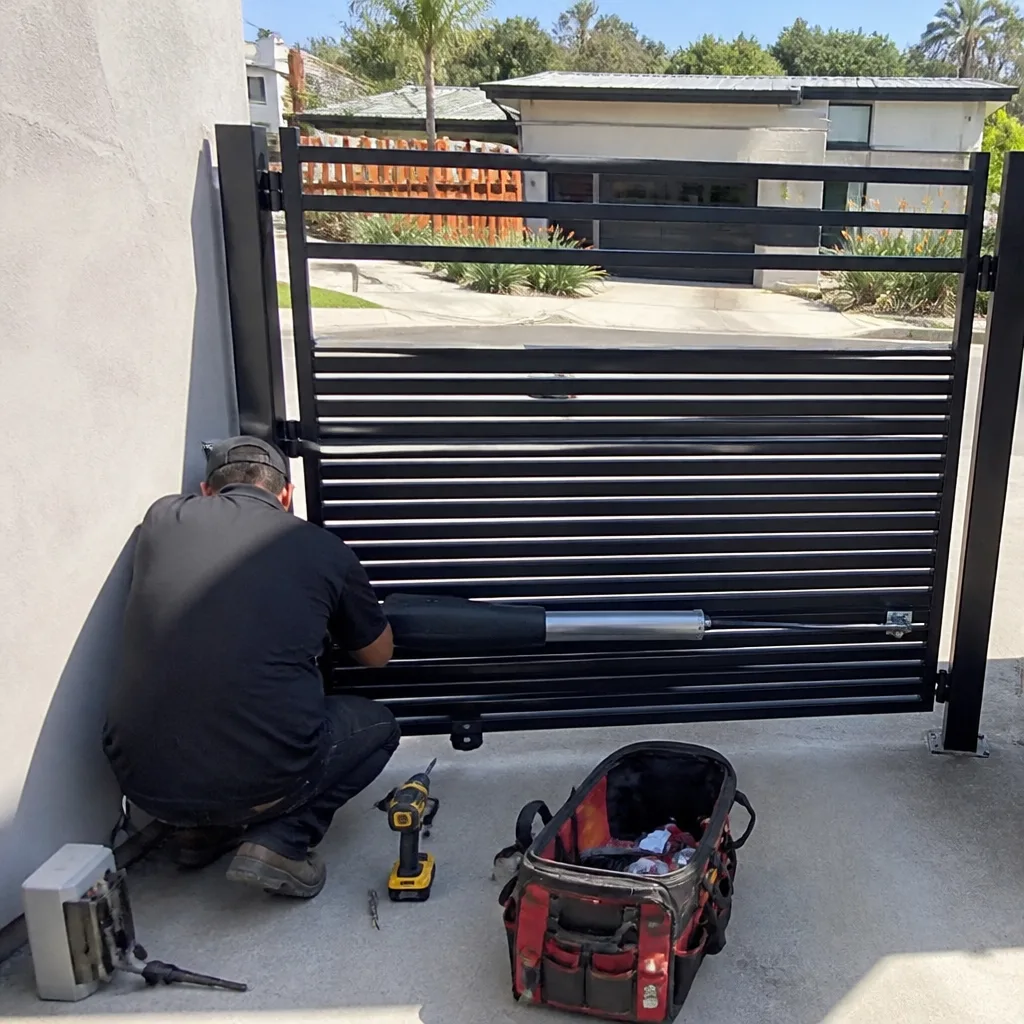 After
After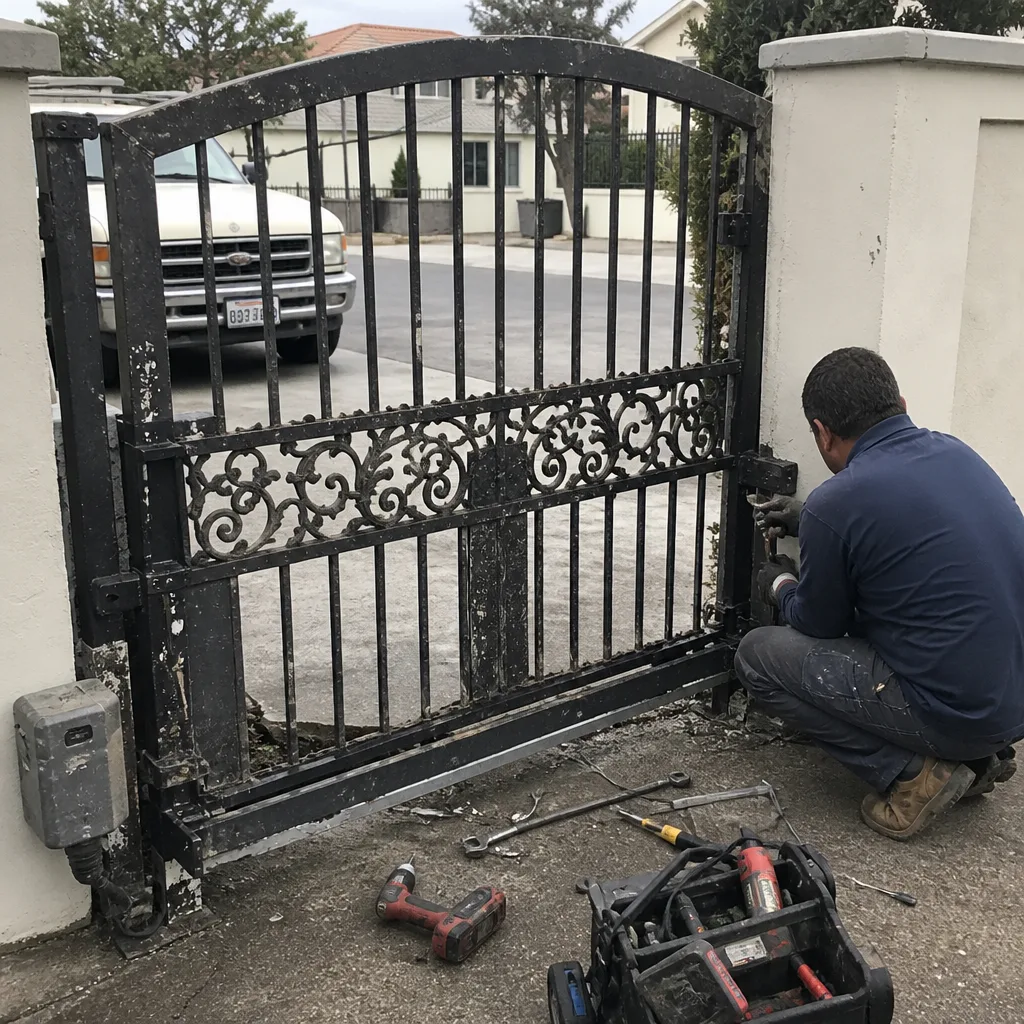 Before
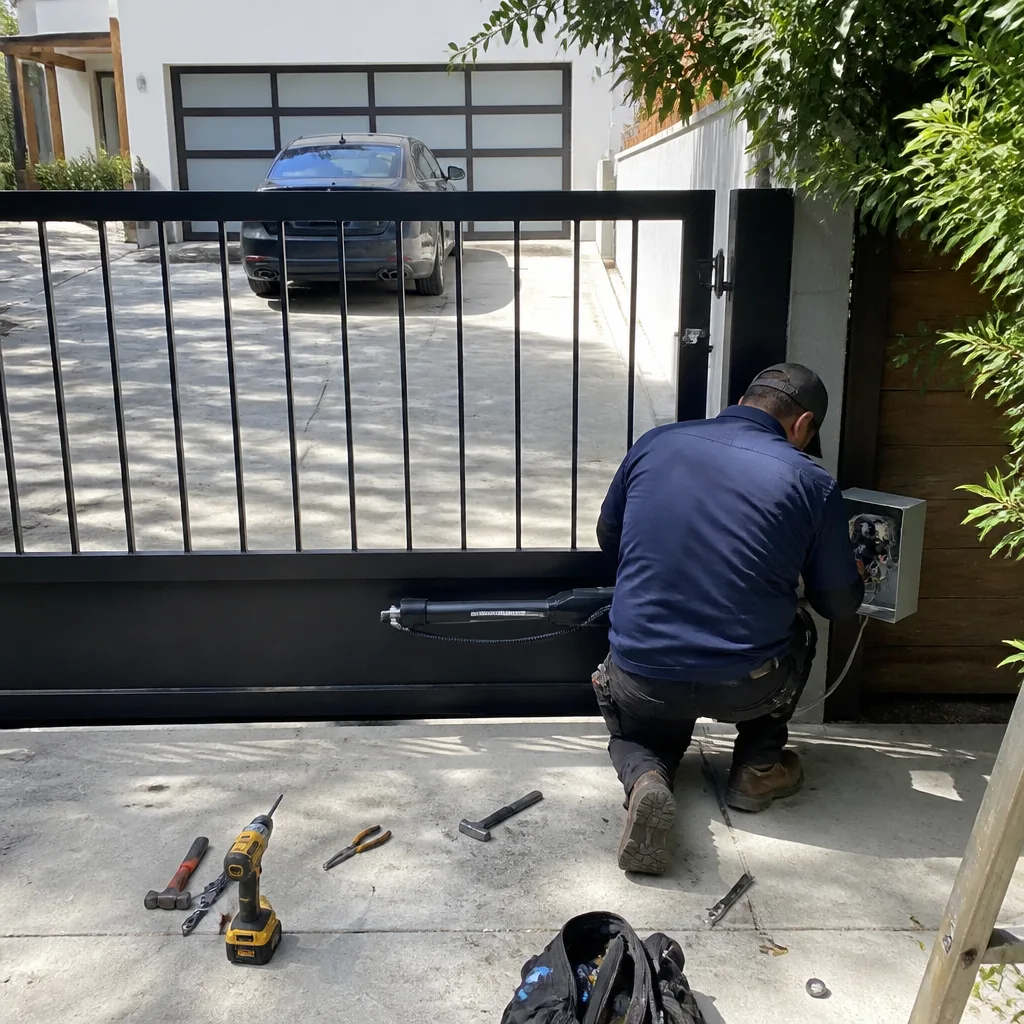 After
AfterGate Repair Warning Signs: A Los Angeles Homeowner’s Reference Guide
Most gates in Los Angeles don’t fail suddenly. They fail gradually, sending signals that homeowners misread or dismiss. A gate that hesitates for two seconds before moving isn’t “warming up” – it’s a motor drawing excess current to overcome mechanical resistance that will burn out the operator within 30 to 90 days. In our experience across Los Angeles neighborhoods from the Valley to the Westside, the average homeowner waits 47 days between first noticing a problem and calling for service. By then, a $180 roller fix has become a $1,400 motor replacement. This guide shows you exactly what to watch for, what each symptom means mechanically, and when to shut the system down before it becomes dangerous. For professional help, see our Gate Repair services.
Quick Answer
Gate repair warning signs fall into four categories: mechanical sounds (grinding, squealing, clicking), movement abnormalities (hesitation, uneven travel, drift), operator signals (beeping patterns, flashing lights, error codes), and safety system failures (sensor bypass, auto-reverse failure, brake slip). Catching these early in Los Angeles typically keeps repair costs between $180 and $520; ignoring them until complete failure usually pushes costs above $1,200 and may require full operator replacement. Read How Long Does Gate Motor Repair Take? Timelines and What to Expect to plan ahead.
Table of Contents
- Mechanical Sounds and What They Mean
- Movement Patterns That Predict Failure
- Operator Signals, Beeping, and Error Codes by Brand
- Safety Warning Signs Requiring Immediate Shutdown
- Why Intermittent Failures Cost More to Ignore Than Complete Failures
- Physical Inspection Points Homeowners Can Check Without Tools
- Los Angeles-Specific Factors That Accelerate Gate Wear
- Common Mistakes to Avoid
- When to Call a Professional
- Frequently Asked Questions
Mechanical Sounds and What They Mean
Every sound a gate makes is diagnostic data. The key is matching pitch, pattern, and timing to the underlying mechanical failure.
Grinding or Gritty Rumbling
This almost always indicates roller or wheel bearing failure on sliding gates, or hinge pin wear on swing gates. The grinding you hear is metal-on-metal contact where a bearing race has collapsed. On sliding gates common in hillside Los Angeles properties – think Mount Washington, Echo Park, or the Hollywood Hills – the bottom track collects grit from Santa Ana wind events and winter rain runoff. That grit accelerates roller wear. When the bearing fails, the roller wobbles, the gate panel torques, and the operator strains against uneven load.
What to check: Open the gate manually (disconnect the operator first using the release handle). Roll or swing it by hand. A healthy gate moves with steady resistance; a failing roller creates flat spots where movement catches or requires extra force.
High-Pitched Squealing or Whining
Squealing during operation points to inadequate lubrication on chain, belt, or rack-and-pinion drives. But pitch matters. A steady whine from the motor housing itself – not the drive mechanism – suggests the operator’s internal gearbox is overheating. This is common on older Mighty Mule and Elite operators installed during the 2008-2014 construction boom across the San Fernando Valley. Those units used nylon gearing that degrades in heat. Los Angeles summer temperatures in the Valley regularly hit 100°F, and operator housings in direct sun can exceed 140°F internal temperature.
Clicking or Ticking
Rhythmic clicking that matches gate travel speed usually means a chain or belt is riding over damaged sprocket teeth. Irregular clicking – random timing, varying intensity – often signals electrical arcing in the control board relay. Both will worsen. Chain skipping eventually throws the gate off track. Relay arcing carbonizes the board and can cascade into full electrical failure.
Thumping or Clunking
A single thump at start or stop indicates a loose drive arm or failing articulating arm bushing. Multiple thumps during travel suggest a bent track, damaged guide wheels, or – on cantilever systems – a counterweight that’s shifted. In Los Angeles, where clay soil expansion and contraction is severe in areas like Hancock Park and the Westside, foundation movement can throw cantilever gates out of alignment slowly, then suddenly.
| Sound | Most Likely Cause | Typical Repair Cost in Los Angeles | Timeline to Failure if Ignored |
|---|---|---|---|
| Grinding/rumbling | Roller bearing collapse or hinge pin wear | $180-$340 | 2-6 weeks |
| High-pitched whine | Dry chain/belt or gearbox overheating | $140-$280 (lube/service) or $680-$1,200 (gearbox) | 1-4 weeks |
| Rhythmic clicking | Chain over damaged sprocket | $220-$420 | 3-8 weeks |
| Irregular clicking | Control board relay arcing | $380-$720 (board replacement) | 1-3 weeks |
| Thump at start/stop | Loose drive arm or bushing failure | $160-$340 | 4-12 weeks |
| Multiple thumps during travel | Track misalignment or guide wheel damage | $280-$580 | 2-6 weeks |
Movement Patterns That Predict Failure
Sound is what you notice first. Movement pattern is what confirms the diagnosis. Watch your gate through three full cycles – open, close, open – and note any of these behaviors.
Hesitation at Start
The gate receives the open command, pauses one to three seconds, then jerks into motion. This is not normal. In a LiftMaster or FAAC system, that pause means the motor is drawing locked-rotor amperage – up to six times normal running current – to break static friction. The control board’s soft-start circuitry is being overridden by mechanical resistance. Do this repeatedly and the motor’s thermal overload will trip, or the start capacitor will fail. We’ve replaced more FAAC 746 operators in Los Angeles for this exact progression than for any other single failure mode. See How Long Does Gate Installation Take? Timelines and What to Expect if replacement becomes necessary.
Uneven Travel Speed
A gate that slows mid-travel, then speeds up, has a binding point in its mechanical path. On sliding gates, this is typically a dented track section, a roller with a flat spot, or debris accumulation. On swing gates, look for a settling post that’s tilted the hinge axis out of plumb. The operator compensates by varying torque, which overheats the motor and confuses the limit switch positioning.
Drift After Stopping
The gate reaches its programmed stop position, then rolls or swings another few inches. This indicates brake failure in the operator, or on swing gates, hydraulic fluid bypass in a ram-style closer. Drift is a safety hazard – the gate may not clear the vehicle path, or may close on a person after the “all clear” signal. Any gate that drifts more than six inches past its stop point should be taken out of service immediately.
Incomplete Travel
The gate opens or closes 80% of its range, then reverses or stops. This is often misdiagnosed as an obstruction sensor issue. But if the sensor test passes – nothing blocks the photo eye, and the loop detector shows no vehicle – the cause is usually mechanical overload. The operator hits its torque limit and reverses as programmed. The underlying problem is progressive: increasing friction from worn components, or a gate panel that’s become heavier due to water absorption (common with wooden gates in Los Angeles after winter rains) or added hardware.
Failure to Respond to Remote or Keypad
Intermittent response – works on the third try, or only from certain angles – is typically a radio frequency issue, antenna damage, or failing receiver. But if the gate responds to a wired wall button but not wireless devices, the problem is almost certainly the receiver board. In Los Angeles, where RF congestion from WiFi, cellular, and security systems is extreme, we’ve seen LiftMaster MyQ systems lose reliable range to less than 15 feet due to interference from neighboring mesh networks.
Operator Signals, Beeping, and Error Codes by Brand
Modern gate operators communicate through sound and light patterns. Learning to read them saves diagnostic time and prevents unnecessary service calls.
LiftMaster
LiftMaster operators use a two-digit LED display and audible beep patterns. A steady beep every 30 seconds with no gate movement indicates the entrapment protection system has triggered and latched – usually a photo eye misalignment or loop detector fault. Rapid beeping (four per second) during travel means the operator has hit its force limit and reversed; this is the “overload” warning. A flashing “01” code indicates a limit switch fault – the operator has lost track of gate position and needs relearned travel limits.
In Los Angeles, we see “02” errors frequently on older LiftMaster LA500 series units: this is a thermal overload from extended operation in high ambient temperature. The unit protects itself by shutting down until the motor cools. If your gate works fine at 7 AM but fails at 3 PM in August, this is likely the cause.
FAAC
FAAC operators use a combination of flashing green/red status LEDs and numerical error codes on the display. Code “E5” indicates excessive current draw – the motor is working harder than specification, almost always due to mechanical binding. Code “E8” is a limit switch error, similar to LiftMaster’s “01.” Code “E2” signals a safety device fault: photo eye, safety edge, or loop.
One FAAC-specific behavior: the 746 and 844 models will emit a brief chirp every two hours if the battery backup is depleted or the charging circuit has failed. Homeowners often mistake this for a smoke detector. If your FAAC chirps and the gate won’t operate during a power outage, the battery needs replacement – typically every 3-4 years in Los Angeles, where heat accelerates battery degradation.
Mighty Mule
Mighty Mule FM500 and MM560 series units use a simpler diagnostic system: a single status LED that changes color and flash pattern. Solid red means the control board has detected a safety circuit open – check photo eyes and edges. Flashing red indicates a motor overload or thermal trip. Flashing green-red alternation means the unit is in “learning mode” and hasn’t stored travel limits yet.
Mighty Mule units are particularly sensitive to voltage fluctuation. In neighborhoods like Silver Lake and Los Feliz where older electrical infrastructure sees brownouts during summer peak demand, we’ve seen repeated flashing red conditions that clear when voltage stabilizes. A whole-house surge protector at the gate circuit helps, but persistent issues warrant a technician check of the supply wiring.
Elite
Elite CSW and Robus series operators display numeric codes on a small LCD. Code “F1” is a force setting fault – the operator has adjusted its own force profile beyond safe parameters and needs recalibration. Code “F2” indicates a safety edge circuit fault. Code “F5” is a communication error between the control board and any networked accessories.
Elite units store a history of the last 50 operations with peak force readings. A technician with the diagnostic tool can pull this data and see exactly when force started climbing – often weeks before the owner noticed any problem. This is one reason we carry Elite diagnostic equipment on every Los Angeles service truck.
Safety Warning Signs Requiring Immediate Shutdown
Some symptoms don’t allow a “watch and wait” approach. These four conditions create genuine entrapment or crushing risk. If you observe any of them, stop using the gate immediately, disconnect power at the breaker if you can do so safely, and call for service.
- Gate drift with power off. Disconnect the operator using the manual release handle. If the gate moves on its own – even slowly – the mechanical brake has failed. Gravity or wind can move the gate unpredictably.
- Auto-reverse failure. Test monthly: place a solid object like a cardboard box in the gate path during closing. The gate must reverse on contact. If it continues pushing, the entrapment protection system has failed. This is federal safety standard UL 325 compliance; non-functional systems are hazardous and may create liability exposure.
- Photo eye bypass or constant illumination. The photo eye transmitter should show a steady beam indicator; the receiver should show alignment. If the receiver LED is dark, or if the gate operates despite a blocked beam, the safety circuit is compromised. In Los Angeles, we see this after landscaping work displaces the eye mount, or after vehicle impact to the post.
- Gate that “runs away” – continues moving after stop command. This indicates a stuck relay or control board logic fault. The gate may not stop at its programmed limit and can overtravel into the structure or vehicle.
Before the technician arrives: secure the area with cones or tape if the gate is in a shared driveway, post a “gate out of service” sign, and if the gate is open, do not attempt to hold it manually – a failed brake can release without warning.
Why Intermittent Failures Cost More to Ignore Than Complete Failures
This is the counterintuitive math that costs Los Angeles homeowners thousands.
An intermittent failure – works Monday, fails Tuesday, works Wednesday – creates diagnostic ambiguity. When you call for service on a fully failed gate, the technician arrives, observes the failure, identifies the cause, and repairs it. One trip, one diagnosis, one repair.
When you call for an intermittent failure, the technician may arrive to a gate that’s working fine. The diagnostic process then requires: testing components under load, reviewing operator history logs if available, checking connections for corrosion or looseness, and often scheduling a return visit to catch the failure in progress. Two trips. Extended labor. And if the intermittent condition has damaged multiple components – a failing relay that spiked voltage to the motor, for example – the repair scope expands.
Here’s the cost comparison we see in Los Angeles:
| Scenario | Typical Outcome | Typical Cost Range |
|---|---|---|
| Early intervention: roller noise, prompt call | Single roller replacement, track cleaning, lubrication | $180-$340 |
| Delayed: intermittent hesitation, eventual motor thermal failure | Motor replacement, possible control board damage from overload | $680-$1,400 |
| Ignored until complete failure: motor burnout, mechanical cascade damage | Full operator replacement, multiple mechanical components, possible gate panel repair | $1,800-$3,400 |
The 47-day average delay we mentioned earlier? It tracks almost linearly to cost escalation. Every two weeks of delay adds approximately $200-$400 to the eventual repair, based on our Los Angeles service data.
Physical Inspection Points Homeowners Can Check Without Tools
You don’t need a multimeter or torque wrench to gather useful diagnostic information. These checks take five minutes and tell you whether to schedule service or emergency service.
Rollers and Wheels (Sliding Gates)
Kneel at the gate’s trailing edge and push the panel side-to-side. There should be minimal play – less than a quarter-inch. Excessive lateral movement means the roller bearings are worn and the axle is wallowing in its housing. Look at the roller tread: flat spots, cracks, or embedded metal indicate replacement need. In Los Angeles, UV degradation cracks roller treads in 4-6 years if the gate faces south or west.
Hinges (Swing Gates)
Open the gate to 90 degrees and lift the free end vertically. Movement here indicates hinge pin wear or elongated bolt holes in the post plate. A swing gate that sags when open puts constant side load on the operator arm, accelerating bushing and gearbox wear.
Bottom Track and Guide Wheels (Sliding Gates)
Run a finger along the track surface. You should feel smooth steel, not ridges, dents, or rust scaling. Check that guide wheels (the small wheels that keep the gate upright) spin freely and aren’t cracked. In beach-adjacent Los Angeles neighborhoods – Marina del Rey, Playa del Rey, San Pedro – salt air corrosion attacks track and guide wheel hardware aggressively. We’ve replaced track sections in these areas with stainless or aluminum equivalents to break the replacement cycle.
Control Box and Weatherseals
Open the operator housing. Look for water staining, insect nests, or corrosion on terminal blocks. The gasket around the access cover should be intact and slightly compressible; if it’s hardened or missing, water intrusion during Los Angeles winter storms is likely. Check that conduit entries are sealed – rodents enter through gaps as small as a half-inch and can destroy wiring.
Photo Eye Alignment
Clean both lenses with a dry cloth. The transmitter LED should be steady; the receiver should show alignment confirmation. Gently wiggle each housing – if the indicator flickers, the mount is loose and will misalign in wind or from vibration.
Los Angeles-Specific Factors That Accelerate Gate Wear
Climate and code environment in Los Angeles create unique failure modes that gate owners elsewhere don’t see.
Santa Ana wind events. Sustained 40-60 mph winds with gusts above 80 create lateral loads on swing gates that exceed operator design limits. Gates with wind load sensors – more common on newer installations in exposed hillside areas – may refuse to operate during events. But older systems without this protection attempt operation and overload. We see a spike in motor and arm failures 24-72 hours after major Santa Ana events, typically in December through February.
Thermal cycling. Los Angeles sees 40°F morning lows and 85°F afternoon highs during spring and fall. Aluminum gate panels expand and contract significantly; steel frames less so. The differential stress fatigues weld joints and fastener connections. Check for cracked paint at welds – it’s often the first visible sign of fatigue.
Seismic activity. Even minor tremors shift post foundations, especially on hillside installations with limited embedment depth. After any noticeable shake, check that swing gate posts are still plumb and that sliding gate tracks haven’t developed new high or low points.
Water restrictions and landscaping changes. As Los Angeles homeowners replace lawns with hardscape or drought-tolerant plantings, drainage patterns change. Water that previously soaked into turf now runs toward foundations and gate posts. We’ve seen multiple cases of accelerated post rot in wood installations and concrete spalling at steel post bases where drainage was redirected. Explore our more guides & resources for additional maintenance tips.
Local code: Los Angeles Department of Building and Safety (LADBS) requirements. Gate installations in Los Angeles require permits for new construction and significant modifications. More relevant to repair: any safety system modification – replacing photo eyes, adding safety edges, updating control boards – must maintain UL 325 compliance. Non-compliant repairs can create liability issues and may be flagged during property sale inspections. Our technicians document UL 325 compliance on every safety-related repair.
Common Mistakes to Avoid
- Assuming hesitation is normal “warm-up.” Motors don’t warm up. Hesitation is excess current draw and measurable motor stress. The $180 fix becomes $1,200 because the delay feels acceptable.
- WD-40 as a lubricant. WD-40 is a solvent and water displacer, not a lubricant. It strips existing grease and attracts dust. On gate chains and open gears, use a lithium-based or synthetic gate lubricant. In Los Angeles dust conditions, we prefer dry-film lubricants that don’t collect particulate.
- Ignoring beeping because the gate still works. That beeping is the operator’s distress signal. By the time it becomes constant, the underlying fault has usually damaged a second component. Address the first signal.
- DIY spring or tension adjustments on swing gate closers. These are under significant stored energy. We’ve seen homeowners sustain facial injuries from released tension on heavy-duty gate closers. This work requires proper winding bars and technique.
- Clearing error codes without fixing the cause. Some operators allow code reset through button sequences. Resetting a force-limit error without finding the mechanical binding just sets up the next, more expensive failure.
- Waiting for “one more thing” before calling. The diagnostic cost math works against delay. Two symptoms means two potential interaction effects, which means longer diagnostic time. Call at the first reliable symptom.
When to Call a Professional
Call for same-day service when you observe any safety warning sign, any drift condition, or any failure of auto-reverse. Call for scheduled service within one week for new mechanical sounds, movement hesitation, or operator error codes that clear with reset but recur. Gate Repair in Los Angeles is our core service, and we stock parts for LiftMaster, FAAC, BFT, Linear, Viking, Ghost Controls, DoorKing, Elite, and Mighty Mule systems to complete most repairs in a single visit. Carver Gate Repair offers free estimates in Los Angeles – call (469) 530-2485. Every estimate includes a written price before any work starts, backed by our 365-Day Done Right Promise.
Frequently Asked Questions
Most residential gate repairs in Los Angeles fall between $180 and $680, depending on the component. Roller and hinge repairs typically run $180-$340. Control board replacement ranges $380-$720. Full operator replacement on a standard residential swing or slide gate runs $1,200-$2,400 including installation and programming. We provide a written price before any work starts, and estimates are free. Call (469) 530-2485 for exact pricing on your system.
You can safely clean photo eye lenses, clear track debris, and lubricate accessible chain or rack surfaces with proper gate lubricant. Do not attempt to adjust spring tension, modify safety settings, or open the operator control box. The high-voltage capacitors inside can retain charge even with power disconnected. If cleaning and lubrication don’t resolve the noise within two cycles, the cause is likely mechanical wear requiring professional diagnosis.
This pattern in Los Angeles almost always indicates thermal overload in the operator motor or control board. Morning cool allows normal operation; afternoon heat – especially in the San Fernando Valley or inland neighborhoods – pushes internal temperatures past the thermal protection threshold. The operator shuts down to prevent permanent damage. This is not a setting to override; it’s a symptom of either inadequate operator capacity for the gate weight, failing motor bearings creating excess heat, or blocked ventilation. A technician can distinguish these causes with a clamp meter and thermal gun.
For residential gates in Los Angeles, we recommend annual service including mechanical inspection, safety system testing, lubrication, and operator diagnostic scan. Gates in high-exposure locations – beach areas, hillside wind zones, or with heavy daily cycle counts – benefit from semi-annual service. Commercial or multi-family gates should be serviced quarterly per most insurance requirements. Regular service catches the warning signs this guide describes before they become failures.
Steady 30-second beeping on a LiftMaster operator indicates the entrapment protection system has detected a fault and latched into safe mode. Check photo eye alignment first – the transmitter and receiver LEDs should both be steady. If aligned, test the safety edge circuit if your gate has one. If both test clear, the fault is likely in the control board’s safety input circuit, which requires professional diagnosis. The gate will not operate reliably until the fault is cleared.
Yes. Hillside installations – Mount Washington, Echo Park, Laurel Canyon, Pacific Palisades, Bel Air – are common in our Los Angeles service area. These gates face unique loads from gravity on swing gates, drainage challenges for sliding gate tracks, and wind exposure. Our technicians carry specialized equipment for hillside access and are trained on the structural considerations these installations require. Gate Installation in Los Angeles includes hillside-specific engineering when replacement is needed.
The Bottom Line
Gate failures announce themselves. The two-second hesitation, the new grinding note, the afternoon thermal trip – these are not quirks to adapt to. They’re mechanical distress signals with predictable timelines to more expensive failure. The homeowner who learns to read these signs and acts within days, not weeks, controls both cost and safety. The homeowner who waits for complete failure pays for the delay in dollars and, potentially, in compromised security. In Los Angeles conditions – thermal stress, seismic risk, salt air in coastal zones – gates age faster than their inland counterparts. Regular observation and prompt response to warning signs are the difference between a $200 maintenance visit and a $2,000 system replacement.
For gate motor issues specifically, see our dedicated Gate Motor Repair in Los Angeles page. For new installations or full system replacement, our Gate Installation in Los Angeles team provides measured, written proposals with no pressure. Return to Carver Gate Repair home for all service information.
If you’ve noticed any warning sign described in this guide, call Carver Gate Repair at (469) 530-2485. A live person answers 24 hours a day. We’ll schedule a free estimate, provide a written price before any work begins, and back every repair with our 365-Day Done Right Promise. If it’s not done right, we make it right – no charge, no argument.
Written by Lonnie Burke, Owner at Carver Gate Repair, serving Los Angeles since 2008.