
Last updated October 10, 2026
Free on-site gate assessment - hinges, posts, and your LiftMaster or Nice gate operator checked before anything is quoted
The assessment is free and the quote is the invoice.


 Before
 After
After Before
 After
After Before
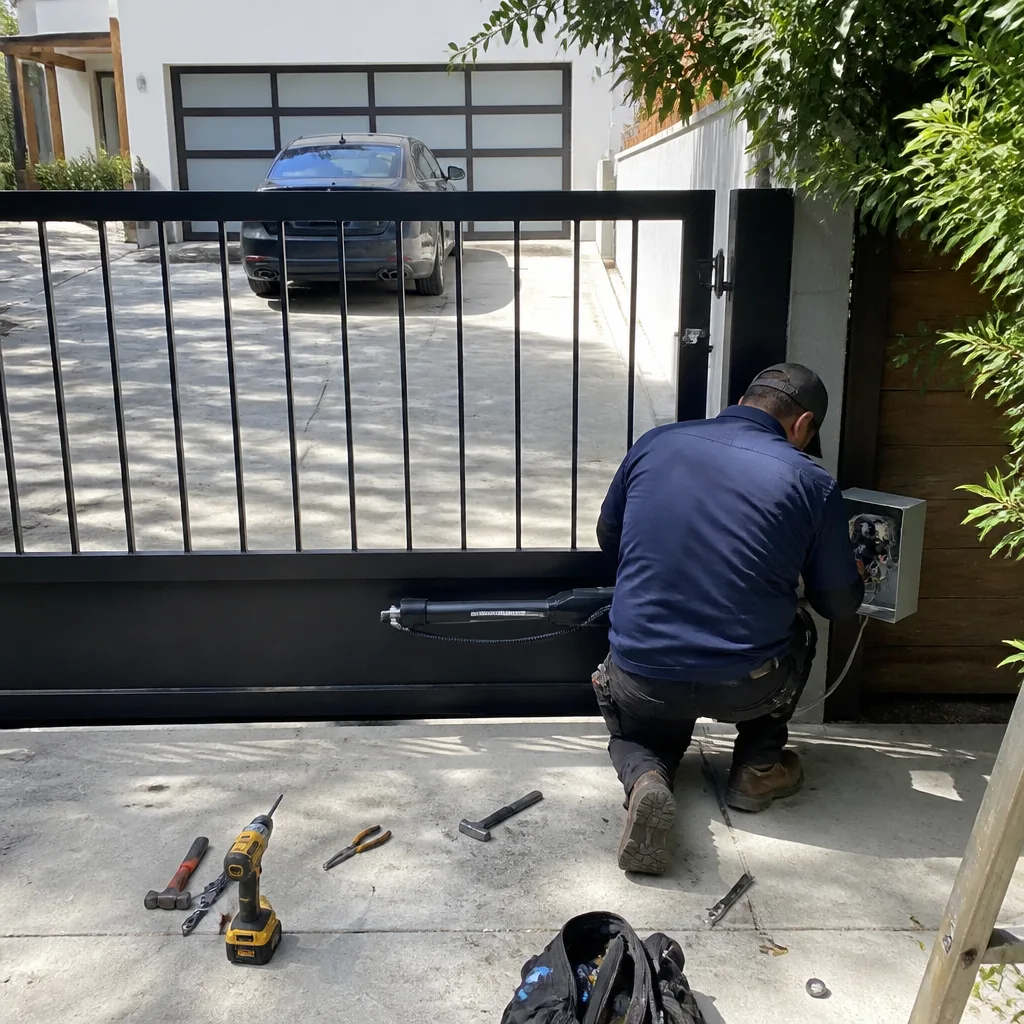 After
AfterGate Motor Repair Maintenance Schedule: What to Do and When
Most gate motor maintenance guides read like grocery lists – check this, clean that, call someone eventually. Here’s what they don’t tell you: lubricating a chain drive takes ten minutes and prevents the single most common cause of residential motor burnout, yet it’s the task most homeowners in Los Angeles have never performed because no one explained what actually happens when it’s skipped. The chain binds, the motor strains, the thermal overload trips repeatedly, and eventually the windings fail. A $12 tube of lubricant prevents a $900 motor replacement. This guide ranks every maintenance task by failure-prevention value, separates what you can do from what requires a technician, and gives you measurable standards instead of vague “inspect and clean” instructions. We wrote this for homeowners in Los Angeles who are tired of being handed checklists that don’t explain why anything matters.
Quick Answer
Gate motor maintenance breaks into three tiers: monthly tasks you can complete in ten minutes (visual inspection, chain lubrication, remote battery check), semi-annual tasks requiring basic tools and judgment (chain tension measurement, safety sensor alignment, battery backup testing), and annual technician-level inspections covering limit switch calibration, loop detector function, and gear wear assessment. In Los Angeles, add seasonal checks: post-rain sensor cleaning in February-March, summer heat venting inspection in July-August, and dry-season dust purging in October-November.
Table of Contents
- Why Most Maintenance Schedules Fail Homeowners
- Monthly Tasks: The High-Value Ten-Minute Routine
- Semi-Annual Tasks: Tools, Judgment, and Measurable Standards
- Annual Inspections: What a Technician Should Actually Check
- Battery Backup Maintenance: Lead-Acid vs. Lithium Timelines
- Los Angeles Seasonal Adjustments: Climate-Specific Maintenance
- Building a Maintenance Log for Warranty Protection
- Common Mistakes to Avoid
- When to Call a Professional
- Frequently Asked Questions
- The Bottom Line
Why Most Maintenance Schedules Fail Homeowners
The problem with standard gate motor maintenance guides isn’t that they’re wrong. It’s that they’re equally weighted. “Inspect chain” sits next to “check circuit board” as if both tasks prevent the same failures at the same rate. They don’t.
We’ve been repairing gate motors across Los Angeles since 2008, from Santa Monica to Pasadena to the Valley, and the failure data tells a clear story. If you’re already seeing symptoms, read our Gate Motor Repair Warning Signs Every Homeowner Should Know first. Chain-related problems account for roughly 40% of residential motor replacements. Safety sensor misalignment causes another 25% of service calls, though rarely motor damage. Everything else – limit switches, loop detectors, control boards, gearboxes – splits the remainder. Yet most guides devote equal space to all categories, which trains homeowners to treat a ten-minute chain lube with the same urgency as an annual gear inspection. The result: chains get ignored until they scream, and gears get over-inspected by anxious homeowners who should be watching their battery backup instead.
Our approach at Carver Gate Repair follows The Garrison Standard: rank tasks by failure-prevention value, assign clear ownership (homeowner vs. technician), and give measurable pass/fail criteria instead of “check and report” vagueness. The schedule below reflects what we’ve actually seen fail in the field – not what sounds comprehensive in a manual.
One more thing: your gate motor brand matters for maintenance specifics. A LiftMaster slide operator uses different chain specs than a Mighty Mule swing arm. A FAAC hydraulic system has no chain at all but demands different fluid checks. We work on nine brands daily – LiftMaster, FAAC, BFT, Linear, Viking, Ghost Controls, DoorKing, Elite, and Mighty Mule – and the schedule below notes where brand differences change the task.
Monthly Tasks: The High-Value Ten-Minute Routine
These three tasks prevent the majority of expensive failures. Do them. The rest of the schedule is secondary if these get skipped.
1. Chain or Belt Visual Inspection and Lubrication
Look at the chain or belt with the gate in the closed position. You’re checking for three things: rust on chain links, cracking on rubber belts, and visible slack that lets the chain droop more than one inch at midpoint. For chain drives, apply white lithium grease to the top surface of the chain while manually cycling the gate slowly. The chain should carry a thin, even film – not drip, not cake. For belt drives, no lubrication; just check for fraying or dry rot, especially on older LiftMaster units in Los Angeles where summer heat accelerates rubber degradation.
What happens when this gets skipped: the chain binds, the motor draws 30-50% more amperage, the thermal overload trips repeatedly, and the motor windings eventually fail from heat cycling. We’ve replaced motors in Brentwood and Silver Lake that had clean cabinets and perfect limit switches but destroyed windings from a dry, rusted chain that the homeowner never noticed.
2. Safety Sensor Beam Test
Place a solid object – a trash can works – in the gate path during closing. The gate should reverse immediately on contact with the infrared beam. Then test the mechanical edge if your gate has one: a light tap on the leading edge should trigger reversal. In Los Angeles, where dust and spider webs accumulate quickly during dry months, clean the sensor lenses with a dry cloth monthly. Even a thin film reduces beam strength enough to cause intermittent failures that frustrate everyone.
3. Remote Battery and Manual Release Check
Replace remote batteries before they weaken. A weak signal causes the homeowner to press the button twice, which confuses some control boards and causes erratic behavior. Test the manual release mechanism: disengage the motor, move the gate by hand, and re-engage. If the release lever sticks or the gate binds when manual, address it now – not during a power outage at 11 PM.
Semi-Annual Tasks: Tools, Judgment, and Measurable Standards
These tasks require a tape measure, basic hand tools, and the confidence to know when something is outside normal range. Schedule them for April and October in Los Angeles, aligning with seasonal transitions.
Chain Tension Measurement
This is the most under-taught maintenance task in residential gate service. Here’s the measurable standard: with the gate closed, press down on the chain at midpoint between the motor sprocket and the idler. The deflection should be 1/2 to 3/4 inch for typical residential slide gates, 1/4 to 1/2 inch for swing gate chains. More slack causes slap and sprocket wear; too tight overloads the motor bearings.
To adjust: loosen the idler bracket, move it to achieve proper tension, and retighten. On Mighty Mule swing operators, the tension bolt is typically accessible from the motor housing rear. On FAAC hydraulic units, there’s no chain – check the articulating arm pivot points for play instead. If you can wiggle the arm more than 1/8 inch at the pivot, the bushings need attention.
Safety Sensor Alignment Verification
Most photo eyes have LED indicators that show alignment status. But the real test is range: stand at the maximum specified distance (usually 30 feet for residential units) and break the beam with a 6-inch object. The gate should still reverse. In Los Angeles, where afternoon sun angles can blind sensors on west-facing installations, check alignment at the time of day when the gate is used most.
Battery Backup Load Test
Disconnect AC power and cycle the gate three times on battery alone. Note the gate speed on the third cycle. If it’s noticeably slower than the first, the battery capacity has degraded. More on battery-specific maintenance in the next section.
Control Cabinet Cleaning
Open the motor housing with power disconnected. Remove accumulated dust and spider webs with a dry brush – never compressed air, which can force debris into circuit board connectors. In Los Angeles, dust accumulation is severe from June through September; the October semi-annual check should show significant buildup if the cabinet seal is compromised.
Annual Inspections: What a Technician Should Actually Check
These tasks require specialized knowledge, calibration equipment, or safety training. Don’t attempt them yourself. Our Gate Motor Repair services cover these technician-level inspections. When you hire a technician, verify they’re checking these specific items – not just “servicing the motor.”
- Limit switch calibration. The limit switches tell the motor when to stop at fully open and fully closed positions. Drift causes over-travel, which strains mechanical stops and can bend gate frames. A technician should verify stop positions with a tape measure and adjust potentiometer settings to within 1/2 inch of specification. On newer LiftMaster and DoorKing units, this is digital; on older systems, it’s screwdriver-adjusted and prone to drift from vibration.
- Loop detector function and sensitivity. The in-ground loop that detects vehicles approaching or occupying the gate path must trigger consistently without false activation from adjacent metal. A technician should test with a metal plate of specified dimensions, verify hold time settings, and check for loop insulation damage that causes intermittent faults after rain – common in Los Angeles where clay soil shifts and abrades loop conduit.
- Gear wear assessment. Remove the gear housing cover and inspect the main reduction gear for tooth wear, cracking, or lubricant breakdown. On BFT and FAAC hydraulic systems, check the fluid level and condition; dark or metallic fluid indicates internal wear. On screw-driven Linear units, measure screw thread wear with a caliper – significant wear causes position drift that limit switches can’t compensate for.
- Electrical connection torque check. Vibration loosens terminal screws. A technician should torque all power and control connections to manufacturer specification, typically 12-15 in-lbs for control terminals, higher for power connections. Loose terminals cause arcing, heat damage, and intermittent operation that mimics control board failure.
- Gate balance and hardware inspection. The motor doesn’t operate in isolation. A technician should check gate wheels, track alignment, hinge wear, and overall balance. A gate that requires 15 pounds of force to move manually will eventually destroy any motor. In Los Angeles, where coastal salt air affects hardware in Marina del Rey and Redondo Beach, this inspection is especially critical.
At Gate Motor Repair in Los Angeles, our annual inspection follows this exact protocol. We provide a written report with measured values, not a checkbox form. If a technician can’t show you specific numbers, they didn’t inspect – they visited.
Battery Backup Maintenance: Lead-Acid vs. Lithium Timelines
Battery backup maintenance is where most homeowners and many technicians fail. The battery is out of sight, the gate works fine on AC power, and the failure only reveals itself during the outage when backup is actually needed. Here’s what the two battery types require, based on what we see in Los Angeles installations.
Lead-Acid Backup Batteries
These are still common in older Mighty Mule and some LiftMaster residential systems. They have a reliable failure timeline: 18 to 24 months in Los Angeles climate, shorter if the motor housing lacks ventilation and summer heat exceeds 120°F internal temperature. The maintenance task is simple but specific: check electrolyte level every six months if the battery has removable caps (many sealed units don’t), and replace at 24 months regardless of apparent function. A lead-acid battery can show full voltage at rest and collapse under load – the semi-annual three-cycle test catches this.
Signs of impending failure: the gate moves slower on battery from the first cycle, or the control board emits a low-battery chirp that persists after charging. Don’t ignore these warnings. A failed battery can also damage the charging circuit, turning a $75 battery replacement into a $400 control board repair.
Lithium Backup Batteries
Newer LiftMaster and some FAAC systems use lithium iron phosphate packs. They last 5 to 7 years and require essentially no maintenance – which creates its own problem. Homeowners forget they exist. The control board may not provide low-battery warning until capacity is critically degraded. Check the installation date; if it’s approaching five years, have a technician test capacity with a load tester. Lithium batteries fail more abruptly than lead-acid, giving less warning.
In Los Angeles, where PSPS (public safety power shutoff) events have become more frequent in fire-prone areas like the hills above Pasadena and the Santa Monica Mountains, backup battery reliability has moved from convenience to genuine security requirement. A gate that won’t open during an evacuation order is a serious problem.
Los Angeles Seasonal Adjustments: Climate-Specific Maintenance
Southern California’s climate creates specific maintenance timing that national guides miss entirely. Adapt your schedule to these local patterns.
February-March: Post-Rain Sensor Cleaning
Los Angeles receives the majority of annual rainfall between December and March. Rain carries dust and oils that film sensor lenses. It also displaces ground loops slightly in expansive clay soils common to the San Fernando Valley. After the last significant storm of the season, clean all photo eye lenses and test loop detector sensitivity. We’ve seen more false “gate won’t close” calls in March than any other month, almost always from rain-contaminated sensors or shifted loops.
July-August: Summer Heat Venting Inspection
Los Angeles summer temperatures routinely exceed 90°F, and motor housing internal temperatures can reach 140°F in direct sun. Check that ventilation slots are unobstructed by vegetation, dirt, or wasp nests. If your motor is in a metal enclosure with no shade, consider adding a ventilated hood – not for the motor’s comfort, but because sustained high temperatures degrade capacitor life and accelerate control board electrolytic capacitor failure. On south-facing installations in the Valley, this is critical.
October-November: Dry-Season Dust Purging
The Santa Ana wind season brings fine dust that infiltrates motor housings through every gasket gap. Before the winds peak, open the control cabinet (power disconnected) and remove accumulated dust with a vacuum and soft brush. Check gasket condition; cracked gaskets should be replaced. This is also the ideal time for the semi-annual tension and alignment checks, since you’ll be working on the system anyway.
Year-Round: Coastal Salt Air
For installations within two miles of the Pacific – Santa Monica, Venice, Marina del Rey, Redondo Beach, San Pedro – salt air accelerates corrosion on all metal components. Monthly chain lubrication is essential, not optional. Consider upgrading to stainless chain if replacement becomes necessary. Hardware should be inspected quarterly, not semi-annually, for rust formation.
Building a Maintenance Log for Warranty Protection
Here’s something almost no one tells you: when a motor fails under warranty, manufacturers routinely deny claims for “lack of maintenance.” The burden of proof is on you. A maintenance log transforms your claim from “trust me, I took care of it” to documented evidence.
Your log doesn’t need to be elaborate. A simple format:
- Date of service
- Task performed (specific: “chain lubricated with white lithium grease,” not “maintenance done”)
- Measurements taken (chain deflection: 5/8 inch; sensor range test: passed at 30 feet)
- Parts replaced (battery, date code, reason)
- Technician name and company (for professional service)
- Photo documentation (chain condition, sensor LED status, battery date label)
Store this digitally with date stamps. If you use Gate Installation in Los Angeles services and have a new system installed, request the initial commissioning measurements in writing. This establishes baseline values that make future deviation obvious.
For warranty claims, the log demonstrates due diligence. For your own planning, it reveals patterns: if you’re replacing batteries every 14 months instead of 24, something in the charging circuit or environment is wrong. Data turns maintenance from reactive chore into predictive tool.
Common Mistakes to Avoid
- Using WD-40 on chains. WD-40 is a solvent and light lubricant, not a chain lubricant. It displaces existing grease, evaporates within days, and leaves the chain drier than before. Use white lithium grease or manufacturer-specified chain lube only. We’ve replaced chains in Los Angeles homes where years of WD-40 use created a gummy, abrasive paste that accelerated sprocket wear.
- Ignoring the gate itself. A motor cannot overcome binding wheels, bent track, or corroded hinges. Homeowners who maintain the motor but neglect the gate structure experience repeated “motor failures” that are actually mechanical problems. The motor is only as healthy as the gate it moves.
- Testing safety features with body parts. Never use your hand or foot to test obstacle detection. Use a rigid object of known dimensions. A trash can, a piece of lumber, a cardboard box. Injuries from gate entrapment are serious and preventable.
- Assuming “quiet” means “fine.” A chain that has gone silent because it’s seized and the clutch is slipping is not healthy – it’s about to fail catastrophically. Normal chain operation produces light mechanical sound. Complete silence on a chain drive often indicates the clutch is doing all the work, which means the motor is effectively running unloaded while the gate doesn’t move.
- Skipping battery replacement on schedule. Waiting for total failure guarantees the battery will die during an outage or damage the charging circuit. Lead-acid at 24 months, lithium at 5-7 years, regardless of apparent condition. This is preventive, not reactive.
- Pressure-washing the motor housing. The high-pressure stream forces water past gaskets and into control boards. We’ve seen multiple control board replacements in Los Angeles after “spring cleaning” included aggressive washing of the gate system. Wipe exterior surfaces; never direct water at seams or ventilation openings.
- Adjusting limit switches without reference measurements. Randomly turning adjustment screws without knowing the correct open and close positions leads to over-travel, bent gates, and stripped mechanical stops. Mark current positions before any adjustment, and measure gate travel with a tape measure, not by eye.
When to Call a Professional
Call a technician when you encounter any of these: the motor hums but the gate doesn’t move (clutch or gear failure); the gate reverses randomly without obstruction (loop detector or control board fault); you smell electrical burning or see scorch marks; the manual release won’t disengage or re-engage; or any maintenance task requires working on energized electrical components. The 24-volt control circuit won’t kill you, but the 120-volt supply line can, and capacitor discharge can deliver serious shock even with power disconnected.
At Gate Repair in Los Angeles, Carver Gate Repair offers free estimates with written prices before any work starts. Our technicians are background-checked, uniformed, and trained on all nine major brands. We answer calls with a live person 24 hours a day, including weekends and holidays. If you’re unsure whether a task is within your capability, call (469) 530-2485 and we’ll walk through it – no charge for honest guidance on what’s safe to attempt yourself.
Frequently Asked Questions
Professional annual inspection and maintenance typically runs $180-$320 for a standard residential swing or slide gate motor, depending on access difficulty and whether the system includes battery backup or loop detectors. Chain lubrication and sensor cleaning you can perform yourself for under $20 in supplies. We provide written prices before any work starts at Carver Gate Repair – call (469) 530-2485 for an exact quote on your system.
No. Monthly and semi-annual tasks are within capable homeowner scope if you follow measurable standards. Annual inspections require technician expertise for limit switch calibration, loop detector testing, gear wear assessment, and electrical torque verification. Attempting these without training risks personal injury, equipment damage, and warranty voidance. The Garrison Standard separates homeowner tasks from technician tasks precisely so you know where the line is.
Replace lead-acid backup batteries every 18-24 months regardless of apparent function; Los Angeles summer heat accelerates degradation, so lean toward 18 months for unshaded installations. Lithium batteries last 5-7 years but should be capacity-tested at year five. The semi-annual three-cycle load test reveals degradation before total failure. If your gate slows noticeably on battery power by the third cycle, replace the battery even if it’s within the nominal timeframe.
West-facing photo eye sensors can be blinded by direct afternoon sun, especially in Los Angeles where solar angles are low in winter. The sensor LED may show normal alignment but insufficient signal strength. Solutions include sensor hoods, repositioning, or upgrading to sunlight-immune models. This is a common call we receive in hillside installations above Sunset Boulevard and in the Hollywood Hills where afternoon sun exposure is severe.
Running a dry chain until the motor fails. A $12 tube of white lithium grease, applied for ten minutes twice yearly, prevents the chain binding that destroys motor windings. The replacement cost – motor, labor, possible control board damage from repeated overload – typically exceeds $900. No other skipped maintenance task has this cost-prevention ratio. Yet it’s the most commonly neglected task because the chain is out of sight and the failure mode is gradual enough to ignore until it’s catastrophic.
Yes. Our technicians are trained and carry parts for LiftMaster, FAAC, BFT, Linear, Viking, Ghost Controls, DoorKing, Elite, and Mighty Mule systems. Brand-specific knowledge matters because chain tension specs, limit switch adjustment procedures, and diagnostic codes vary significantly. A technician familiar only with one brand may misdiagnose problems on another. We match the technician to your installed equipment. Call (469) 530-2485 to schedule service with a technician qualified for your specific motor.
The Bottom Line
Effective gate motor maintenance isn’t about completing every possible task. It’s about completing the right tasks at the right frequency with measurable standards. Explore more guides & resources on our blog for related maintenance topics. The ten-minute monthly routine – chain lube, sensor test, remote check – prevents more failures than all other tasks combined. Semi-annual tension measurement and battery testing catch degradation before it becomes failure. Annual technician inspection addresses the complex systems that require calibration equipment and trained judgment. In Los Angeles, adapt this schedule to local climate: post-rain sensor cleaning, summer heat venting checks, dry-season dust removal, and coastal corrosion vigilance. Document everything in a maintenance log. And when a task exceeds your capability or comfort, call a technician who provides written prices, specific measurements, and stands behind the work with a real guarantee.
Written by Lonnie Burke, Owner at Carver Gate Repair, serving Los Angeles since 2008.