
Last updated October 10, 2026
Free on-site gate assessment - hinges, posts, and your LiftMaster or Nice gate operator checked before anything is quoted
The assessment is free and the quote is the invoice.
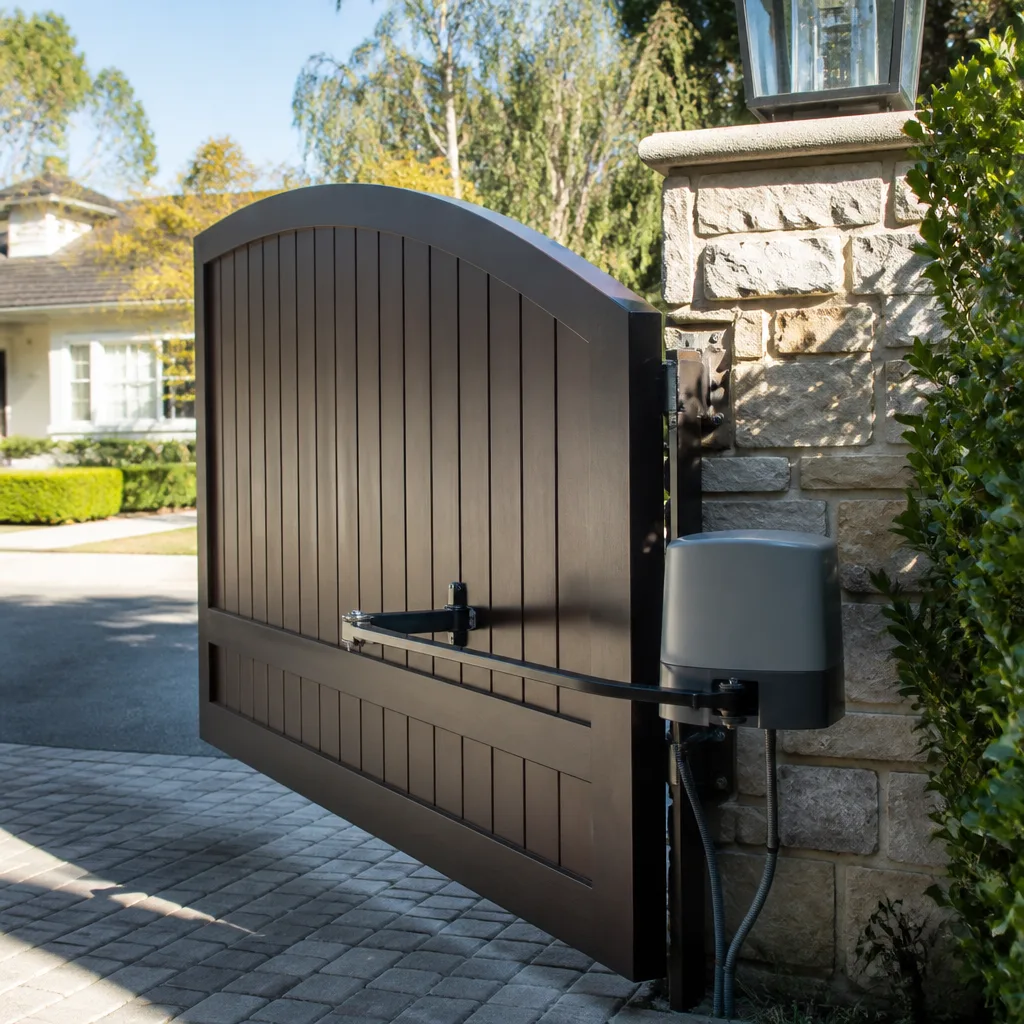
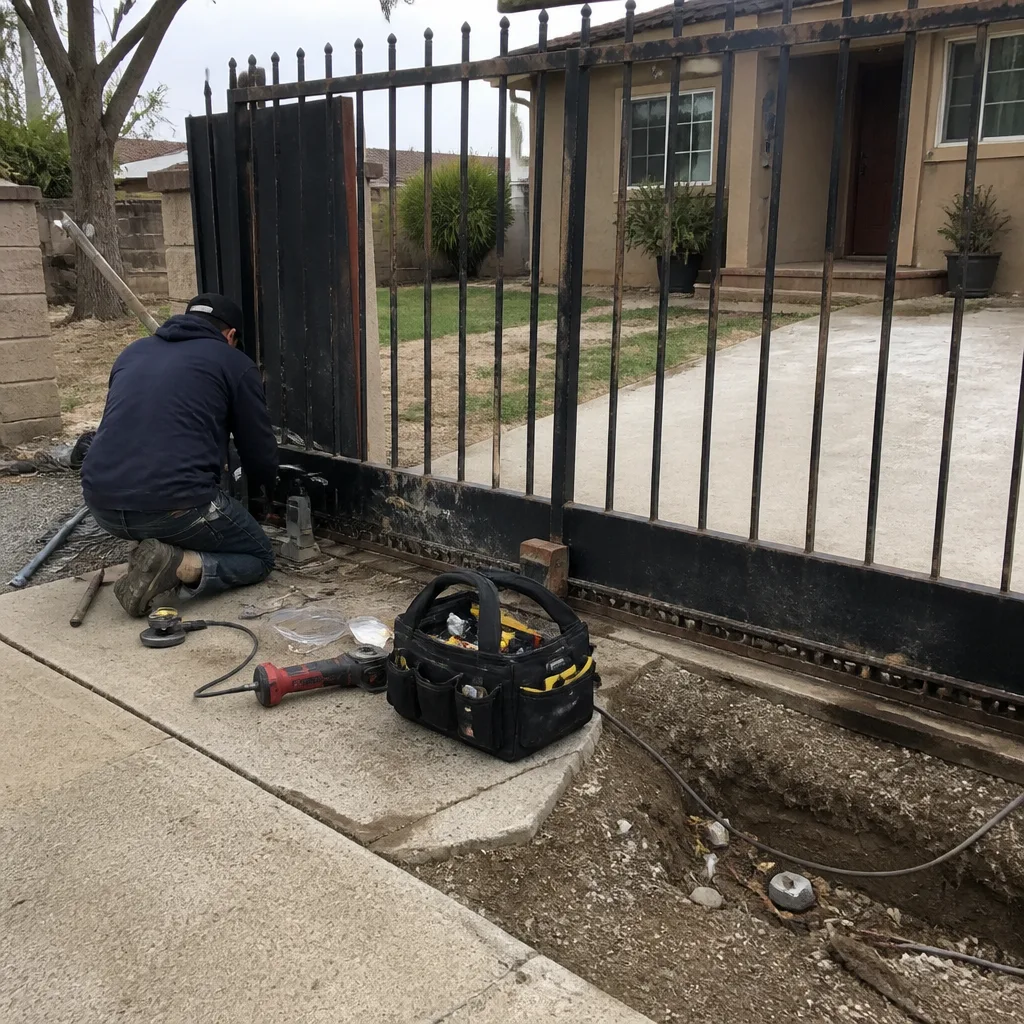 Before
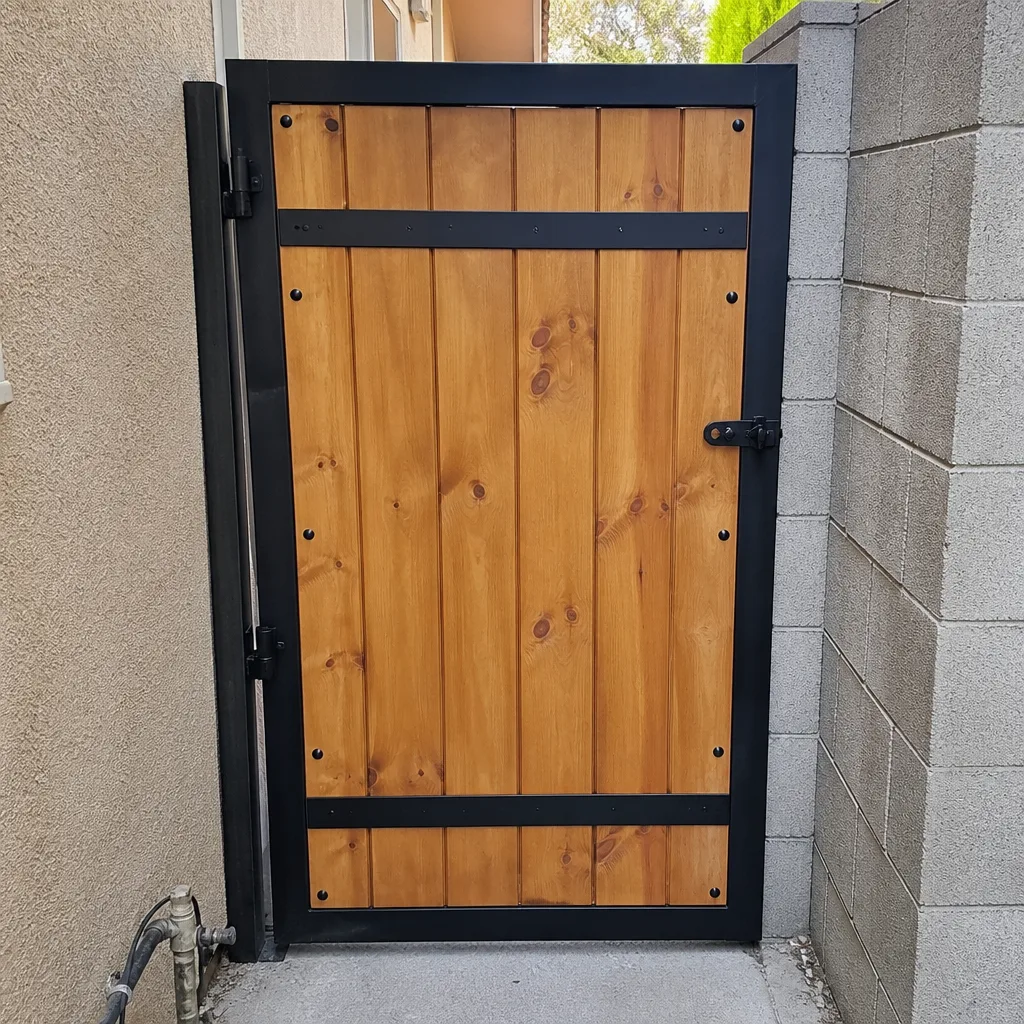 After
After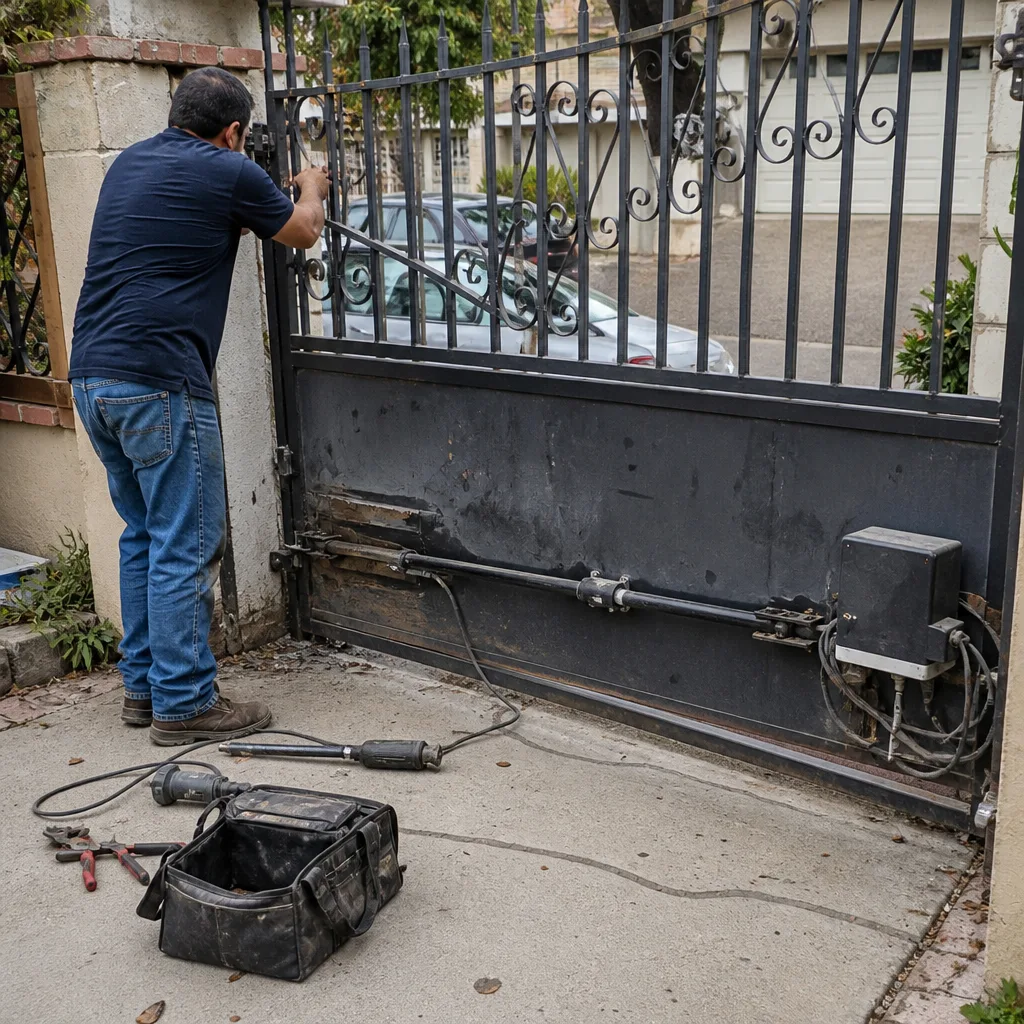 Before
 After
After Before
 After
AfterGate Motor Repair Warning Signs Every Homeowner Should Know
A gate that hesitates for two seconds before moving isn’t “warming up.” That hesitation is a capacitor losing its ability to deliver starting torque, and it means the motor will eventually refuse to start entirely. In Los Angeles, where driveway gates are standard security equipment from Bel Air to the Valley, most gate motors send mechanical distress signals for weeks before they fail completely. Homeowners simply learn to live with the quirks. This guide names each warning sign, maps it to the specific component that’s failing, and shows you how to distinguish a 30-day concern from a same-day emergency-alongside our Gate Repair Emergency Preparedness Guide for Los Angeles Homes.
Quick Answer
The eight most common gate motor warning signs are: hesitation on startup, reversing without obstruction, grinding during direction change, slow cycle speed, shrinking remote range, blinking error codes, stopping at partial open, and continuous running. Each points to a specific failing component – capacitor, safety sensor, gear assembly, motor windings, receiver board, limit switch, or control logic. Catching these early typically saves $200 – $600 versus a full motor replacement after catastrophic failure, as detailed in our Gate Repair Cost Breakdown: The Los Angeles Homeowner’s Reference for 2026.
Table of Contents
- Hesitation on Startup: The Capacitor’s Death Rattle
- Reversing Without Obstruction: When Safety Sensors Lie
- Grinding on Direction Change: Gear Wear You Can Hear
- Slow Cycle Speed: The Most Missed Warning Sign
- Remote Range Reduction: Receiver Board Degradation
- Blinking Error Codes: What the Light Pattern Means
- Partial Open Stopping: Limit Switch Drift
- Running Continuously: Control Logic Failure
- The Urgency Timeline: 30-Day, 90-Day, and Immediate Risk
- The 90-Second Weekly Observation Protocol
- Weather-Specific Warning Signs in Los Angeles
- Common Mistakes to Avoid
- When to Call a Professional
- Frequently Asked Questions
Hesitation on Startup: The Capacitor’s Death Rattle
That two-second pause between your remote click and the gate’s first movement? It’s the single most common early warning we see on service calls across Los Angeles. The start capacitor stores the electrical burst that overcomes inertia and gets the motor turning. When it degrades, the motor strains against a load it can’t immediately move.
Here’s what happens mechanically. The capacitor acts like a battery for torque. A healthy capacitor dumps its charge in a fraction of a second. A failing one dribbles current, so the motor hums, stalls, or starts with a lurch after a noticeable delay. In hot Los Angeles garages and gate housings, capacitor electrolyte dries out faster than in cooler climates. We’ve replaced capacitors in Woodland Hills that tested at 40% of rated capacity after just six years of Valley heat.
The danger isn’t the hesitation itself. It’s what follows. The motor draws excess amperage during those stalled seconds, overheating windings and accelerating wear on the entire drive system. A $180 capacitor replacement becomes a $1,200 motor and gearbox rebuild.
What to check:
- Time the delay from remote press to gate movement. Under one second is normal. Two to four seconds is failing. Five or more is imminent failure.
- Listen for a low hum before movement starts. That’s the motor energized but not turning, the classic capacitor-failure sound.
- Check if hesitation worsens on hot afternoons. Heat expands the symptom, confirming thermal degradation.
This is a 30-day urgency Gate Motor Repair services call. The gate still functions, but every start cycle causes cumulative damage.
Reversing Without Obstruction: When Safety Sensors Lie
Your gate reaches three-quarters open, stops, and returns to closed. No car, person, or object blocks the path. The safety sensor system has developed a false positive, and the motor is doing exactly what it’s programmed to do – retreat from perceived danger.
Photoelectric sensors (the through-beam pairs mounted on gate posts) and loop detectors (the wire embedded in the driveway) both degrade. In Los Angeles, where Santa Ana winds carry fine dust and construction debris, sensor lenses cloud and loop connections corrode. A partially blocked beam reads as interruption. A loop with compromised insulation triggers randomly when moisture shifts the capacitance.
The critical distinction: intermittent reversing versus consistent reversing at the same position. Intermittent suggests environmental interference or loose wiring. Consistent at a specific point suggests mechanical misalignment or a damaged sensor housing.
We’ve traced “ghost” reversals in Pacific Palisades to salt air corrosion of loop detector terminals, and in downtown-adjacent neighborhoods to vibration-loosened photoelectric mounts from heavy truck traffic. The motor itself is usually healthy; it’s responding correctly to bad data.
Diagnostic steps:
- Clean sensor lenses with a dry microfiber cloth. Even a spiderweb can break the beam.
- Check for physical movement in sensor housings. A mount shifted 1/8 inch can misalign the beam at gate extremes.
- Test in direct sunlight versus shade. Some older photoelectric sets are blinded by low-angle sun, common in Los Angeles winter mornings.
- Observe if reversal correlates with sprinkler cycles or recent rain. Moisture intrusion into loop connections is a frequent culprit.
This ranges from 30-day to 90-day urgency depending on frequency. A gate that reverses once weekly is annoying. One that reverses three times daily is unreliable enough to strand you or leave property exposed.
Grinding on Direction Change: Gear Wear You Can Hear
The sharp grinding noise when your gate transitions from opening to closing, or when it seats against the stop, isn’t normal mechanical sound. It’s metal-on-metal contact where lubricated meshing should occur. In sliding gate operators, it’s typically the rack-and-pinion or chain drive. In swing operators, it’s the worm gear or articulating arm pivot.
Gear lubrication breaks down. In Los Angeles, where summer temperatures in exposed gate housings routinely exceed 140°F, grease separates and runs off vertical surfaces. Dust from nearby construction or landscaping abrasion contaminates what’s left, creating grinding paste instead of protective film.
The sound location matters enormously. Grinding at the motor housing points to internal gearbox wear. Grinding at the gate arm or track points to external hardware. We’ve opened FAAC and BFT operators in the Hollywood Hills where the bronze worm gear had worn to sharp ridges, and the only solution was full gearbox replacement. Caught six months earlier, a lubrication service would have prevented it.
What the grinding tells you:
- High-pitched squeal on direction change: dry bearings or inadequate grease on the output shaft.
- Deep rumbling grind: actual gear tooth damage, often from operating with degraded lubrication for months.
- Metallic click at full open or close: limit cam or mechanical stop wear, less urgent but worth addressing before it becomes a misalignment issue.
This is immediate to 30-day urgency. Grinding means material is being removed with every cycle. The gear that exists today is the most gear you’ll ever have.
Slow Cycle Speed: The Most Missed Warning Sign
Of all the warning signs we document, slow cycle speed is the one homeowners accommodate longest. The gate still opens. It still closes. It just takes twelve seconds instead of eight. Most people adjust their timing – start the car after pressing the remote, wait a beat before pulling through – and never consider that the motor is failing under load.
Cycle speed is determined by motor torque output and control board programming. When speed drops without programming changes, the motor is losing torque. Causes include degraded windings (from the capacitor-failure overheating we described earlier), failing Hall effect sensors that govern speed feedback, or increased mechanical resistance from dry bearings and track contamination.
The insidious part: slower speed feels like reduced convenience, not impending failure. But the motor is drawing more current for longer periods to complete each cycle. Thermal overload protectors trip more frequently. In Los Angeles, where many gates cycle twenty to thirty times daily for multi-tenant driveways, that accumulated stress converts a repairable motor into a replacement.
We measure cycle speed on every service call. A gate that left the factory at 12 inches per second and now moves at 8 inches per second has lost one-third of its effective capacity. That margin is gone. The next resistance increase – temperature, debris, slight track misalignment – pushes it over the edge.
Benchmark your gate:
- Time a complete open-close cycle with a stopwatch.
- Compare to the manufacturer’s spec, usually printed on the operator housing or manual.
- Repeat the timing monthly. A 10% slowdown in one month is urgent. A gradual 20% slowdown over two years still warrants inspection.
This is 90-day urgency if the gate still completes cycles reliably, 30-day if thermal trips are increasing.
Remote Range Reduction: Receiver Board Degradation
You used to open the gate from fifty feet down the street. Now you need to be at the bumper, window down, remote extended. The transmitter battery is the obvious first check, but if fresh batteries don’t restore range, the receiver board in the motor housing is degrading.
Receiver sensitivity drifts with age, temperature cycling, and voltage fluctuation. In Los Angeles, where utility voltage can sag during peak summer demand, receiver boards operating at marginal voltage accumulate capacitor and crystal oscillator degradation. The board still functions at close range where signal strength overcomes reduced sensitivity. At distance, the weakened signal falls below the degraded detection threshold.
We’ve also seen range reduction from RF interference. New construction with extensive LED lighting, solar inverter installations, and even electric vehicle chargers can raise the noise floor in the 300-400 MHz band used by many gate remotes. The receiver isn’t broken; it’s being shouted over. But distinguishing interference from genuine receiver failure requires spectrum analysis most homeowners don’t have access to.
Quick isolation test:
- Test range at different times of day. Interference often correlates with solar production hours or evening lighting activation.
- Test with a second known-good remote. Eliminates transmitter variables.
- Stand directly beside the operator and test. If even close-range operation is intermittent, the receiver board needs replacement, not just adjustment.
This is 90-day urgency for single-family homes, 30-day for multi-tenant properties where range reduction causes traffic backup.
Blinking Error Codes: What the Light Pattern Means
Most modern gate operators – LiftMaster, Linear, and others – flash diagnostic codes through an LED on the control board. One flash, two flashes, steady on: each pattern maps to a specific fault condition. Homeowners rarely consult the manual until the gate stops entirely, but these codes are the motor’s most explicit distress signal.
Common patterns and their meaning:
- One flash: Safety sensor obstruction or misalignment. The gate thinks something blocks the path.
- Two flashes: Limit switch error. The gate doesn’t know where open and closed positions are.
- Three flashes: Mechanical obstruction or binding. The motor detects excess load.
- Four flashes: Motor thermal overload. The unit has overheated and shut down protectively.
- Five flashes: Control board or power supply fault. Internal electronics failure.
- Steady light, no operation: Power present but logic frozen, often from voltage spike or failed component.
In Los Angeles, where power quality varies by neighborhood and microgrid, we see voltage-spike damage after transformer events or construction backfeed. A gate in Venice Beach, three blocks from a major commercial corridor, experienced repeated five-flash errors until we traced intermittent neutral connection in the service panel.
The key is documenting the pattern before resetting. Most homeowners cycle power, which clears the code but erases the diagnostic. Photograph the flashing pattern, note the frequency, and check the manual. That information directs the repair before the technician arrives.
Error codes are 30-day urgency minimum. They’re explicit failure notifications, not suggestions.
Partial Open Stopping: Limit Switch Drift
The gate opens eighteen inches and stops. Or it opens fully but closes to eighteen inches and reverses. The limit switches – mechanical cams or magnetic sensors that tell the control board where the gate is – have drifted from their set positions.
Limit switches require physical calibration. On rack-and-pinion sliding gates, the cam rotates with the drive gear, triggering at set revolutions. On swing gates, magnetic or mechanical switches engage at arm angle extremes. Vibration, temperature expansion and contraction, and accumulated cycle wear all shift these relationships.
In Los Angeles, where clay soils in the hills shift seasonally and concrete pads settle, we’ve seen gate posts move enough to change the mechanical relationship between gate and operator without the limit switches themselves failing. The switch triggers correctly for a gate position that is no longer fully open or closed.
Partial open stopping is often intermittent early on. The gate reaches full open on the third try, or closing works fine in cool morning temperatures but fails in afternoon heat expansion. These patterns help diagnose whether the issue is switch drift (consistent) or mechanical binding (temperature or load dependent).
This is 30-day urgency. A gate that stops partial open is a security and safety liability. It may also damage itself if repeatedly cycled against the fault.
Running Continuously: Control Logic Failure
The motor runs after the gate is fully open. Or it runs after fully closed, straining against the mechanical stop. The control board has lost the feedback loop that says “stop, we’re here.” This is the most immediately damaging failure mode.
Continuous running overheats the motor, strips gears if mechanical limits are exceeded, and in extreme cases causes fire risk from sustained high current draw. The causes include failed limit switches (the board never gets the stop signal), welded relay contacts on the control board (the board sends stop but the relay stays closed), or corrupted logic from voltage spike or moisture intrusion.
In Los Angeles, we’ve traced continuous running to failed sealant on operator housings after rare heavy rains, allowing moisture into the control compartment. The Garrison Standard requires housing seal inspection on every service call for exactly this reason.
If your gate motor runs continuously, disconnect power at the breaker immediately. This is same-day emergency repair. The damage compounds with every minute of operation.
The Urgency Timeline: 30-Day, 90-Day, and Immediate Risk
Not every warning sign demands emergency response. Prioritizing correctly saves money and prevents the panic that leads to poor contractor selection.
Immediate failure risk – same-day repair:
- Continuous running with gate at limit
- Grinding with visible sparking or smoke
- Complete refusal to start with electrical burning smell
- Gate moving uncommanded (safety hazard)
30-day urgency – schedule within two weeks:
- Hesitation on startup (capacitor degradation)
- Consistent reversing without obstruction
- Blinking error codes (any pattern)
- Partial open stopping
- Grinding at direction change without sparking
90-day urgency – monitor and plan:
- Slow cycle speed without thermal trips
- Remote range reduction with close-range function intact
- Intermittent reversing (less than weekly)
- Metallic click at limits without other symptoms
The 30-day category is where most homeowners lose money. These symptoms feel manageable. The gate works. The inconvenience is minor. But capacitor failure leads to motor failure. Limit switch drift leads to control board damage from repeated fault cycling. Addressing at 30 days typically costs one-third to one-half of addressing at failure.
The 90-Second Weekly Observation Protocol
Catching warning signs early requires systematic observation, not casual noticing. We teach this protocol to every Los Angeles homeowner who asks how to avoid emergency repair bills, and share more guides & resources on our blog.
- Time one complete cycle. Use your phone’s stopwatch. Open, close, total elapsed. Log it. A spreadsheet, a notes app, a piece of tape on the operator housing with dates and times. Any method works. What matters is comparison over time.
- Listen at the motor housing. Stand beside the operator during operation. Normal sound is smooth mechanical whir with brief electrical contactor click at start and stop. New sounds – hum before movement, grinding, clicking during travel, change in pitch – are data.
- Test remote range at three distances. From inside the house, from the driveway approach, from the street. Note any reduction from your baseline.
- Observe in both directions, full travel. Some failures only appear opening or only closing. Some only appear at the mechanical extremes. Watch the complete cycle.
- Check the error LED. Most operators show steady or off when healthy. Any flashing pattern is worth documenting.
Total time: 90 seconds once weekly. Cumulative benefit: catching capacitor degradation at $180 instead of motor replacement at $1,200. Catching limit switch drift at adjustment instead of control board replacement.
We include this protocol documentation on every Gate Motor Repair in Los Angeles service report, so homeowners have a baseline after our visit.
Weather-Specific Warning Signs in Los Angeles
Los Angeles weather is mild compared to most U.S. markets, but specific local conditions create failure patterns that homeowners misattribute to “just the weather” rather than mechanical wear.
Cold morning hesitation: December through February, valley and hillside locations see 40°F mornings. Battery-backed operators (common in solar or remote installations) show voltage sag in cold that mimics capacitor failure. The difference: cold hesitation improves by 10 AM as temperature rises. True capacitor failure is consistent. If your gate hesitates only before 9 AM in winter, test the battery under load before replacing the capacitor.
Rain-day sensor faults: Los Angeles rain is infrequent but often intense when it arrives. Photoelectric sensor housings with degraded seals collect condensation. Loop detector connections corrode faster from wet-dry cycling than from constant moisture. A gate that reverses reliably on rainy days but behaves normally dry has moisture intrusion, not random malfunction.
Santa Ana wind dust: The dry, high-velocity winds that precede fire season carry fine particulate that accumulates in operator housings and on sensor lenses. Gates that develop intermittent faults only during Santa Ana events need housing seal inspection and more frequent cleaning, not component replacement.
Summer thermal overload: Operators in direct sun without shade reach temperatures that trigger protective shutdown. This is normal protection, not failure. But if your gate trips thermal overload at 10 AM in June when it previously handled 2 PM in August, the motor is running hotter due to internal degradation. The threshold hasn’t changed; the motor has.
Recognizing weather-correlated patterns prevents unnecessary parts replacement and directs repair to the actual failure mechanism.
Common Mistakes to Avoid
- Ignoring hesitation because “it’s always done that.” Gates don’t develop personality. Hesitation is measurable degradation, and the baseline you remember from installation was different.
- Resetting error codes without recording them. The flashing pattern is diagnostic data. Power-cycling erases the evidence your technician needs.
- Attributing slow speed to “the gate is heavy.” Gate weight hasn’t changed. The motor’s ability to move it has. This rationalization costs Los Angeles homeowners hundreds in delayed repair.
- DIY lubrication with the wrong product. WD-40 is a solvent, not a lubricant, and it strips the grease gates need. White lithium or manufacturer-specified grease is required. We’ve replaced gears in Encino gates destroyed by well-intentioned spray lubricant.
- Replacing the remote before testing the receiver. Transmitter batteries and remotes are cheap; receiver boards are not. Always test a known-good remote at range before assuming transmitter failure.
- Waiting for complete failure to call. Emergency repair in Los Angeles carries premium pricing and limited technician availability. Scheduled repair during the 30-day window costs less and allows part ordering without rush freight.
- Hiring a general handyman for gate motor work. Gate operators are specialized electromechanical systems. Generalist contractors lack the diagnostic equipment and brand-specific training. Gate Repair in Los Angeles requires technicians who work on these systems daily.
When to Call a Professional
Call when any warning sign appears in the immediate or 30-day categories. Call when your weekly protocol shows measurable degradation over two consecutive weeks. Call when you cannot confidently distinguish weather-related behavior from mechanical failure.
Gate motor repair involves high-tension mechanical components, line-voltage electrical work, and safety system calibration that affects property security and liability. The Garrison Standard requires background-checked, uniformed technicians on every call, with written pricing before work starts and a 365-Day Done Right Promise on every repair.
Carver Gate Repair offers free estimates in Los Angeles. Our phones are answered by a live person 24 hours a day, including weekends and holidays. Call (469) 530-2485 to schedule diagnosis, or visit our Carver Gate Repair home page to learn more about The Garrison Standard.
Frequently Asked Questions
Gate motor repair in Los Angeles typically ranges from $180 for capacitor or limit switch replacement to $650 for control board or gearbox work. Full motor replacement runs $900 – $1,800 depending on brand and horsepower. Carver Gate Repair provides a written price before any work starts, so the number never moves at the door. Call (469) 530-2485 for a free estimate on your specific system.
Homeowners can safely perform visual inspection, sensor cleaning, and remote battery replacement. Internal electrical work, spring-assisted mechanism adjustment, and control board repair involve line voltage and stored mechanical energy that can cause serious injury. We recommend professional service for any repair beyond external cleaning and observation. Our technicians are trained on LiftMaster, FAAC, BFT, Linear, and five additional brands.
A properly maintained residential gate motor in Los Angeles typically lasts 10 – 15 years. Harsh sun exposure without housing shade, high cycle counts on multi-tenant properties, and deferred maintenance reduce this to 7 – 10 years. The 90-second weekly observation protocol extends motor life by catching degrading components before they damage related systems.
Temperature-dependent failure usually indicates capacitor degradation, thermal overload from motor winding damage, or control board components with temperature-sensitive drift. In Los Angeles, afternoon temperatures in exposed operator housings can exceed 140°F, expanding marginal electrical faults into functional failures. This pattern is 30-day urgency; the component will eventually fail at all temperatures.
A complete diagnostic includes cycle timing and amperage draw measurement, capacitor and winding testing with multimeter and capacitance meter, gear housing inspection for lubrication condition and wear, safety sensor alignment and function verification, limit switch calibration check, control board error code retrieval, and remote receiver sensitivity testing. Carver Gate Repair provides written findings and a fixed repair price before any work proceeds.
Yes. When repair cost approaches replacement value, or when the motor has exceeded reliable service life, we provide options for new operator installation. Every Gate Installation in Los Angeles includes written specification of the recommended unit, measured cycle count and load requirements, and full integration with existing safety systems. The same 365-Day Done Right Promise applies.
The Bottom Line
Gate motors communicate failure in advance through specific, observable behaviors. Hesitation, grinding, slow cycles, range reduction, error codes, partial stopping, and continuous running each map to a degrading component with a predictable repair cost and timeline. The homeowners who spend least on gate repair are not those who find the cheapest technician; they’re those who recognize warning signs during the 30-day window and act before catastrophic failure. In Los Angeles, where gate security is property security, that attentiveness protects both your driveway access and your repair budget.
Written by Lonnie Burke, Owner at Carver Gate Repair, serving Los Angeles since 2008.