
Last updated October 10, 2026
Free on-site gate assessment - hinges, posts, and your LiftMaster or Nice gate operator checked before anything is quoted
The assessment is free and the quote is the invoice.
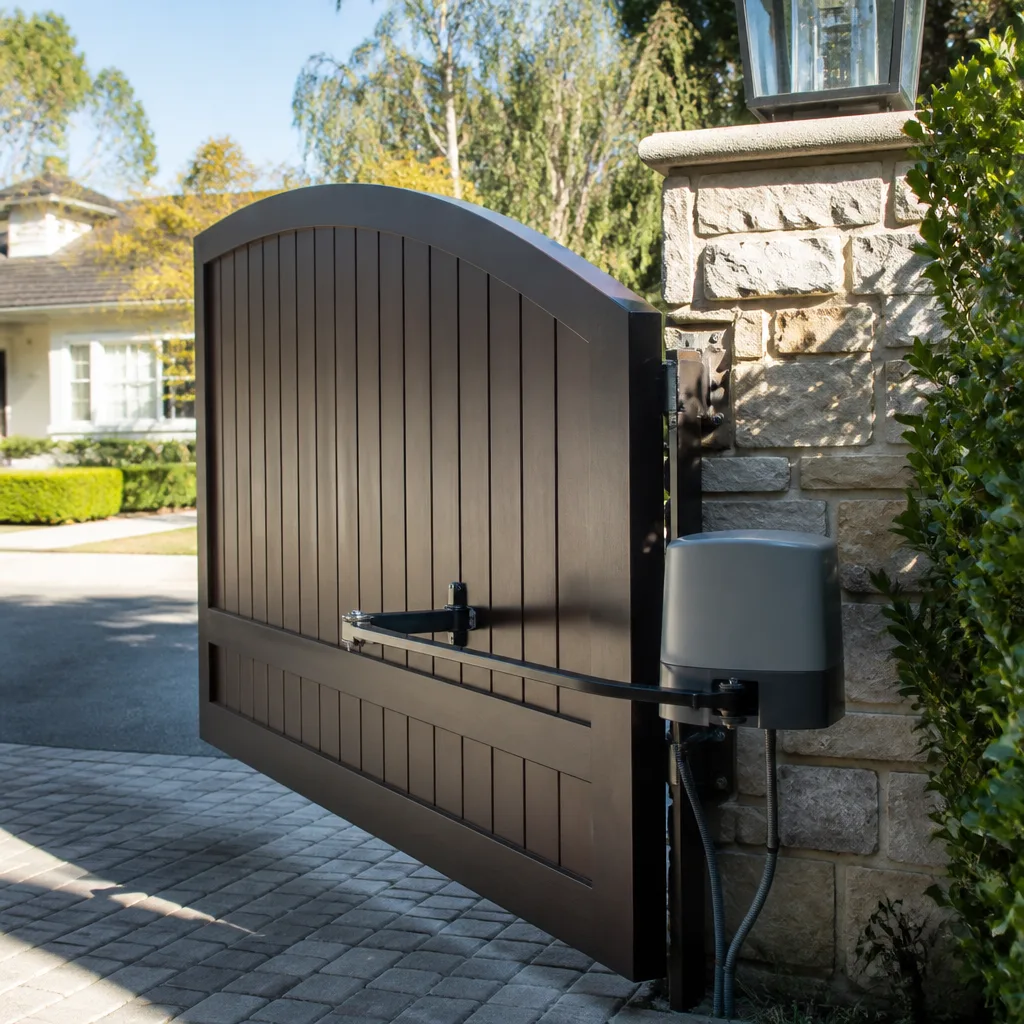
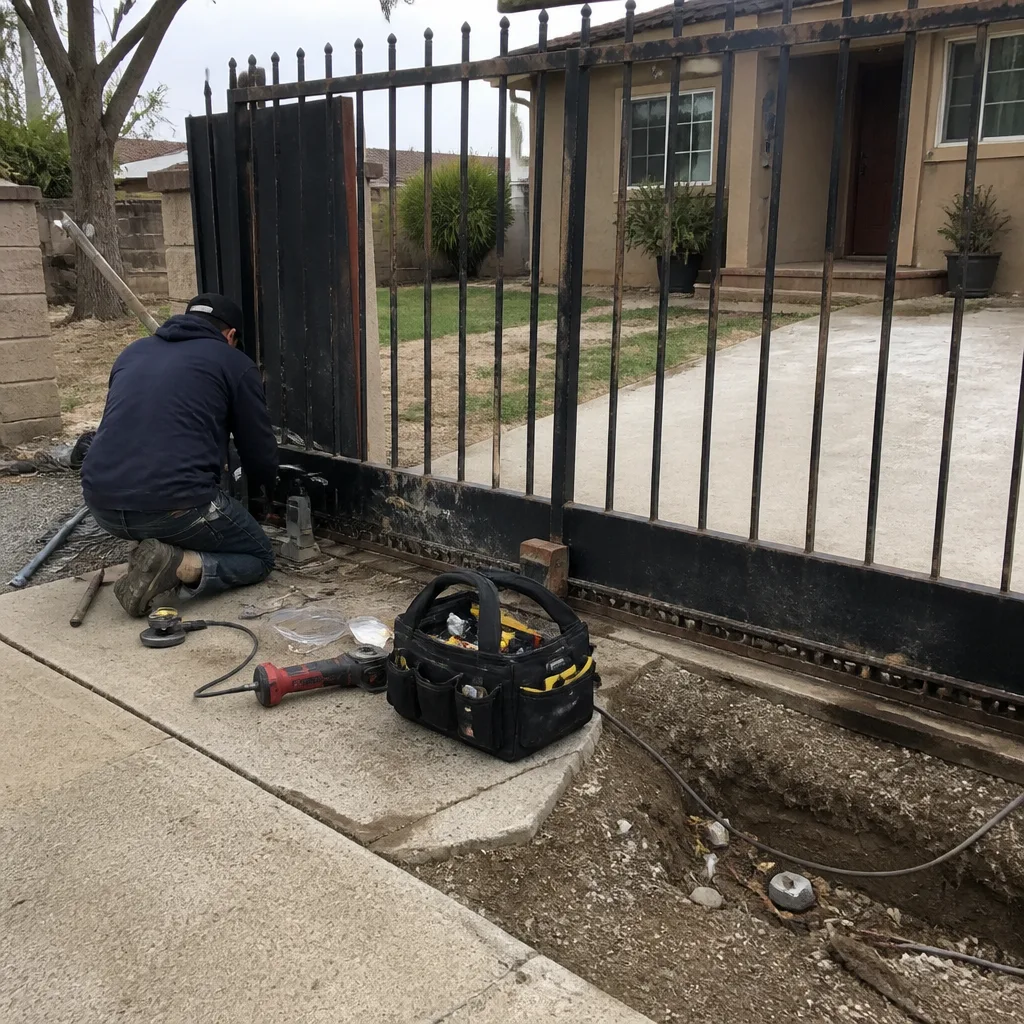 Before
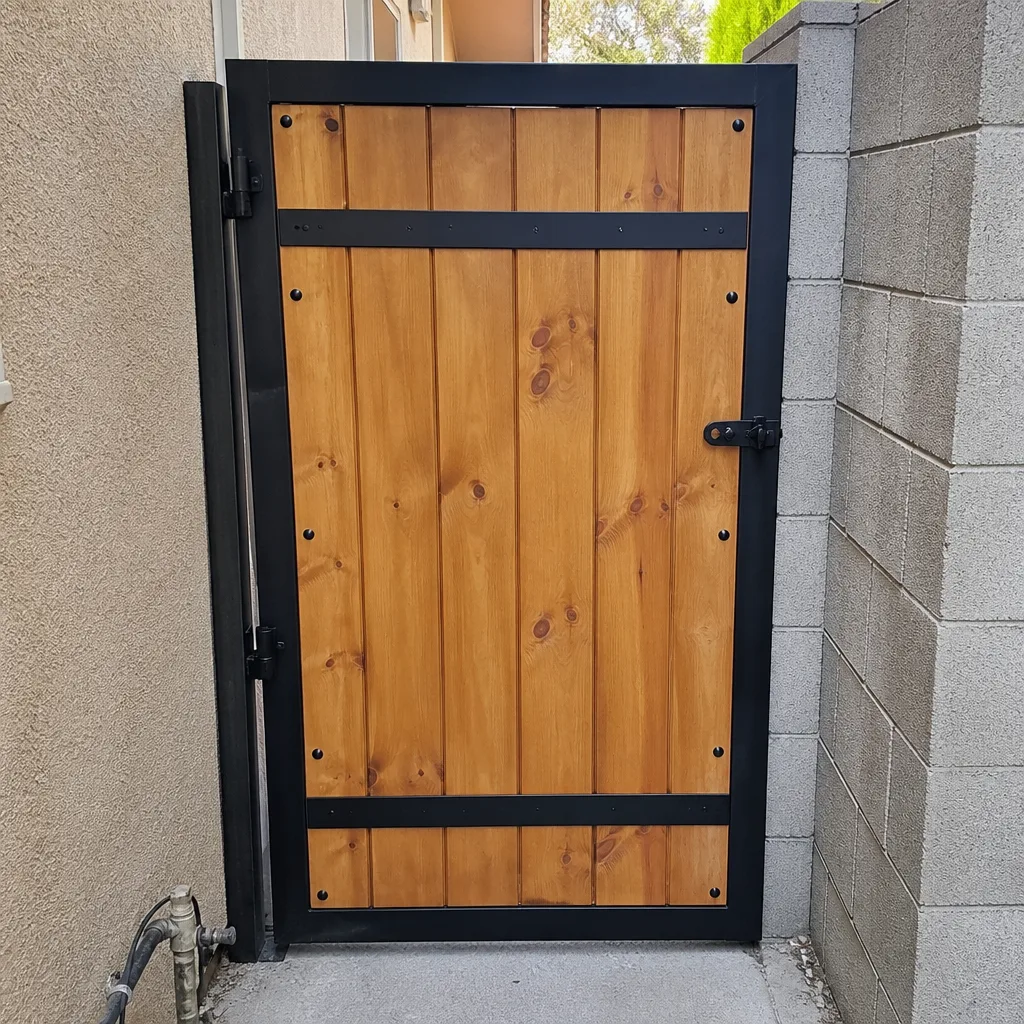 After
After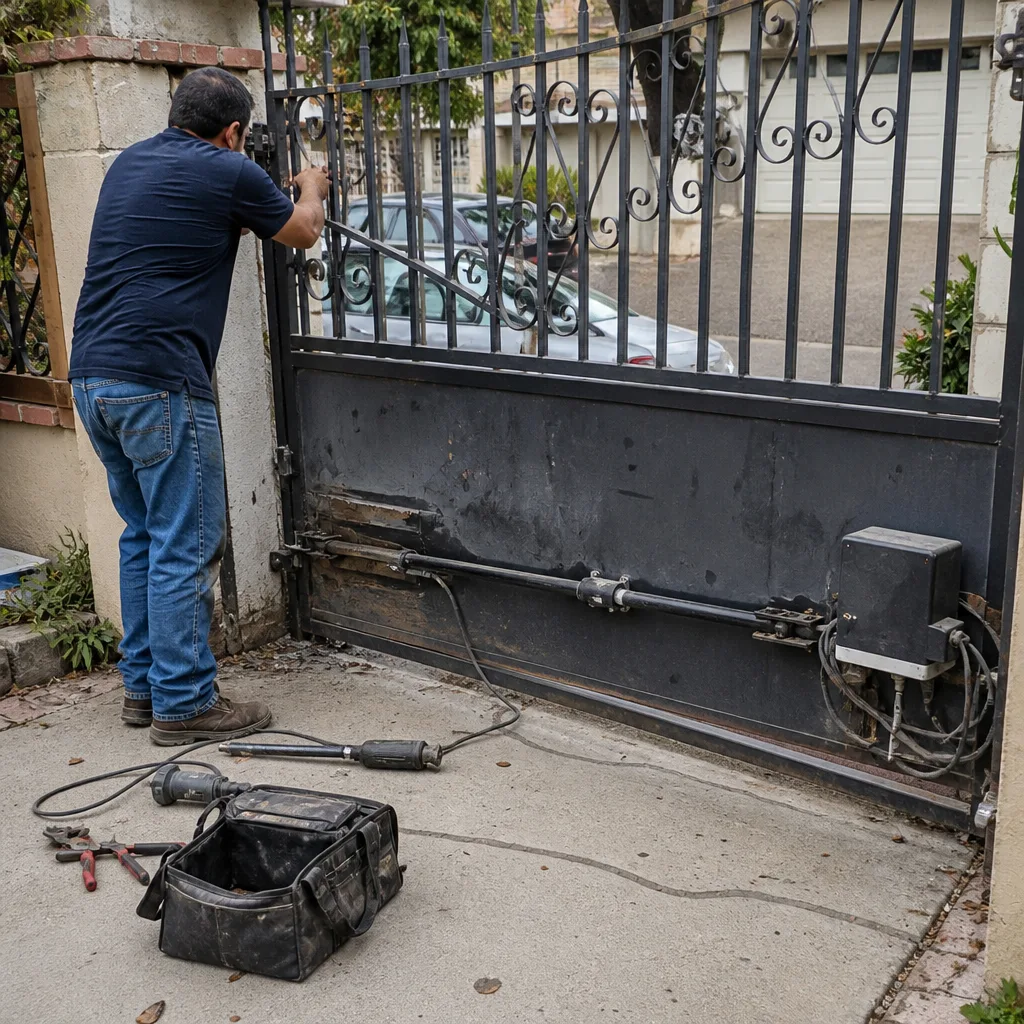 Before
 After
After Before
 After
AfterGate Repair Warning Signs Every Homeowner Should Know
A gate that hesitates for two seconds before moving isn’t “a little slow” – it’s a motor working harder than it should, usually because of a mechanical friction problem that costs $150 to fix now and $900 to fix after the motor burns out. In Los Angeles, where we service gates from the hillside homes of the Hollywood Hills to the zero-lot-line properties of Koreatown, we’ve seen this exact progression hundreds of times. Homeowners who learn to read the early signals save money, avoid lockouts, and schedule repairs on their own terms instead of making emergency calls at 11pm on a Sunday. This guide teaches you to recognize those signals before they become failures.
Quick Answer
Gate failures announce themselves through hesitation before movement, unusual sounds mapped to specific components, unexpected reversals, rust staining at load-bearing joints, and declining remote range. Catching these signs early typically means a $150 – $400 repair; ignoring them usually leads to motor replacement at $800 – $1,800 or a complete gate rebuild. In Los Angeles, salt air near the coast and thermal cycling inland accelerate every one of these failure modes.
Table of Contents
- The Hesitation Pattern: Your Gate’s First Cry for Help
- Why Your Gate Reverses for No Apparent Reason
- Sound Mapping: What Each Noise Means
- Reading Rust: Cosmetic Stain vs. Structural Failure
- Using Your Remote as a Diagnostic Tool
- Motor Warning Signs Specific to Los Angeles Climate
- Safety System Failures You Can’t Ignore
- Common Mistakes to Avoid
- When to Call a Professional
- Frequently Asked Questions
- The Bottom Line
The Hesitation Pattern: Your Gate’s First Cry for Help
The most commonly missed warning sign is also the earliest: a gate that pauses before it moves. Homeowners describe it as “thinking about it” or “taking a breath.” What they’re actually hearing is the motor’s start capacitor delivering its surge, the drive mechanism straining against friction load that exceeds normal torque threshold, and the system finally breaking inertia through sheer current draw.
This hesitation pattern has three distinct causes, and distinguishing between them matters for both cost and urgency.
Cause 1: Lubrication Breakdown
Gate hinges and rollers in Los Angeles dry out faster than most homeowners expect. The combination of low humidity, high UV exposure, and occasional Santa Ana wind events strips grease from pivot points. When we service properties in Pasadena or the San Fernando Valley, we regularly find hinges that haven’t seen lubricant in three years. The metal-on-metal friction increases gradually. The motor compensates by drawing more amperage. The hesitation lengthens from half a second to two seconds to five seconds. Eventually the thermal overload trips, or the motor burns out entirely.
The diagnostic check: Open the gate manually (disengage the motor first, per your manufacturer’s procedure). If it moves with obvious resistance or grinding, lubrication is the likely culprit. Use a lithium-based gate grease, not WD-40, which evaporates and attracts dust.
Cause 2: Hinge Misalignment or Sag
Gate posts settle. Hinge pins wear oval. In hillside Los Angeles neighborhoods like Mount Washington or Laurel Canyon, soil movement is constant, and gates bear uneven loads that they weren’t designed for. A gate that sags even 3/8 of an inch changes its travel geometry. The motor must lift as well as swing or slide. That vertical load component shows up as hesitation, especially at the start of the cycle.
We’ve measured gates in Los Feliz that drew 40% more amperage than specification because of hinge sag alone. The motor wasn’t failing. The mechanical system was forcing it to work outside its design envelope.
Cause 3: Early Motor Failure
If the gate moves freely by hand but hesitates under power, the motor itself is suspect. Start capacitors weaken over time. Winding insulation degrades. In Los Angeles, where many gate motors sit in direct sun on 100-degree days, thermal cycling accelerates this deterioration. A motor that hesitates and runs hot to the touch is approaching end of life.
The cost spread is stark. A lubrication service runs $150 – $250. Hinge realignment or replacement runs $200 – $450. Motor replacement on a standard residential swing gate runs $800 – $1,400, plus the underlying cause still needs fixing. Catching hesitation early is the difference between the first two numbers and the third.
Why Your Gate Reverses for No Apparent Reason
Homeowners call us saying their gate is “malfunctioning” because it reaches a certain point and reverses. The gate isn’t malfunctioning. The safety system is doing exactly what it was designed to do. The problem is that the obstruction it’s detecting isn’t visible to the homeowner.
Modern gate operators, whether it’s a LiftMaster, DoorKing, or Elite system, use multiple safety inputs: photocells, edge sensors, and current sensing in the motor itself. When any of these inputs suggests an obstruction, the operator reverses. Here are the hidden causes we find most often in Los Angeles.
Sagging Geometry Triggers Current Sensing
When a gate sags, its travel path changes. The motor draws more current to maintain speed. If that current crosses the operator’s safety threshold, the system assumes something is blocking the gate and reverses. The gate isn’t hitting anything. The geometry has shifted enough to make the motor work as if it were hitting something.
In older Los Angeles neighborhoods with original 1940s – 1960s walls and footings, we’ve seen this repeatedly. The gate frame is sound. The operator is sound. The post has settled 1/2 inch, and that’s enough to trigger reversal at the same point in every cycle.
Photocell Misalignment from Thermal Expansion
Photocell pairs send an invisible beam across the gate opening. If the beam breaks, the gate reverses. In Los Angeles, daily temperature swings of 30 – 40 degrees cause mounting brackets to expand and contract. A photocell aligned perfectly in March may be 1/4 inch out of alignment by August. The beam still works most of the time. But at certain temperatures, vibration from the gate movement is enough to break the connection momentarily.
The tell: Reversal happens intermittently, more often in the hottest part of the day, and the reversal point varies slightly.
Edge Sensor Water Intrusion
Los Angeles may be dry, but our winter storms are intense when they arrive. Edge sensors on sliding gates sit low to the ground. If the seal has degraded, water enters, creates phantom resistance readings, and triggers reversal. The sensor isn’t broken. It’s wet. Dry it, reseal it, and the problem disappears.
The key insight for homeowners: Reversal is information, not chaos. The gate is telling you which safety system is active and what kind of problem to look for. Document when it reverses, at what point in the travel, and under what conditions. That pattern is diagnostic gold.
Sound Mapping: What Each Noise Means
Gates are mechanical systems with moving parts, and moving parts announce their condition through sound. The mistake homeowners make is treating all unusual sounds as “squeaky” and spraying lubricant everywhere. Specific sounds map to specific components, and matching them correctly saves both money and unnecessary parts replacement.
| Sound | Component | Mechanism | Typical Repair Cost in Los Angeles |
|---|---|---|---|
| Grinding, metallic | Chain or rack drive | Wear elongation, missing rollers, dry sprockets | $180 – $350 |
| Rapid clicking | Control board relay | Relay cycling on overload, failing capacitor, or safety loop interruption | $200 – $450 |
| Squealing, sustained | Hinge or roller | Metal-on-metal without lubrication film | $150 – $250 |
| Low hum, no movement | Motor or capacitor | Capacitor failed to start phase; motor thermally locked | $250 – $450 (capacitor); $800 – $1,400 (motor) |
| Clunk at start/stop | Drive coupling or gearbox | Backlash from worn coupling, chipped gear tooth | $300 – $600 |
| Intermittent chirp | Limit switch | Switch bouncing at transition point, indicating wear or misalignment | $180 – $320 |
The grinding sound deserves special attention because it’s the most destructive if ignored. A chain or rack drive with worn components doesn’t just make noise. It introduces vibration that loosens mounting hardware, accelerates wear in the gearbox, and can eventually jump teeth and jam the gate mechanically. In Los Angeles, where many sliding gates run on galvanized steel rack with nylon rollers, the combination of dust and UV degradation turns rollers brittle in 3 – 5 years. They crack, the steel rack runs directly on the carrier, and the grinding begins.
The clicking sound confuses homeowners because it seems electrical. Often it is, but not in the way they think. A relay on the control board cycles rapidly when it detects a condition it can’t resolve: a safety input that’s borderline, a motor current that’s near threshold, or a limit switch that hasn’t registered properly. The relay isn’t the problem. It’s the symptom. Replacing the board without finding the underlying condition is a $400 mistake we see too often.
Reading Rust: Cosmetic Stain vs. Structural Failure
Los Angeles homeowners see rust and assume the worst, or they see rust and assume it’s nothing. Both assumptions cost money. The critical distinction is where the rust appears and what kind of staining it produces.
Surface Rust on Welds: Usually Cosmetic
Wrought iron and steel gates in Los Angeles develop surface oxidation, especially inland where the air is drier and dust settles on the metal. When that dust holds moisture against the surface, rust forms. On welds, this often looks like orange discoloration on the weld bead itself, without any flaking or section loss. The weld metal is exposed, uncoated, and slightly more active electrochemically than the base metal. It stains first.
This rust is cosmetic. Wire brush it, prime it, paint it, and monitor it. It doesn’t compromise the joint unless you let it progress for years without attention.
Rust Staining Below Hinges and Brackets: Structural Warning
When rust appears as streaking below a hinge, bracket, or connection point, the mechanism is different. Water is entering the joint, either through capillary action at a bolted connection or through a crack in the weld. The water carries dissolved iron away from the joint and deposits it as staining on the surface below. The metal you’re seeing stained isn’t the problem. The metal that dissolved to create that stain is.
In coastal Los Angeles neighborhoods like Venice, Pacific Palisades, and San Pedro, salt spray accelerates this dramatically. We’ve replaced hinge brackets in Marina del Rey that looked sound from the outside but had lost 40% of their cross-section to internal corrosion. The tell was rust staining that ran down the gate frame from behind the bracket, where no surface rust was visible without disassembly.
The inspection protocol: Look for staining that originates above and runs below. Tap the suspect area with a wrench. A dull thud instead of ring suggests section loss or delamination. If you find it, the joint needs opening, cleaning, and rewelding or replacement. Not next year. Before the next storm season.
Using Your Remote as a Diagnostic Tool
Most homeowners blame the remote when range decreases. They replace batteries, they buy new remotes, and when that doesn’t work, they assume the operator is failing. The actual cause is usually in the receiver, not the remote, and it points to a specific failure mode that gets worse with time.
- Establish baseline range. When the system is working normally, note how far away you can reliably trigger the gate. Do this in the same location, with the remote at the same height, to control for variables. Typical reliable range is 50 – 100 feet for residential systems.
- Monitor for gradual decline. Range that drops from 75 feet to 50 feet to 30 feet over months indicates receiver sensitivity degradation, not remote weakness. The receiver’s antenna or front-end circuitry is degrading, often from water intrusion or corrosion at the antenna connection.
- Test at multiple angles. If range is poor in one direction but normal in another, the antenna may be physically damaged or the receiver enclosure may be shielded by new construction, landscaping growth, or a metal fence addition.
- Check for intermittent operation. A remote that works only on the second or third press, or only when held at specific angles, suggests receiver desensitization plus possible multipath interference from reflective surfaces.
In Los Angeles, water intrusion in receiver enclosures is more common than homeowners expect. Our winter storms come fast and hard. Enclosures that were marginal in dry weather fail under sustained rain. The receiver doesn’t die immediately. Its sensitivity degrades as corrosion progresses on the circuit board. Range drops. Eventually it fails entirely, often during a storm when you need the gate to work.
The receiver antenna is a specific vulnerability. On many Mighty Mule and Ghost Controls systems, the antenna is a simple wire whip that exits through a grommet in the enclosure. The grommet hardens in UV, cracks, and allows water to track down the antenna wire directly onto the RF board. We’ve replaced dozens of these in Los Angeles, particularly in hillside installations where wind-driven rain hits the operator enclosure directly.
When range declines, Gate Repair should be scheduled before the receiver fails completely. A receiver replacement runs $200 – $400. An emergency call when you’re locked out because the receiver died during a storm costs more and fixes nothing faster.
Motor Warning Signs Specific to Los Angeles Climate
Los Angeles presents a specific set of thermal and environmental stresses on gate motors that don’t apply uniformly elsewhere. Understanding them helps homeowners interpret behavior that seems random.
Thermal cycling stress: Inland Los Angeles sees 40-degree daily temperature swings routine, 50-degree swings common. Motor enclosures expand and contract. Gasket seals fatigue. Condensation forms inside the enclosure when warm daytime air cools overnight. This condensation is distilled water, highly corrosive to electrical contacts because it lacks the ionic buffering of groundwater. We find green copper oxide on motor terminal blocks in Burbank and Glendale more often than in coastal zones where temperature swings are milder.
UV degradation of plastic components: Operator housings, control board enclosures, and wire insulation on systems installed before UV-stable formulations became standard are failing now in Los Angeles. A housing that looks intact may be structurally brittle. We’ve had technician call-backs where a housing that was sound at morning inspection cracked by afternoon when touched for adjustment. The plastic had reached its embrittlement threshold.
Dust and particulate loading: Los Angeles air carries more abrasive particulate than most homeowners realize, especially near construction, freeways, or the desert fringe. Sliding gate operators with exposed rack and pinion accumulate this dust in grease, forming a grinding paste. The symptom is gradual increase in motor current draw, showing up as slower operation or more frequent thermal trips.
Earthquake aftermath: After significant seismic events, gate posts shift, tracks twist, and operator mounting points stress. The Northridge earthquake damaged gates that continued operating for months before failing. After any notable shaking, inspect for new gaps at post bases, fresh cracks in masonry, or changed gate travel geometry. These are not cosmetic issues. They’re preconditions for motor overload.
Safety System Failures You Can’t Ignore
Gate safety systems are not convenience features. They’re legally required, liability-critical, and life-safety systems. When they fail, the gate becomes dangerous. The warning signs are specific and unmistakable once you know them.
- Photocell indicator behavior: Most photocell pairs have LED indicators showing alignment status. A steady green or red means aligned. Flashing means misaligned or obstructed. No light means no power or complete failure. Check these indicators monthly. A photocell that’s gone dark has failed, and the gate should not operate in automatic mode until it’s replaced.
- Edge sensor response test: With the gate moving, press the edge sensor manually. The gate must reverse immediately. If it stops but doesn’t reverse, or if it continues moving, the edge sensor circuit has failed. This is a hard stop condition. Disconnect automatic operation and call for service.
- Entrapment alarm: Modern operators sound an alarm if the safety system detects an entrapment event. If your operator alarms repeatedly without apparent cause, the current sensing threshold may be misadjusted, or the gate may have a mechanical obstruction that’s borderline. Either condition means the safety system is operating at its margin, which is where false negatives happen.
- Manual release function: Every operator has a manual release for power failure or emergency. Test it quarterly. If it binds, requires excessive force, or doesn’t fully disengage, the mechanism is corroded or damaged. In an emergency, this is how first responders or family members get past the gate. A failed manual release is a trapped-in or trapped-out hazard.
Los Angeles municipal code and California state law both reference UL 325 standards for gate operator safety. A gate with disabled or failed safety systems is not just dangerous. It’s not code-compliant, and liability for injury falls on the property owner. We document safety system condition on every service call and provide written notice if any component is non-functional.
Common Mistakes to Avoid
- Ignoring the two-second hesitation. That pause is measurable motor overload. The repair cost doubles roughly every six months of continued operation. In Los Angeles, where emergency calls carry premium rates, a Sunday night motor failure costs 3 – 4 times what scheduled maintenance would have.
- Lubricating with the wrong product. WD-40 is not gate lubricant. It’s a water displacer with light oil that evaporates in days. In Los Angeles dust, it creates an abrasive paste. Use lithium-based gate grease or silicone spray with Teflon for specific applications.
- Adjusting force settings to overcome mechanical problems. When a gate slows, some homeowners or handymen increase the operator’s force setting. This overrides the safety system margin, accelerates wear, and creates entrapment hazard. The correct response is fixing the mechanical problem, not defeating the safety system.
- Assuming coastal rust is worse than inland rust. Salt spray accelerates surface corrosion, but inland thermal cycling and condensation create hidden internal corrosion that’s more structurally dangerous. Inspect inland gates with equal or greater attention to staining patterns.
- Replacing the remote twice before checking the receiver. Remote batteries are cheap. Receiver degradation from water intrusion is common. Systematic diagnosis saves money and frustration.
- Waiting for complete failure to call. A gate that works intermittently is telling you exactly what’s wrong. That information is most valuable before the failure becomes total. Emergency service in Los Angeles carries scheduling premiums and often requires after-hours rates.
When to Call a Professional
Call when you observe any warning sign described in this guide, when safety system testing reveals any anomaly, or when your gate’s behavior changes in any way you can’t explain with confidence. The Garrison Standard we operate to at Carver Gate Repair means we diagnose before we quote, quote in writing before we work, and guarantee every repair for a full year.
Specific scenarios that warrant immediate professional attention: any safety system test failure, any reversal pattern you can’t correlate to a visible obstruction, any rust staining below structural joints, any motor that runs hot or smells of electrical overheating, and any gate that has changed its travel geometry after seismic activity. Carver Gate Repair offers free estimates in Los Angeles – call (469) 530-2485.
Frequently Asked Questions
Most residential gate repairs in Los Angeles range from $180 to $450 for mechanical issues like hinge realignment, lubrication service, or component replacement. Motor replacement runs $800 to $1,400 depending on brand and horsepower. Full gate installation starts around $2,500 for a standard single swing. We provide written pricing before any work begins, and estimates are free. Call (469) 530-2485 to schedule.
Lubrication and debris clearing are reasonable homeowner maintenance. Anything involving the operator’s force settings, electrical components, or high-tension spring systems on swing gates should be handled by a trained technician. Incorrect adjustment of safety systems creates liability exposure and entrapment hazard. Our technicians are background-checked and uniformed, and we carry the specific parts for LiftMaster, DoorKing, Elite, and other major brands.
Thermal expansion changes gate geometry through the day, and motor efficiency drops as enclosure temperature rises. In Los Angeles, this pattern is common in summer when afternoon temperatures exceed 90 degrees. If the change is gradual and reversible, it’s likely thermal. If it’s progressive day to day, mechanical wear is advancing. Either way, it’s worth diagnosing before it becomes a hard failure.
For residential gates in Los Angeles, annual professional service is the minimum. Gates in coastal zones or high-dust environments benefit from semi-annual service. Commercial gates with high cycle counts need quarterly maintenance. Our service includes full safety system testing, mechanical inspection, lubrication with appropriate products, and written documentation of gate condition. Visit our more guides & resources for additional maintenance information.
Every repair by Carver Gate Repair carries a written, full-year guarantee. If the same component or repair fails within 365 days of service, we return and fix it at no charge. No arguments, no pro-rating, no diagnostic fees. This applies to every repair we perform, not as an upsell but as standard practice. It’s been The Garrison Standard since 2008.
Permit requirements in Los Angeles vary by scope. Operator replacement on existing gates typically doesn’t require permitting. New gate installation, structural modifications, or changes to safety systems may trigger LADBS review. We advise on permit requirements during our free estimate and can coordinate permit submission when needed. Our written quotes specify whether permit costs are included.
The Bottom Line
Gate failures follow predictable progressions, and the signs are there for homeowners who know what to observe. Hesitation before movement, specific sounds mapped to components, reversal patterns that reveal hidden geometry changes, rust staining that distinguishes cosmetic from structural, and remote range decline that points to receiver degradation – these are the signals. Reading them accurately means scheduling repair on your terms, at standard rates, with full parts availability. Ignoring them means emergency calls, premium pricing, and often damage that cascades from one component to the next. In Los Angeles, where climate and geography add specific stress modes, attentive observation pays back multiply.
Written by Lonnie Burke, Owner at Carver Gate Repair, serving Los Angeles since 2008.