
Last updated October 10, 2026
Free on-site gate assessment - hinges, posts, and your LiftMaster or Nice gate operator checked before anything is quoted
The assessment is free and the quote is the invoice.
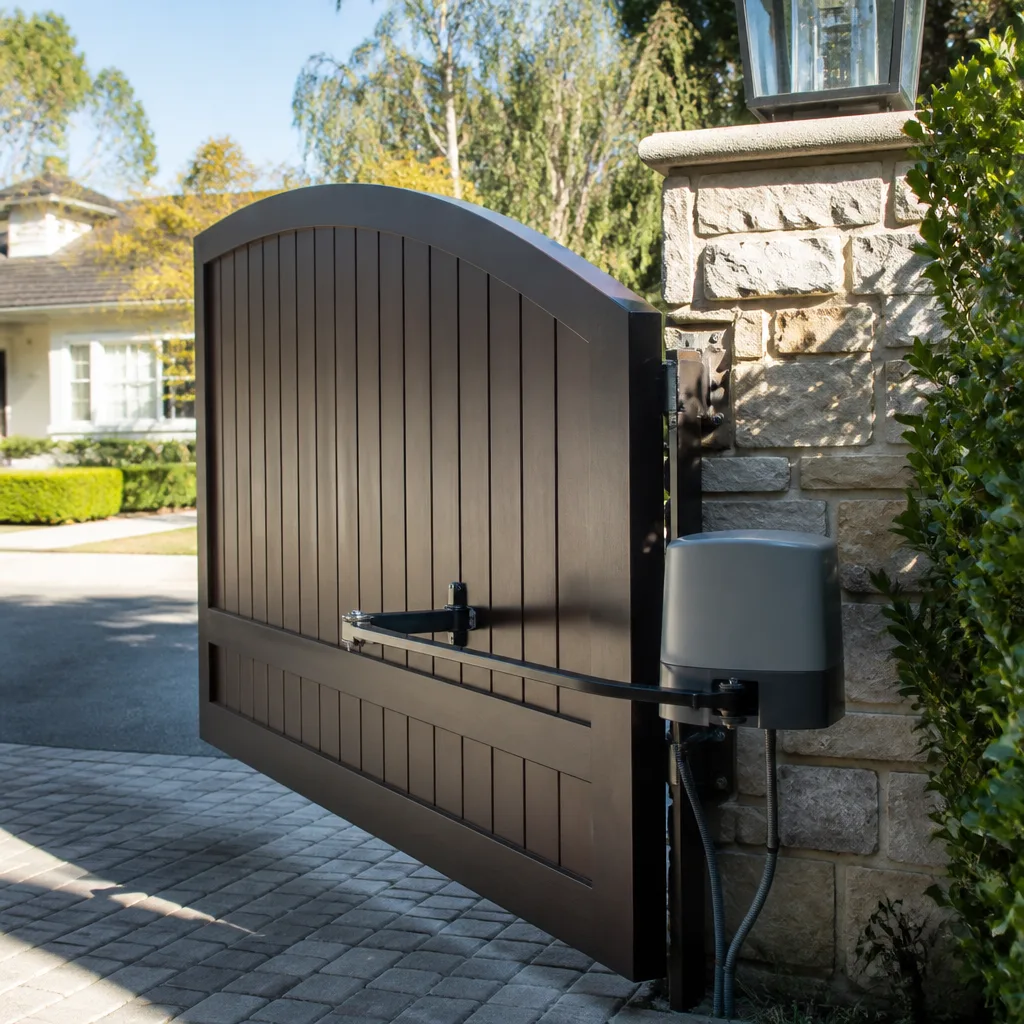
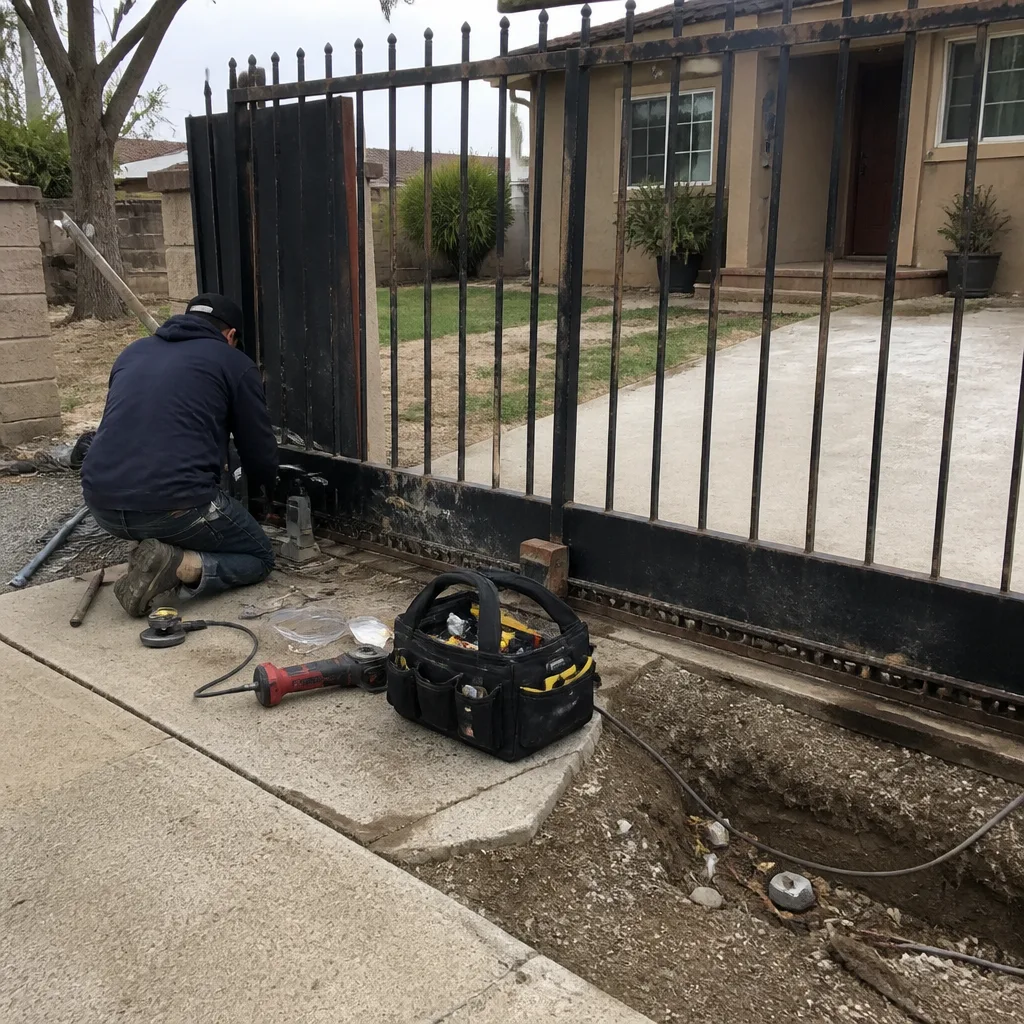 Before
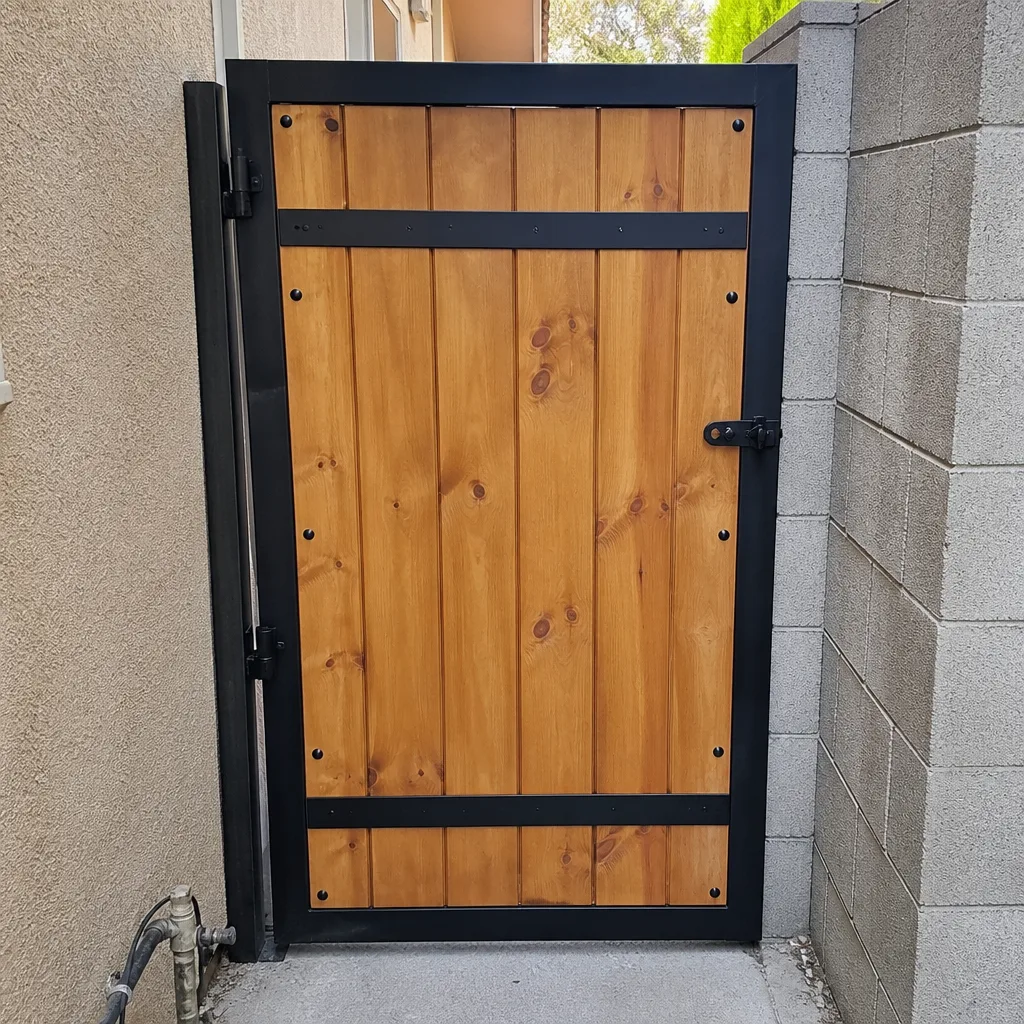 After
After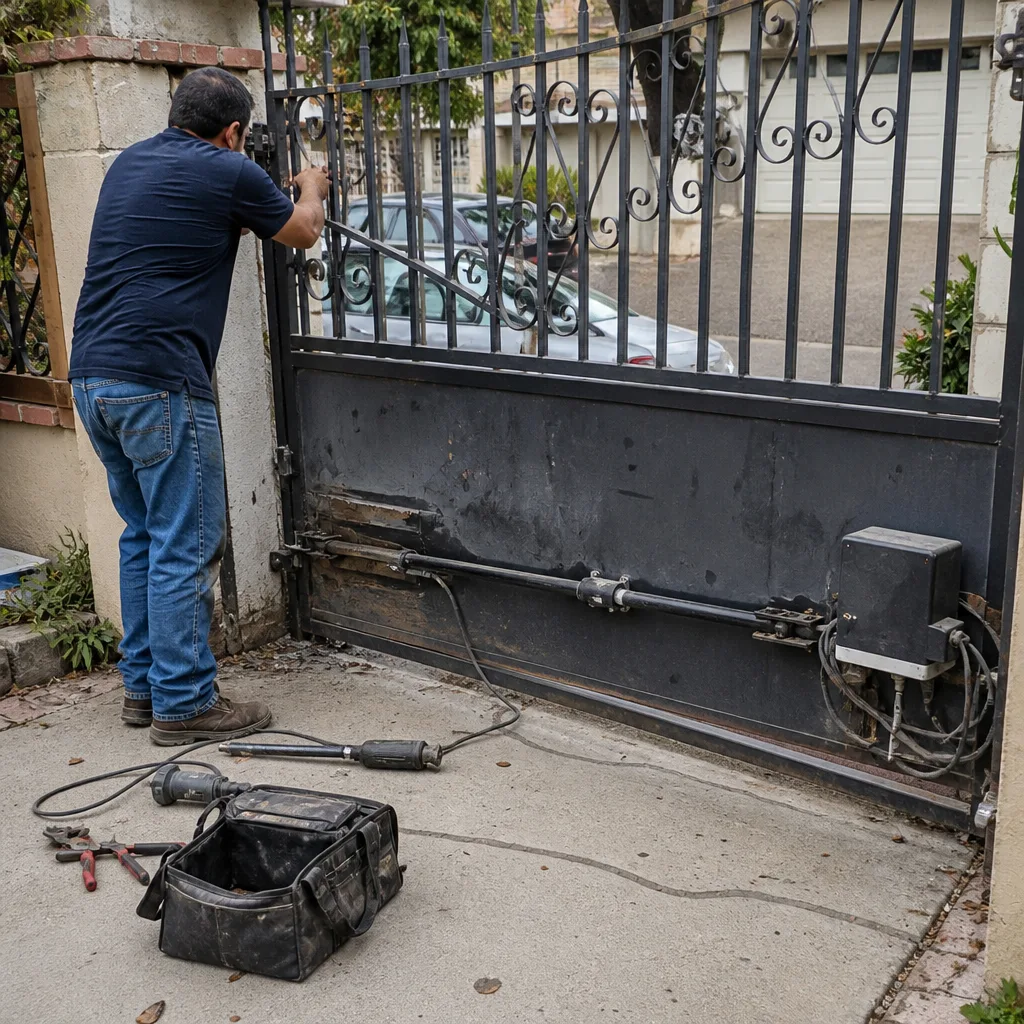 Before
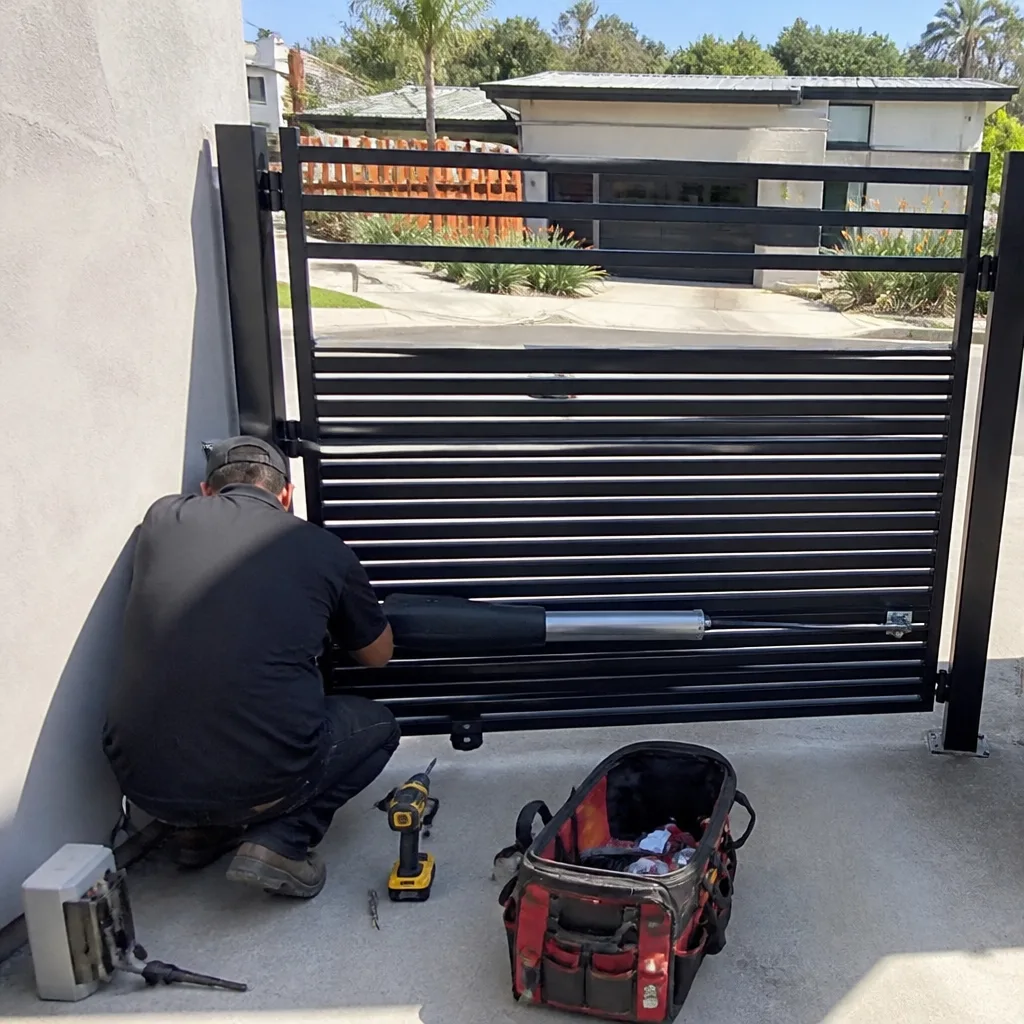 After
After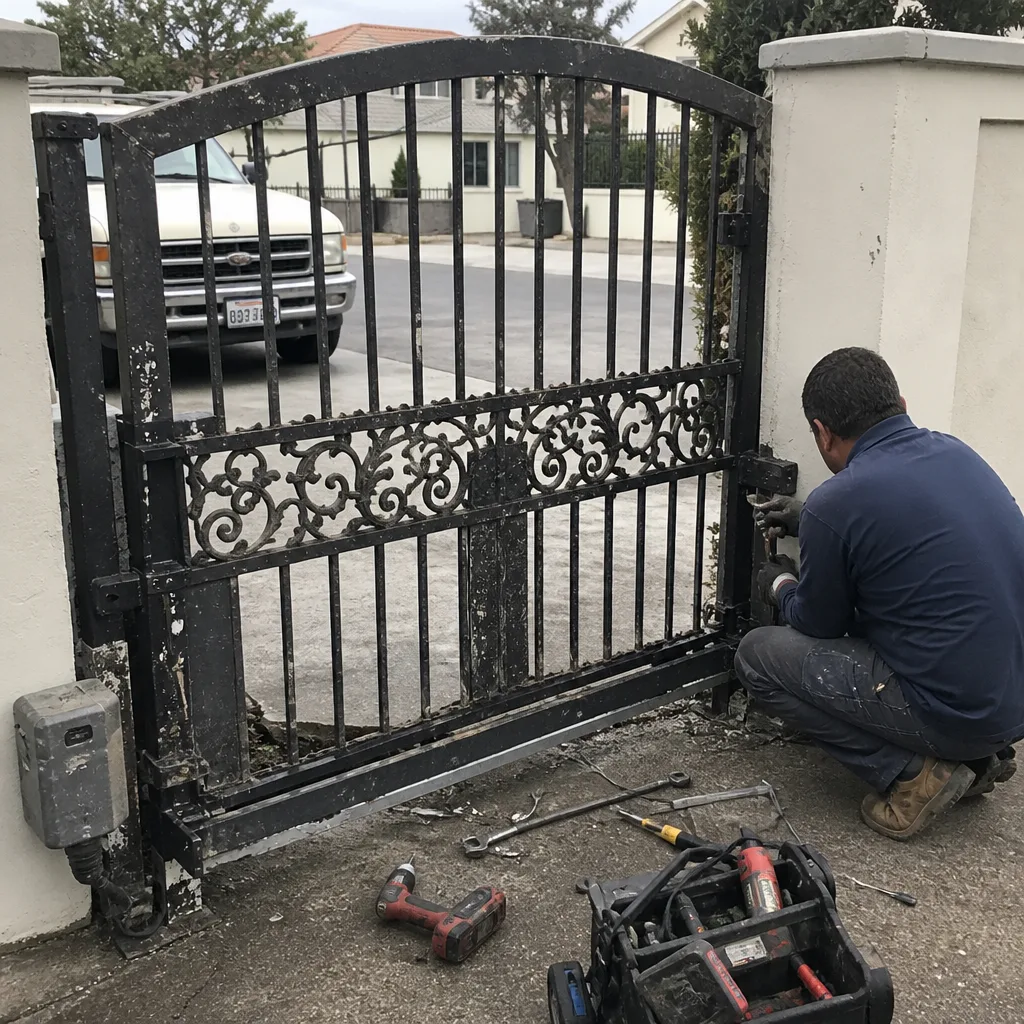 Before
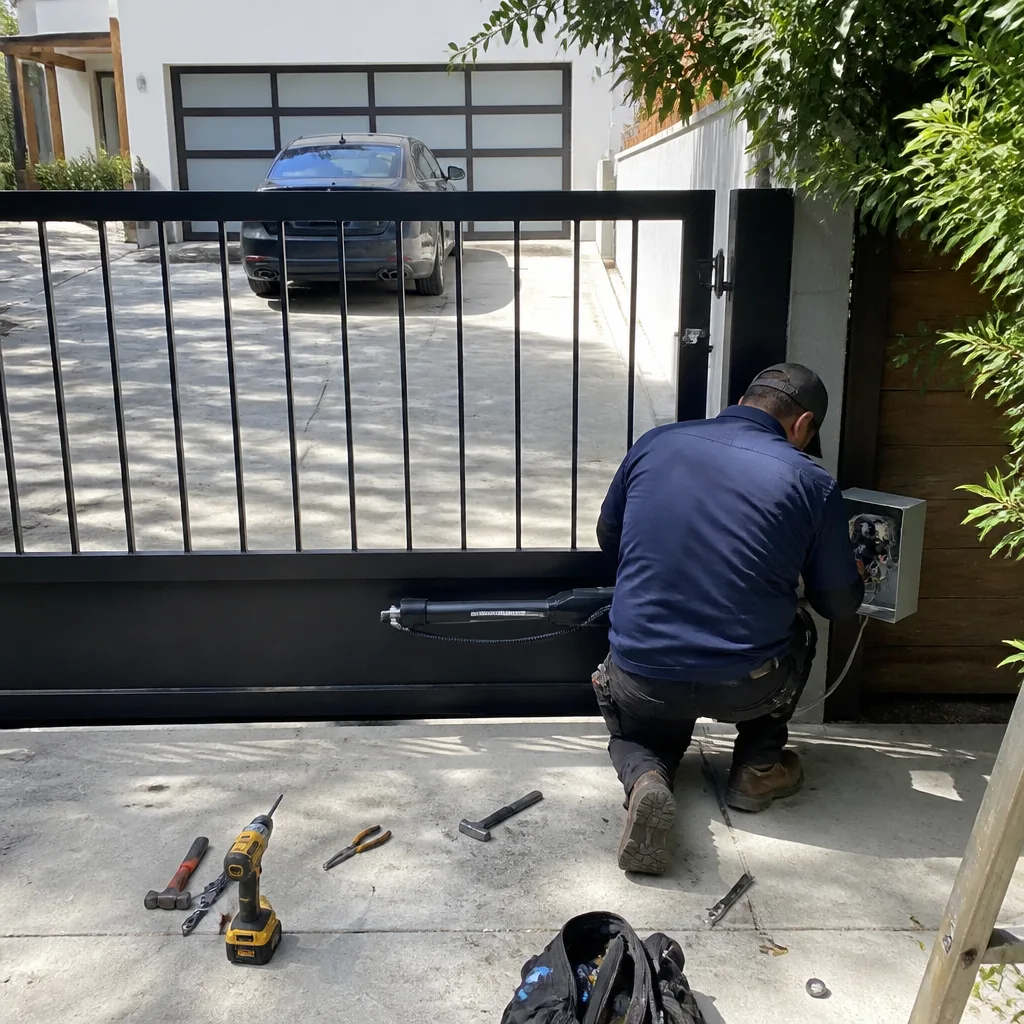 After
AfterGate Repair Troubleshooting: Common Problems and How to Fix Them
Most gate troubleshooting guides list symptoms without teaching homeowners how to distinguish a $40 sensor adjustment from a $900 motor replacement. That gap is exactly where dishonest contractors operate. In Los Angeles, where hillside gates in the Hollywood Hills and beach-adjacent installations in Venice face entirely different corrosion and foundation stress patterns, the same symptom can mean wildly different things. If a technician tells you your gate motor is “burned out” but can’t show you the specific fault code on the control board, you’re either dealing with someone who hasn’t actually diagnosed it, or someone who has and is hoping you won’t ask. This guide gives you the diagnostic vocabulary to understand what you’re being told and push back when something doesn’t add up.
Quick Answer
Most residential gate failures in Los Angeles fall into four categories: power supply issues (dead transformer or failed battery backup), obstruction in the travel path triggering safety sensors, misaligned or dirty photo eyes, and mechanical wear in hinges, rollers, or track. A five-minute physical inspection covering hinge play, track debris, sensor alignment, and battery backup voltage will identify the actual cause in roughly 60% of cases before you call anyone.
Table of Contents
- How to Read Fault Codes Before the Technician Arrives
- The Four-Point Homeowner Inspection That Rules Out Most Failures
- “Opens But Won’t Close” vs. “Closes But Won’t Open”
- Cracked Weld or Bent Hinge? Why the Distinction Matters
- What a Legitimate Repair Estimate Must Itemize
- Los Angeles Climate and Code Factors That Affect Gate Performance
- Common Mistakes to Avoid
- When to Call a Professional
- Frequently Asked Questions
How to Read Fault Codes Before the Technician Arrives
Modern gate operators from LiftMaster, Viking, and Linear display fault codes through LED patterns on the control board. These codes are not proprietary secrets. They’re printed on a label inside the operator housing or in the installation manual. A technician who claims your motor is “fried” but hasn’t checked the code is either incompetent or padding the bill.
Here’s what to look for on the most common brands we service in Los Angeles:
- LiftMaster LA500 / RSL12U series: A steady red LED with two flashes, pause, two flashes indicates a thermal overload. The motor isn’t burned out; it’s overheated from excessive cycling or blocked ventilation. Clear debris from the housing vents and test again in 15 minutes before authorizing any motor replacement.
- Viking G-5 / L-3 models: Three green flashes followed by a pause signals a limit switch fault. The motor runs fine; the board simply doesn’t know where the gate is in its travel. This is a $45 – $120 adjustment, not a motor swap.
- Linear Pro Access: Rapid amber flashing typically indicates a photocell obstruction or misalignment. Clean the lenses with a dry cloth and verify both units show solid LEDs.
Write down the pattern before you call. A legitimate technician will ask for it over the phone. If they don’t, that’s your first red flag. At Carver Gate Repair home, our dispatchers ask for fault codes on every gate motor repair call because it lets us bring the right parts and the right technician the first time.
One caveat: opening the operator housing exposes line voltage. Do not remove covers or touch terminals. Read the LED through any vent slots or translucent cover panels. If the housing must be opened to see the board, leave it to someone trained.
The Four-Point Homeowner Inspection That Rules Out Most Failures
Intermittent gate failures are the most expensive to diagnose because they’re intermittent. A gate that works at 10 a.m. and fails at 6 p.m. has frustrated more Los Angeles homeowners than we can count, especially in canyon neighborhoods like Laurel Canyon and Topanga where temperature swings between morning fog and afternoon sun are extreme. This inspection takes five minutes and eliminates the most common causes.
Point 1: Hinge Play
Grab the gate leaf near the hinge and push perpendicular to the opening direction. Any movement more than 1/8 inch indicates worn pin, elongated hole, or loose bolt. A gate with hinge play drifts in its track, binding the operator and causing overload faults. In coastal Los Angeles neighborhoods like Pacific Palisades and Playa del Rey, salt corrosion accelerates hinge wear. The fix is hinge replacement or re-bushing, not motor replacement.
Point 2: Track and Roll Debris
Slide gate tracks collect gravel, leaves, and in fire-prone areas like the Santa Monica Mountains, eucalyptus bark. Even a small obstruction can trigger the operator’s obstruction sensitivity, especially on newer operators with force-limiting requirements. Run a broom or compressed air along the full track length. Check that rollers spin freely and aren’t flat-spotted from running on debris.
Point 3: Photo Eye Alignment and Cleanliness
Photo eyes (photocells) are the most common cause of “gate won’t close” calls. Both transmitter and receiver must have clear line of sight, clean lenses, and solid indicator LEDs. In Los Angeles, marine layer condensation fogs lenses in early morning; afternoon dust from Santa Ana winds coats them. Wipe with a dry microfiber cloth. If either LED flickers, the bracket has shifted. Loosen the mounting bolt, align until both LEDs are steady, and retighten.
Point 4: Battery Backup Voltage
Operators with battery backup sound a warning tone when voltage drops. But many homeowners don’t know the tone means battery, not motor. Check the operator display or press the test button. A 12V battery reading below 10.5V under load needs replacement. This is a $60 – $90 part, not a service call. In Los Angeles, where PSPS outages and grid stress are increasingly common, battery backup isn’t optional for many homeowners.
If all four points check out and the gate still malfunctions, you’ve ruled out the cheap fixes. Now the technician’s diagnosis carries weight.
“Opens But Won’t Close” vs. “Closes But Won’t Open”
These two symptoms point to entirely different subsystems. A technician who quotes the same repair for both hasn’t isolated the fault.
Opens but won’t close implicates the closing safety circuit. This includes photo eyes, edge sensors, loop detectors, and the close command path. The motor and drive system are proven good because the gate opened. In our experience across Los Angeles, from Pasadena craftsman homes with original iron gates to new construction in Playa Vista, 70% of “won’t close” calls are photo eye issues. Another 15% are loop detector failures on automatic vehicle detection systems. The remaining split between edge sensor damage and control board relay faults.
Closes but won’t open implicates the opening circuit, the motor’s forward direction, or mechanical binding that the operator’s greater closing force overcomes but opening force cannot. This is where mechanical inspection matters. A gate that closes under gravity assist and operator power but stalls opening against gravity and friction has a real mechanical problem. We’ve seen this in hillside Los Angeles installations where foundation settling has racked the gate frame, creating binding that worsens over months.
The diagnostic test: disconnect the operator arm and move the gate manually through full travel. If it moves freely in both directions, the problem is electrical. If it binds in one direction, it’s mechanical. Any technician who skips this test is guessing.
For Gate Motor Repair in Los Angeles, brand-specific knowledge matters here. LiftMaster and Linear operators handle overload detection differently; a technician trained on both knows which fault patterns indicate real motor stress versus control board misinterpretation.
Cracked Weld or Bent Hinge? Why the Distinction Matters
A gate that sags, drags, or makes popping sounds during operation has structural damage. But the type of damage determines whether you need our Gate Repair services or a metal fabricator, and the cost difference is substantial.
Cracked welds appear as hairline fractures at joint intersections, often where vertical pickets meet horizontal rails or where hinge plates attach to the frame. They’re common in Los Angeles on wrought iron gates installed before 1990, when welding standards were less consistent and thermal cycling from sun exposure stresses older joints. A cracked weld requires grinding, re-fit, and re-weld by someone with structural welding capability. Most gate repair technicians, including our crews, can handle this in the field for standard residential gates. For ornamental work or historic properties in neighborhoods like Hancock Park or West Adams, we may coordinate with a certified welder to preserve architectural review compliance.
Bent hinges show as visible deformation in the hinge barrel or leaf, or as a gate that sits out of plumb when closed but straight when open. Hinge bending usually results from impact, vehicle contact, or foundation movement loading the gate unevenly. A bent hinge must be replaced; straightening work-hardens the steel and guarantees future failure. The critical question is whether the hinge bent because it was underspecified for the gate weight, or because of an isolated impact. If underspecified, replacing with the same size hinge repeats the failure. A proper technician weighs the gate and specifies hinge capacity with margin.
Here’s the practical test: close the gate and measure the gap between gate and latch post at top and bottom. If the gap tapers (wider at top or bottom), the hinge geometry has changed. If the gap is parallel but the gate rattles, the hinge pin is worn. If the gate frame itself is twisted, you may have both problems.
At Gate Repair in Los Angeles, we carry hinge inventory sized for gates from 200 to 2,000 pounds because guessing on a hillside estate gate in Bel Air or a security installation in Downtown Los Angeles isn’t acceptable.
What a Legitimate Repair Estimate Must Itemize
The most common complaint we hear from Los Angeles homeowners who’ve had bad experiences is that the final invoice bore no resemblance to the phone quote. The Garrison Standard exists specifically because this practice is endemic in gate repair. Here’s what any legitimate estimate must break out:
- Diagnostic fee: The charge to determine what’s wrong. This should be stated separately from labor, and many companies including ours apply it toward the repair if you proceed.
- Parts: Each component listed by name, quantity, and individual price. Not “motor assembly – $850” but “Linear HSLG-17-1HP operator, 1 each, $620; mounting bracket kit, 1 each, $85.”
- Labor: Hours or flat rate with the scope described. “Remove failed operator, install replacement, program limits and safety settings, test all functions.”
- Tax and permit fees: In Los Angeles, permit requirements vary by jurisdiction. Los Angeles City requires permits for new gate installations but not typically for like-for-like motor replacement; unincorporated County areas may differ. The estimate should note whether permits are included or homeowner-responsible.
A lump-sum quote with no breakdown is designed to obscure markup. We’ve seen $1,200 quotes for “gate motor replacement” where the actual motor was a $280 Mighty Mule unit from a big-box store and the remaining $920 was labor that took 90 minutes. The homeowner had no way to know.
Our written prices itemize everything before work starts. If we find additional damage during repair, we stop, explain, and get written authorization. The number never moves at the door. That’s The Garrison Standard, and it’s been non-negotiable since 2008.
Los Angeles Climate and Code Factors That Affect Gate Performance
Generic troubleshooting guides ignore geography. Los Angeles gate owners face specific conditions that accelerate certain failures and create others that don’t exist in milder climates.
Marine layer and salt air: Gates within two miles of the coast, from Malibu through Venice to San Pedro, corrode faster than inland equivalents. Stainless steel hardware is essential; zinc-plated fasteners fail in 3 – 5 years. We replace corroded hinge pins and latch bolts regularly in coastal neighborhoods, and we spec 316 stainless for new Gate Installation in Los Angeles near the beach.
Thermal cycling: The 40-degree temperature swing between a January morning in the 40s and an August afternoon over 100 stresses metal, welds, and electronic components. Control boards in direct sun without housing ventilation fail prematurely. We install shade covers or specify operators with extended temperature ranges for exposed locations.
Seismic movement: Los Angeles gate posts and foundations move. A gate that worked perfectly in March may bind in October after summer soil contraction and winter expansion. The fix is rarely the operator; it’s post adjustment or hinge realignment to accommodate foundation shift.
Fire code access requirements: Los Angeles City Fire Code requires that automatic gates have manual release accessible from both sides and that emergency responders can open them without specialized tools. A gate that “works fine” but lacks compliant release hardware is a code violation, not a functional gate. This matters for troubleshooting because some “failures” are actually safety systems working correctly.
Water and power infrastructure stress: Aging transformers in neighborhoods like Silver Lake and Echo Park deliver voltage at the low end of acceptable range. Operators at voltage minimums run hotter and fail faster. We check supply voltage on every service call; it’s part of The Garrison Code.
Common Mistakes to Avoid
- Ignoring the fault code and power-cycling repeatedly. Clearing a code by unplugging the operator masks the underlying fault. If the thermal overload code returns, there’s a reason. Repeated resets without diagnosis damage the motor.
- Adjusting force settings to overcome mechanical binding. The UL 325 force limitation exists to prevent entrapment injury. Turning up force to make a binding gate close is dangerous and exposes the homeowner to liability. Fix the binding.
- Using generic lubricants on gate components. WD-40 is not a gate lubricant; it’s a water displacer that attracts dust and forms grinding paste. Use lithium grease on hinges, silicone spray on rollers, and never lubricate track on slide gates where the operator’s friction drive depends on clean contact.
- Replacing the operator without checking the gate mechanics. A new motor on a binding gate fails in months. We’ve replaced operators installed by others where the real problem was a single seized roller that a $12 part would have fixed.
- Skipping battery maintenance in solar or backup systems. Los Angeles sunlight supports solar gate systems well, but the battery is the weak point. A solar panel with a dead battery produces no usable power. Test battery voltage seasonally.
- Accepting a verbal quote for work over $500. California law requires written contracts for home improvement work exceeding $500. More practically, a verbal quote has no standing when the invoice arrives. Demand written pricing.
When to Call a Professional
Call a technician when the four-point inspection reveals no obvious cause, when fault codes indicate board-level or motor faults, when structural damage is visible, or when the gate is part of a multi-family or commercial access control system where code compliance is legally required. High-tension spring-assisted gates and hydraulic operators present genuine safety hazards; the spring energy stored in a commercial swing gate can cause serious injury if released improperly.
Carver Gate Repair offers free estimates in Los Angeles. Our technicians are background-checked, uniformed, and trained on LiftMaster, FAAC, BFT, Linear, Viking, Ghost Controls, DoorKing, Elite, and Mighty Mule systems. Every repair carries our 365-Day Done Right Promise in writing, and if anything fails inside that window, we return free. Call (469) 530-2485 to schedule.
Frequently Asked Questions
Most residential gate repairs in Los Angeles range from $150 for sensor realignment or hinge adjustment to $850 – $1,400 for operator replacement, depending on brand and horsepower. Commercial systems and custom ironwork run higher. We provide written, itemized pricing before any work starts, and our diagnostic fee applies to the repair if you proceed. Call (469) 530-2485 for an exact quote on your system.
Homeowners can safely handle photo eye cleaning, track debris removal, and battery replacement on low-voltage systems. Do not attempt control board repair, spring or counterbalance work, hydraulic system service, or any repair requiring cover removal from line-voltage equipment. The stored energy in gate systems can cause serious injury. When in doubt, call a professional.
Temperature-related expansion and contraction is the most common cause in Los Angeles. Morning marine layer moisture affects photo eyes and electronics; afternoon heat expands metal and can bind a marginally aligned gate. Foundation movement from soil moisture changes and voltage drop under afternoon air conditioning load are also frequent culprits. Intermittent failures require systematic logging of conditions when failure occurs.
A quality residential operator in Los Angeles should last 10 – 15 years with proper maintenance. Coastal installations see shorter lifespans due to corrosion. Operators running near their weight capacity, cycling frequently, or operating in unshaded direct sun typically fail in 7 – 10 years. Regular hinge and track maintenance reduces motor strain and extends life.
Our technicians are trained and carry parts for LiftMaster, FAAC, BFT, Linear, Viking, Ghost Controls, DoorKing, Elite, and Mighty Mule operators. Brand-specific training matters because fault codes, limit procedures, and safety configurations vary significantly. We match the right technician to your system.
Every repair carries our 365-Day Done Right Promise in writing. If the same component or repair fails within one year of service, we return and make it right at no charge. No argument, no re-diagnostic fee. The guarantee is not an upsell; it’s standard on every job we perform.
The Bottom Line
Gate troubleshooting isn’t about becoming a technician. It’s about knowing enough to distinguish a legitimate diagnosis from a padded invoice. Read the fault codes. Do the four-point inspection. Understand that “opens but won’t close” and “closes but won’t open” are different problems. Demand itemized written pricing. In a Los Angeles market with thousands of gates and uneven contractor quality, these habits protect your time and your money. For Gate Repair Warning Signs Every Homeowner Should Know, read our guide. When the problem exceeds your inspection, call someone who’ll show you the code, explain the failure, and put the guarantee in writing before touching a tool.
Written by Lonnie Burke, Owner at Carver Gate Repair, serving Los Angeles since 2008.